
Non-FictionSelf-HelpRole Management
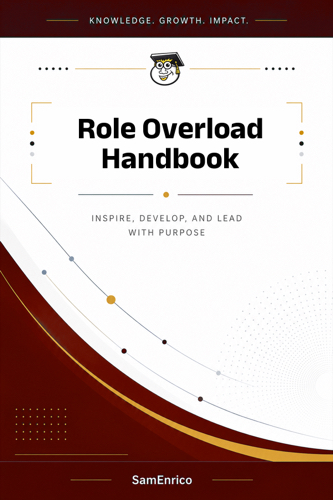
Role Overload Handbook eBook
Managing parent, spouse, child, and caregiver iden
Managing parent, spouse, child, and caregiver identities without collapse.
Formats
Free sample
Chapter 1: The Fractured Self--–- You wake up at 6:15 AM to the sound of a child crying. Before you can take three breaths, your brain has already cycled through four identities: the parent who must comfort, the spouse who should check if your partner is also awake, the professional who remembers the 8:30 AM deadline, and the adult child who hasn't called your mother in three days. By the time your feet hit the floor, you are not one person waking up. You are four people arguing about who gets to be you first.This is not burnout. Burnout is what happens when you do too much of one thing for too long.
It feels like depletion, cynicism, and the quiet certainty that none of your work matters. But what you are experiencing is different. You are not exhausted because you have been parenting too much, or working too much, or caregiving too much. You are exhausted because you are switching between these versions of yourself so rapidly that none of them feel real anymore. The person who leads a meeting at 10 AM, the person who cleans spilled cereal at 12:30 PM, the person who calls a doctor at 2 PM, and the person who tries to be present for your partner at 9 PM—they do not feel like the same human being.
They feel like strangers sharing a calendar.This book names that experience. It is called role overload, and it is the defining psychological crisis of the modern multitasking life. Unlike burnout, which has been studied for decades, role overload is still poorly understood. It is not about the quantity of your tasks. It is about the fragmentation of your identity.
You are not doing too much. You are being too many people, and the seams between them are tearing.The Paradox of Having It All Modern culture has sold you a beautiful lie. The lie is that holding multiple meaningful roles—parent, partner, professional, caregiver, friend, sibling—is the pinnacle of success. Magazines feature profiles of women and men who "do it all" with what appears to be serene competence. Social media feeds show perfectly staged moments of work triumphs followed immediately by family bliss.
The underlying message is clear: a full life is a multi-role life, and if you are struggling, you are simply not managing your time well enough.But here is the paradox that no magazine cover admits: the very richness of your role portfolio is what threatens to destroy your sense of self. Each role demands not just time but a distinct identity. The version of you who advocates fiercely for a patient parent cannot simply slide into the version of you who is playful with a toddler. The version of you who is decisive and authoritative at work cannot instantly become the version of you who is vulnerable and receptive with a partner. These are not costumes you can change in a dressing room.
They are different selves, with different values, different emotional registers, and different physical postures.When you are forced to switch between them too quickly—without transition, without breath, without ritual—something strange happens. Your brain begins to experience these selves as separate. Not metaphorically separate. Neurologically separate. The pathways that activate for "professional you" are not the same as those for "parent you," and when you jam them together in rapid succession, your brain stops integrating them into a single narrative.
You begin to feel like a committee, not a person.This is the Fractured Self. It is the core experience of role overload, and it is the central problem this book exists to solve.What Role Overload Actually Is Before we go any further, we need precise language. The term "overload" is used loosely in self-help literature, often as a synonym for busyness or stress. That sloppiness has allowed role overload to remain invisible. Let us be precise.Burnout is a state of emotional, physical, and mental exhaustion caused by prolonged exposure to demanding work conditions.
The key features are exhaustion, cynicism (detachment from the job), and reduced professional efficacy. Burnout is about one role—typically work—and it feels like running out of fuel.Stress is a physiological and psychological response to perceived threats or demands. Stress can be acute (before a presentation) or chronic (living with financial insecurity). Stress is about pressure. It feels like being squeezed.Role overload is neither of these.
Role overload is the experience of having multiple, identity-defining roles whose demands and self-concepts are incompatible with one another, such that the rapid switching between them produces a fragmentation of the self. The key features are:Identity switching fatigue – You are tired not from doing things but from becoming different people.Context collapse – You cannot keep roles separate; work follows you home, caregiving interrupts your partnership, and every role bleeds into every other.The feeling of fraudulence – Each version of you feels like a performance, because none of them feel like the "real" you anymore.Emotional hangover – After switching from one role to another, you carry the emotional residue of the first role into the second, creating a constant low-grade dissonance.Unlike burnout, which can often be solved by reducing hours or changing jobs, role overload requires a different intervention. You cannot solve a problem of identity fragmentation with a time management app. You cannot calendar your way out of feeling like four different people. You need to address the fragmentation itself.The Two Cultural Traps That Make Everything Worse Role overload does not happen in a vacuum.
You live inside cultural stories about what it means to be a good parent, a successful professional, a devoted partner, and a loyal adult child. Two of those cultural stories are particularly dangerous. They are so common, so embedded in everyday language, that you probably do not even notice them. But they are the water you are swimming in, and they are making the fragmentation worse.Trap One: Workism Workism is the belief that work is not just a job but an identity—the primary source of meaning, community, and self-worth. In a workist framework, your career is not what you do; it is who you are.
This sounds harmless, even aspirational. But workism has a dark side. When work becomes your central identity, every other role becomes an interruption. Parenting is something you do after work. Caregiving is a disruption to your real work.
Your partner exists in the margins of your calendar.Workism produces a specific kind of role overload: the sense that your non-work roles are illegitimate competitors for your attention. You feel guilty when you leave the office early for a school event, not because you are failing at parenting but because you have internalized the belief that work is your true self. The parent role feels like a costume. The caregiver role feels like a distraction. And because you cannot abandon these other roles entirely, you end up half-committing to all of them—including work, which now feels polluted by guilt.Trap Two: Enmeshment Enmeshment is the opposite problem.
It occurs when family expectations consume your autonomy so completely that you have no separate self to bring to work, friendships, or partnership.…
This is the end of the free sample. Get the eBook to keep going. Buy now
About this book
Details
- Author
- Donnell Lavelle
- Publisher
- SamEnrico
- Language
- English
- Genre
- Non-Fiction, Self-Help, Role Management
- Released
- 2026-06-07
- Pages (approx.)
- 143
- Available as
- eBook, Audiobook

Read better in the ZLOADR app
Your eBooks on your phone or tablet. Sign in with your SamEnrico account and start reading.
More by Donnell Lavelle
 The Breath Counting App SupplementDonnell Lavelle$11.99
 Loneliness And Forgiveness GuideDonnell Lavelle$11.99
 Uterine Fibroid Period GuideDonnell Lavelle$11.99
 YouTube Unboxing ConsumerismDonnell Lavelle$11.99
 The Last Reel: How a Forgotten Film Saved HollywoodDonnell Lavelle$11.99
 The Silk Road’s Hidden Seas: Soviet Geologists and the Lost Lakes of Central AsiaDonnell Lavelle$11.99
 Understanding Dysostosis PeripheralDonnell Lavelle$17.99
 Court OfficerDonnell Lavelle$11.99
 Stock Photo Quality ControlDonnell Lavelle$12.99
 Fundraising with Co FounderDonnell Lavelle$12.99
 How to Start a Parchment and Imitation Parchment Paper Business (Beginners Guide)Donnell Lavelle$11.99
You may also like
 Hong Kong Handover 1997Dunn Johnnie$11.99
 Zumba For Postnatal Recovery CourseNeal Christian$11.99
 Zumba for BeginnersLadner Nikia$11.99
 YouTube Comment Mining GuideHumes Pandora$12.99
 Worry Box MeditationCarlin Rudy$11.99
 Workplace Stress MeditationNguyen Lynn$11.99
 Workplace Stress and Sleep RepairHawley Ivory$11.99
 Workplace Perfectionism CureDelaney Jeffry$11.99
 Workplace Injustice Anger GuideWallen Isabelle$11.99
 Work Addiction and Burnout LinkGreenwood Ester$11.99
 Women in Yoga and WellnessBeattie Galina$11.99
 Women in Stand Up ComedyChun Evangeline$11.99