
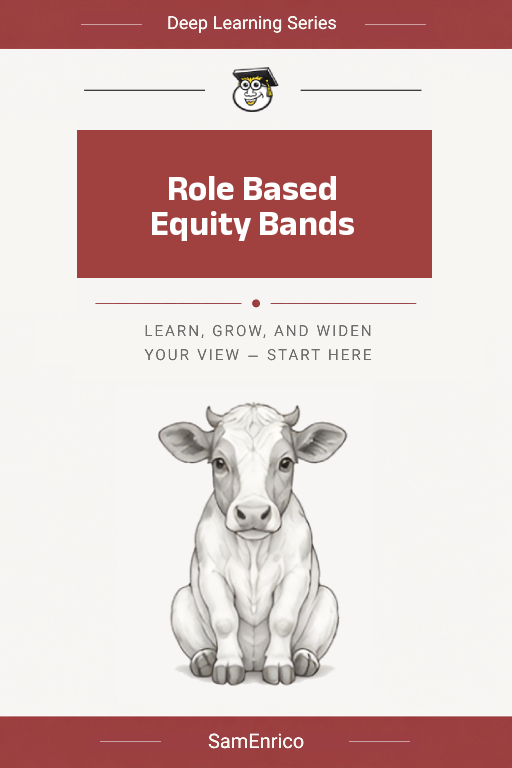
Non-FictionStartup GuideRole BandsEquity Ranges
Role Based Equity Bands eBook
Use 30-40 percent for CEO, 20-30 percent for CTO,
by Earle Tora
Use 30-40 percent for CEO, 20-30 percent for CTO, 10-20 percent for others.
Formats
Free sample
Chapter 1: The Suicide Pact--–- The first time I saw a startup die because of a 50/50 equity split, I was sitting in a cramped conference room in San Francisco, watching two former best friends refuse to look at each other. The CEO had stopped working six months ago—everyone knew it, no one said it—but the CTO couldn't fire him without losing half the company. So instead, the CTO stopped working too. The product rotted. The investors pulled their term sheet.
And two weeks later, the company that had raised 4millionona4 million on a 4millionona20 million valuation filed for dissolution. The lawyers got paid. The employees got nothing. And the two founders? They haven't spoken since.The saddest part?
They thought they were being fair.They had read the startup blogs. They had watched the Y Combinator videos. They had heard the mantra repeated so often it became scripture: "Split equity evenly. It's not worth fighting over. You'll figure it out later." So they did.
Fifty percent each. Equal partners. Best friends forever.Eighteen months later, they had destroyed their company, their friendship, and their reputations. All because they believed that equal was fair.This book exists because that belief is wrong—and it's killing thousands of startups every year.The Myth of Equal Fairness Let me be direct: the most "fair" equity split—equal division among founders—is statistically one of the most dangerous. That statement sounds counterintuitive.
Of course equal is fair. That's what the word means. But fairness in equity allocation is not about equality of percentage; it's about proportionality of contribution, risk, and responsibility.I learned this lesson the hard way. Over the past decade, I've advised more than two hundred startups on their equity structures. I've seen the patterns.
The startups that survive and thrive almost never have equal splits. The ones that die in quiet, painful, preventable ways? They almost always do.The data backs this up. Noam Wasserman's decade-long Harvard Business School study of over ten thousand founders found that 50/50 splits correlate with a significantly higher failure rate than asymmetric splits like 60/40 or 70/30. The reason isn't mathematical—it's psychological.
Equal splits create three specific pathologies that destroy companies from the inside.The Three Pathologies of Equal Splits Pathology One: Deadlock Imagine two founders. They disagree on whether to accept a 30millionacquisitionoffer.Onewantstotakeit.Theotherwantstobuilda30 million acquisition offer. One wants to take it. The other wants to build a 30millionacquisitionoffer.Onewantstotakeit.Theotherwantstobuilda100 million company. Neither has more than 50 percent voting power.
What happens?In theory, they negotiate. In practice, they fight. And while they fight, the acquisition offer expires. The employees sense the tension and start leaving. The investors lose confidence.
The board steps in and forces a decision that makes both founders unhappy. The company survives, but the trust is gone. I've seen this exact scenario play out more than a dozen times. Every single time, the company eventually fails or sells for pennies on the dollar.Deadlock doesn't require malice. It requires only two people who genuinely believe they are right and cannot force a decision.
In a 50/50 split, every major decision becomes a potential veto. Hiring a CEO. Pivoting the product. Raising another round. Accepting an acquisition.
Firing a cofounder who has stopped contributing. All of these become minefields.Pathology Two: The Free Rider Problem The second pathology is more insidious because it starts with good intentions. Two founders agree to split equity equally. They both plan to work full-time. They both plan to contribute equally.
But then life happens.One founder gets sick. Or has a family emergency. Or simply loses motivation. Their contribution drops from fifty hours a week to ten. The other founder picks up the slack—working eighty hours, losing sleep, sacrificing relationships.
But the equity remains equal.Resentment builds. The working founder starts noticing every hour the other founder isn't there. Every late arrival. Every early departure. Every email that goes unanswered.
The non-working founder, meanwhile, feels entitled to their half because it was "agreed upon." Neither is wrong, technically. But the relationship is poisoned.The free rider problem isn't about laziness—it's about the gap between expectation and reality. And that gap almost always appears when you least expect it. I've seen it happen after a founder has a baby, after a parent gets sick, after a mental health crisis, after a simple loss of passion. Life is unpredictable.
Your equity structure should account for that unpredictability.Pathology Three: The Founders' Dilemma The third pathology is the most painful because it emerges from success, not failure. Two founders split equity equally. They build a great product. They raise money from top-tier investors. They grow to fifty employees, then a hundred, then two hundred.
The company is worth $200 million.And then they realize: they hate each other.Not because anyone did anything wrong. But because the skills required to start a company are not the same as the skills required to scale one. The brilliant hacker who built the MVP might be a terrible VP of Engineering. The charismatic visionary who raised the seed round might be a disastrous CEO of a two-hundred-person company.In a healthy organization, one of them would step aside. They would hire a professional CEO or a seasoned CTO.
But in a 50/50 split, neither can fire the other. Neither can force the other to step down. So they stay, both miserable, both underperforming, both watching their company slowly decline because neither has the authority to fix it.This is the Founder's Dilemma, and it has no good solution once you're in it. The only solution is to never get into it in the first place.Static Equity vs. Dynamic Equity: The False Choice Before I introduce the solution that this book is built around, I need to explain why the existing solutions don't work.
Most founders are offered a false choice between two inadequate models: static equity and dynamic equity.Static Equity Static equity is what most founders use. You sit down at a cafe or a conference room, you negotiate percentages, you write them down, and you move on. The percentages never change, regardless of what happens afterward.The advantage of static equity is simplicity. Everyone knows what they own. Investors can model the cap table.
Lawyers can draft the documents. There's no ambiguity.The disadvantage is that static equity is static. It cannot adapt to changing contributions. It cannot account for the founder who works twice as hard as expected or the founder who works half as hard. It cannot resolve the free rider problem or the Founder's Dilemma.
Once the percentages are set, they are set forever—even if the reality of the relationship has completely changed.Most founders choose static equity because they don't know there's an alternative. Or because they assume that fairness at the beginning will ensure fairness at the end. That assumption is wrong. Fairness at the beginning guarantees nothing except the percentages you started with.Dynamic Equity Dynamic equity, popularized by Mike Moyer's book Slicing Pie, takes the opposite approach. Instead of fixing percentages at founding, dynamic equity adjusts continuously based on ongoing contributions.
Every hour worked, every dollar invested, every client brought in, every salary deferred—all of these are tracked and converted into…
This is the end of the free sample. Get the eBook to keep going. Buy now
About this book
Details
- Author
- Earle Tora
- Publisher
- SamEnrico
- Language
- English
- Genre
- Non-Fiction, Startup Guide, Role Bands, Equity Ranges
- Released
- 2026-05-30
- Pages (approx.)
- 144
- Available as
- eBook, Audiobook

Read better in the ZLOADR app
Your eBooks on your phone or tablet. Sign in with your SamEnrico account and start reading.
More by Earle Tora
 Tenzing Everest Interviews ArchiveEarle Tora$11.99
 The Workaholic's Mindfulness PracticeEarle Tora$11.99
 NVC For Negotiation GuideEarle Tora$11.99
 Cleopatra's Economic Policy WorkbookEarle Tora$11.99
 May TheresaEarle Tora$11.99
 The Mount Carmel CompoundEarle Tora$11.99
 Power Outage Preparedness KitEarle Tora$11.99
 Cash Flow for LaundromatsEarle Tora$11.99
 Cognitive Rehearsal for Hot ButtonsEarle Tora$11.99
 The Bitcoin Baron: How a Playboy Laundered Millions Through CryptoEarle Tora$11.99
 Black Samurai: The Ronin of EdoEarle Tora$11.99
 The Great Penguin Highway: A Waddle to FreedomEarle Tora$11.99
You may also like
 Hong Kong Handover 1997Dunn Johnnie$11.99
 Zumba For Postnatal Recovery CourseNeal Christian$11.99
 Zumba for BeginnersLadner Nikia$11.99
 YouTube Comment Mining GuideHumes Pandora$12.99
 Worry Box MeditationCarlin Rudy$11.99
 Workplace Stress MeditationNguyen Lynn$11.99
 Workplace Stress and Sleep RepairHawley Ivory$11.99
 Workplace Perfectionism CureDelaney Jeffry$11.99
 Workplace Injustice Anger GuideWallen Isabelle$11.99
 Work Addiction and Burnout LinkGreenwood Ester$11.99
 Women in Yoga and WellnessBeattie Galina$11.99
 Women in Stand Up ComedyChun Evangeline$11.99