
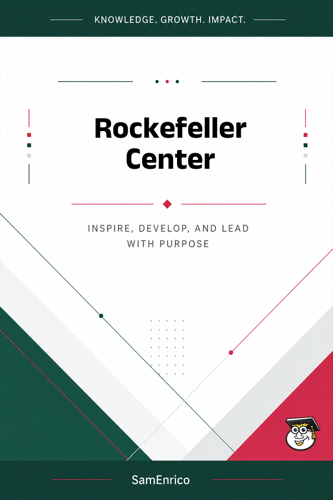
Non-FictionBiographyIndustrialist
Rockefeller Center eBook
Traces the Art Deco complex built by the family.
Traces the Art Deco complex built by the family.
Formats
Free sample
Chapter 1: The Reluctant Billionaire...–- John D. Rockefeller Jr. was thirty-four years old when he first realized he would never escape his father’s shadow. The year was 1908, and the place was a drafty courthouse in Washington, D.C., where the federal government was suing Standard Oil for monopolistic practices that would make the family name synonymous with greed for a generation. Junior sat in the gallery, dressed in a sober gray suit that cost less than his father spent on a single bottle of wine, watching as attorneys painted the Rockefeller fortune as something stolen from the American people.
He did not defend the company. He did not speak at all. He simply sat there, hands folded, wondering if there was any amount of philanthropy large enough to wash away the stain.That moment—silent, anguished, and utterly invisible—was the crucible in which John D. Rockefeller Jr. was forged.
Unlike his father, the ruthless architect of the world’s first great monopoly, Junior was a man who wanted to be loved. He had inherited the largest private fortune in American history, and he had inherited a name that made strangers spit on the sidewalk when they heard it. His father had built an empire out of kerosene and cutthroat deals. Junior would spend the rest of his life trying to build something else: a reputation for decency, a legacy of culture, a monument that would make people forget the oil.He would fail in that specific goal. But his failure would produce something greater than he ever imagined.The Weight of a Name To understand Rockefeller Center, one must first understand the extraordinary burden of being John D.
Rockefeller Jr. He was born in 1874, the fifth child and only son of John D. Rockefeller Sr., a man who had risen from modest beginnings in upstate New York to become the richest person in the world. By the time Junior was ten years old, Standard Oil controlled ninety percent of the nation’s refining capacity. By the time he was twenty, his father was a household name—and a household curse.The elder Rockefeller was a complicated figure: devoutly religious, frugal to the point of absurdity (he famously haggled over a nickel’s worth of lettuce), and utterly ruthless in business.
He destroyed competitors, bribed politicians, and used private detectives to spy on rival executives. He also gave away hundreds of millions of dollars to education and medicine, founding the University of Chicago and the Rockefeller Institute for Medical Research. He was a saint and a sinner, a philanthropist and a predator, and he seemed entirely at peace with the contradiction.Junior was not at peace with anything.From childhood, he was shy, anxious, and desperate for approval. His father had raised him on a strict regimen of moral instruction, biblical study, and financial discipline. Junior’s allowance was carefully tracked.
His clothing was modest. He was taught that money was a sacred trust, not a tool for personal indulgence. But he was also taught that the Rockefeller name was under constant assault, and that it was his duty to defend it.He never learned how.After graduating from Brown University in 1897, Junior joined his father’s business operations. He was given offices, titles, and responsibilities. But he lacked the older man’s killer instinct.
Where John Sr. saw an opportunity to crush a rival, Junior saw an opportunity to negotiate. Where John Sr. saw a hostile press as an annoyance to be managed, Junior saw a wound that would never heal. The younger Rockefeller was a gifted administrator and a genuinely kind human being—he wrote thank-you notes to servants, remembered the names of janitors, and once walked several blocks to return a nickel he had accidentally overcharged a newsboy.
But he was not a predator. And in the world his father had built, predators ate the kind.The Ludlow Massacre and the Search for Redemption The moment that permanently changed Junior’s trajectory came in 1914, at a place called Ludlow, Colorado. The Rockefeller family owned vast coal mines in the state, and the miners—mostly immigrant families from Italy, Greece, and Eastern Europe—had gone on strike to protest brutal working conditions. They lived in a tent colony after being evicted from company housing. On April 20, 1914, the Colorado National Guard attacked the colony with machine guns and set the tents on fire.
Eleven children and two women suffocated in a pit they had dug beneath a tent for shelter. The incident became known as the Ludlow Massacre.Junior was not present. He had never visited the mines. He had delegated labor relations to a subordinate who believed in the iron fist. But the Rockefeller name was on the company letterhead, and the blood of Ludlow was on his hands.The press excoriated him.
Cartoonists drew him as a fat-cat plutocrat standing on the necks of widows and orphans. A federal commission investigated and placed blame squarely on the Rockefeller-controlled company. Junior was summoned to Washington to testify, and he appeared pale, shaken, and utterly unprepared for the fury directed at him.Something broke inside John D. Rockefeller Jr. that year.
He had spent his entire life trying to be a good man, a moral man, a man his father could be proud of. And now the nation was calling him a murderer.He did what he always did in moments of crisis: he sought counsel. And the counsel came from an unlikely source—a fiery progressive labor leader named William Lyon Mackenzie King (who would later become Prime Minister of Canada). King advised Junior to stop hiding behind subordinates. Go to the mines, King said.
Talk to the miners. Listen to them. Let them see your face.Junior did something extraordinary for a man of his class and era. He traveled to Colorado. He walked through the tent colonies.
He sat in the homes of striking miners and listened to their stories. He was jeered, spat upon, and screamed at. He did not leave. He stayed for days, then weeks. And when he returned to New York, he implemented a sweeping series of labor reforms that transformed industrial relations in the Rockefeller mines: collective bargaining, grievance committees, company housing improvements, and safety regulations that went far beyond legal requirements.It was too late to bring back the children of Ludlow.
But it was not too late to change the course of his own life. From that moment forward, John D. Rockefeller Jr. dedicated himself to a single mission: using the Rockefeller fortune to build things that would make the world better, and to ensure that no one would ever again say his name with the same hatred they had directed at his father.The Philanthropic Years Between 1914 and 1928, Junior embarked on an extraordinary spending spree—but not on yachts or mansions. He gave away money with a precision and passion that would have impressed his father’s business rivals.
He funded the reconstruction of Colonial Williamsburg, turning a dilapidated Virginia town into a living museum of American history. He donated the land for the United Nations headquarters in New York (though that would come later). He gave…
This is the end of the free sample. Get the eBook to keep going. Buy now
About this book
Details
- Author
- Peace Cleveland
- Publisher
- SamEnrico
- Language
- English
- Genre
- Non-Fiction, Biography, Industrialist
- Released
- 2026-06-06
- Pages (approx.)
- 127
- Available as
- eBook, Audiobook

Read better in the ZLOADR app
Your eBooks on your phone or tablet. Sign in with your SamEnrico account and start reading.
More by Peace Cleveland
 Uber Driver Insurance HandbookPeace Cleveland$11.99
 90s Nickelodeon GenerationPeace Cleveland$11.99
 Microbreak Strategy GuidePeace Cleveland$11.99
 Career Transition After DisabilityPeace Cleveland$11.99
 Indian GST HSN Code Classification HandbookPeace Cleveland$11.99
 Scott Peterson Warehouse RentalPeace Cleveland$11.99
 Citation Rules for APSA Political SciencePeace Cleveland$11.99
 F16 Viper Pilot MemoirPeace Cleveland$11.99
 The Midnight Code: Harriet Tubman’s Secret MapsPeace Cleveland$11.99
 Shadows Over the Aegean: The Sicilian Expedition's Doomed GambitPeace Cleveland$11.99
 The Vanishing of the Golden Skies: The Untold Story of the 1971 Air France HijackingPeace Cleveland$11.99
 Understanding Aortic Valves Stenosis of The ChildPeace Cleveland$17.99
You may also like
 Hong Kong Handover 1997Dunn Johnnie$11.99
 Zumba For Postnatal Recovery CourseNeal Christian$11.99
 Zumba for BeginnersLadner Nikia$11.99
 YouTube Comment Mining GuideHumes Pandora$12.99
 Worry Box MeditationCarlin Rudy$11.99
 Workplace Stress MeditationNguyen Lynn$11.99
 Workplace Stress and Sleep RepairHawley Ivory$11.99
 Workplace Perfectionism CureDelaney Jeffry$11.99
 Workplace Injustice Anger GuideWallen Isabelle$11.99
 Work Addiction and Burnout LinkGreenwood Ester$11.99
 Women in Yoga and WellnessBeattie Galina$11.99
 Women in Stand Up ComedyChun Evangeline$11.99