
Non-FictionInformativeEducational
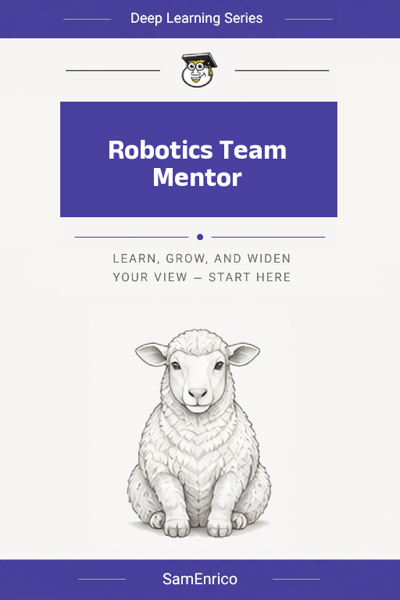
Robotics Team Mentor eBook
A Coursebook on Robotics Team Mentor
by Boren Chance
A Coursebook on Robotics Team Mentor
Formats
Free sample
Chapter 1: The Empty Cup...--–- The first time I watched a student's face fall, I was holding a wrench I should not have been holding.It was my second year as a robotics mentor. The team—seven teenagers, a borrowed drill press, and a budget held together with duct tape and optimism—had spent three hours trying to mount a gearbox to the drivetrain frame. The bolt holes were misaligned by two millimeters. Two millimeters. Less than the thickness of a nickel.
But those two millimeters meant the gearbox would not sit flush, which meant the chain would skip, which meant the robot would drive like a shopping cart with a bad wheel at competition.The students had tried everything. They had loosened all the bolts and retightened them in a different order. They had swapped the gearbox with a spare. They had measured the holes three times. Nothing worked.
The frustration in the room was thick enough to cut with a bandsaw. One student—a quiet sophomore named Marcus who never complained—had his head in his hands. Another, a junior named Priya who normally talked through every problem, had gone silent.And I knew exactly what was wrong.I had seen this exact problem five years earlier when I was an engineering intern. The mounting plate was drilled for a different gearbox model. The students had grabbed the wrong spec sheet.
All they needed to do was elongate the holes by two millimeters with a file. A thirty-second fix.So I walked over, picked up the wrench, and said, "Watch this."I filed the holes. The gearbox dropped into place. The bolts went in smoothly. The robot was saved.And Marcus looked at me like I had stolen something from him.He did not say a word.
He just stood up, walked to the corner of the shop, and sat down. He did not touch another tool for the rest of the night. Priya finished the assembly, but she kept glancing at me with an expression I could not read at the time. I know it now. It was not gratitude.
It was disappointment.I had robbed them.I had robbed Marcus of the satisfaction of solving the problem himself. I had robbed Priya of the chance to lead the troubleshooting. I had robbed the entire team of the story they would have told for years: "Remember the time we spent four hours fighting that gearbox and finally figured out the spec sheet was wrong?" That story belonged to them. I took it.That night, driving home, I realized something uncomfortable. I had not become a mentor to fix robots.
I had become a mentor because I loved the feeling of being the smartest person in the room. And that love—that ego—was actively harming the students I claimed to serve.This chapter is about that realization. It is about the single most important shift a robotics mentor must make: from the "Sage on the Stage" who has all the answers to the "Guide on the Side" who helps students discover their own. It is about the Four Mentor Personas—the Ghost, the Hero, the Warden, and the Gardener—and why only one of them produces independent, confident, resilient young engineers. And it begins with a confession: I have been three of the four.
The only one I have never been is the Ghost, because showing up is the bare minimum. But being present is not the same as being helpful.If you are reading this book, you are already better than the Ghost. You showed up. But showing up is just the door. What you do inside the shop—whether you hold the wrench or watch them fumble for it—is everything.The Two Pillars of Robotics Mentorship Robotics mentoring rests on two pillars, and if either one cracks, the entire structure collapses.The first pillar is technical competence.
You do not need to be a professional engineer. You do not need a degree in robotics. But you need to know enough to keep students safe, to recognize when they are about to make a catastrophic mistake, and to ask the right questions when they get stuck. You need to understand torque versus speed, the difference between a limit switch and a potentiometer, and why you never plug a battery in backward. This pillar is visible, measurable, and relatively easy to build.
Read a few chapters of this book, watch some You Tube tutorials, and spend a Saturday with a drill press. You will be competent enough to mentor.The second pillar is facilitation. This is the hard one. Facilitation is the art of helping students solve problems without solving the problems for them. It requires patience, self-control, and a willingness to watch someone struggle.
It requires biting your tongue when you know the answer. It requires believing that a student who ruins a 50partandlearnswhyisbetteroffthanastudentwhowatchesyouinstallaperfect50 part and learns why is better off than a student who watches you install a perfect 50partandlearnswhyisbetteroffthanastudentwhowatchesyouinstallaperfect50 part. This pillar is invisible, difficult to measure, and takes years to build. Most mentors never build it. They stay technical experts who happen to be in a room with teenagers.This book exists because the second pillar is rarely taught.
Engineering programs teach you how to calculate stress loads. They do not teach you how to watch a student strip a bolt head without intervening. Business schools teach you project management. They do not teach you how to handle a coder who refuses to listen to a builder. Teacher training programs teach lesson planning.
They do not teach you how to run a robot speed dating event.Mentoring is not teaching. It is not engineering. It is a third thing, and this book is your map.The Four Mentor Personas Over a decade of mentoring, observing other mentors, and training new ones, I have identified four distinct personas. Every mentor falls into one of these categories. Most bounce between two or three.
The goal of this book is to move you toward the fourth.Persona 1: The Ghost The Ghost shows up. That is the only nice thing you can say.Ghosts attend meetings. They sit in the corner. They scroll through their phones. When a student asks a question, they say "I don't know" and do not offer to find out.
When a tool breaks, they do not fix it. When a student cries, they look away. Ghosts are not malicious. They are just absent. They have been asked to mentor by a boss, a spouse, or a sense of obligation.
They do not want to be there, and everyone knows it.What Ghosts do well: Nothing.What Ghosts do poorly: Everything that matters.How to stop being a Ghost: Read the rest of this book. If you finish it and still feel no spark, do everyone a favor and resign. There is no shame in admitting this is not for you. The shame is in taking up space that could go to someone who cares.Persona 2: The Hero The Hero is the mentor I was in that shop with Marcus. Heroes are technically competent, sometimes brilliantly so.
They can diagnose a drivetrain problem in thirty seconds. They can write autonomous routines in their sleep. They can wire…
This is the end of the free sample. Get the eBook to keep going. Buy now
About this book
Details
- Author
- Boren Chance
- Publisher
- SamEnrico
- Language
- English
- Genre
- Non-Fiction, Informative, Educational
- Released
- 2026-05-08
- Pages (approx.)
- 159
- Available as
- eBook, Audiobook

Read better in the ZLOADR app
Your eBooks on your phone or tablet. Sign in with your SamEnrico account and start reading.
More by Boren Chance
 Bergman Light in DarknessBoren Chance$11.99
 Gardening Season PriorityBoren Chance$11.99
 CSGO Skin Gambling RecoveryBoren Chance$11.99
 Rapid Rapport TechniquesBoren Chance$11.99
 Upwork Client Interview PreparationBoren Chance$11.99
 Masada: The Last Stand of the ZealotsBoren Chance$11.99
 Project Management Glossary GuideBoren Chance$12.99
 Workforce Skills Long Term GuideBoren Chance$12.99
 Understanding MeningomyeloceleBoren Chance$17.99
 How to Become a Tube RepairerBoren Chance$11.99
You may also like
 Hong Kong Handover 1997Dunn Johnnie$11.99
 Zumba For Postnatal Recovery CourseNeal Christian$11.99
 Zumba for BeginnersLadner Nikia$11.99
 YouTube Comment Mining GuideHumes Pandora$12.99
 Worry Box MeditationCarlin Rudy$11.99
 Workplace Stress MeditationNguyen Lynn$11.99
 Workplace Stress and Sleep RepairHawley Ivory$11.99
 Workplace Perfectionism CureDelaney Jeffry$11.99
 Workplace Injustice Anger GuideWallen Isabelle$11.99
 Work Addiction and Burnout LinkGreenwood Ester$11.99
 Women in Yoga and WellnessBeattie Galina$11.99
 Women in Stand Up ComedyChun Evangeline$11.99