
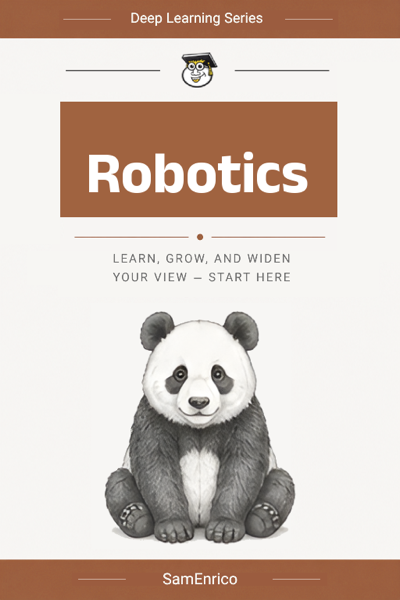
Non-FictionInformativeEducational
Robotics eBook
A Coursebook on Robotics
A Coursebook on Robotics
Formats
Free sample
Chapter 1: The Silent Army...-- Every morning, before you wake, a silent army goes to work. It welds the frame of your car, sorts the packages that arrive at your doorstep, picks the tomatoes in the greenhouse, and explores the craters of Mars. This army never sleeps, never complains, and—if you believe the headlines—is coming for your job. But here is the first and most important truth you will learn in this book: a robot is not a science-fiction creature with gleaming eyes and a desire to overthrow humanity. A robot is a machine.
A very specific kind of machine. And once you understand what a robot actually is—not what Hollywood imagines—you will see that robotics is not magic. It is engineering. Beautiful, systematic, and deeply learnable engineering.This chapter does what no other robotics book does upfront: it throws away the myths and builds a crystal-clear mental model of what a robot is, why robots exist in the first place, and how the entire robotics industry—from fifty-dollar toy robots to half-million-dollar surgical systems—fits together. By the end of this chapter, you will not only define a robot like an engineer, you will understand the economic logic that drives automation, the four categories of tasks that robots dominate, and the value chain that connects sensors to computation to actuators to control.
You will also write your first piece of robotics code: a Python script that calculates exactly how long it takes for a robot to pay for itself. That is not theory. That is the language of the real world.The Myth of the Humanoid Close your eyes for a moment and picture a robot. What do you see? If you are like most people, you see something roughly human-shaped—two arms, two legs, a head with glowing eyes, maybe some metallic skin.
That image comes from a century of science fiction, from the mechanical Maria in Fritz Lang's 1927 film Metropolis to the Terminator to the adorable Wall-E. It is also almost completely wrong as a description of real-world robotics.Walk into any factory in the world—an automotive plant in Stuttgart, an electronics assembly line in Shenzhen, a food packaging facility in Nebraska—and you will see robots. But they will not look like people. They will look like arms. A single mechanical arm bolted to the floor or a wall, with a tool or gripper at its end, moving with precise, repetitive motions.
These are called industrial manipulators, and they account for the vast majority of robots that exist today. According to the International Federation of Robotics, over three million industrial robots were operating in factories worldwide as of 2024, with half a million new units shipped every year. Almost none of them look human.Then there are the other robots—the ones that roam. A robotic vacuum cleaner that maps your living room and avoids your cat. A warehouse robot that lifts entire shelving units and carries them to a human picker.
A drone that inspects a power line. A four-legged robot that climbs stairs and opens doors. These are mobile robots, and they come in wheeled, tracked, legged, and flying varieties. They look like boxes on wheels, or mechanical dogs, or spinning quadcopters. They do not look like people either.So here is the first principle: a robot does not need to look like a human to be a robot.
What makes something a robot is not its shape. It is its behavior.The Engineer's Definition of a Robot Forget the dictionary. Engineers use a precise, functional definition. A robot is a programmable, sensor-feedback-driven machine that performs physical tasks in the real world. Let us unpack each piece of that definition because every word matters.Programmable.
A robot is not a fixed mechanism like a cam-driven assembly line from the 1920s. You can change what a robot does by changing its software. The same physical robot arm that welds a car door this morning can be reprogrammed to pick and place circuit boards this afternoon. That flexibility is the entire point of robotics. If you cannot reprogram it, it is not a robot—it is a hard-automated machine.Sensor-feedback-driven.
A robot does not blindly follow a pre-recorded sequence of motions (that would be a "dumb" automation). A robot uses sensors to measure what is happening in the real world and adjusts its behavior accordingly. A force sensor tells the robot that it has made contact with a surface, so it should stop pushing. A camera tells the robot that a part has shifted on the conveyor belt, so it should reach three centimeters to the left. Without sensors and feedback, you have an open-loop machine.
With them, you have a robot.Performs physical tasks. This distinguishes robotics from pure software. A robot changes the state of the physical world. It moves objects, applies forces, modifies surfaces, transports goods. A chatbot is artificial intelligence, but it is not a robot because it has no physical embodiment.
A robot manipulates matter.In the real world. This is the hardest part. Real worlds are messy. Lighting changes. Friction varies.
Parts have manufacturing tolerances. Humans wander into the workspace. A robot must handle uncertainty, noise, and unexpected events. That is why robotics is so much harder than computer simulation. In simulation, everything is perfect.
In reality, nothing is.Now test this definition against some edge cases. Is a 3D printer a robot? It is programmable. It has some feedback (endstop sensors, sometimes a camera). It performs a physical task (depositing material).
It operates in the real world. Many engineers say yes—a 3D printer is a specialized Cartesian robot. Is a dishwasher a robot? It is programmable (cycles). It has sensors (temperature, turbidity).
It performs a physical task. But most engineers say no because a dishwasher lacks reprogrammability for different tasks—its program is fixed at manufacturing time. The boundary is fuzzy, and that is fine. The useful distinction is between fixed automation (a machine that does one thing forever) and flexible automation (a robot that can do many things with a software change).The Four Ds: Why Robots Exist Robots are not built because they are cool (though they are). Robots are built because they solve an economic problem.
In the early days of industrial robotics, Joseph Engelberger—the man who built the first industrial robot in the United States—famously said that robots are good for tasks that are "hot, heavy, and hazardous." Over time, this list evolved into the Four Ds, a framework that explains every successful robotics application you will ever see.Dull. Some tasks are so repetitive that human workers cannot stay attentive. Watching a conveyor belt for defective parts. Screwing the same four bolts on every car door for eight hours. Scanning barcodes.
Humans get bored. Bored humans make mistakes. Robots never get bored. They will inspect the ten-thousandth widget with the same attention as the first. This is not a limitation of human character; it is a limitation of human neurobiology.
The brain evolved to notice novelty, not monotony. Robots have no such evolution.Dirty. Some environments are unpleasant for humans. Paint booths filled with volatile organic compounds. Foundries…
This is the end of the free sample. Get the eBook to keep going. Buy now
About this book
Details
- Author
- Brewster Refugio
- Publisher
- SamEnrico
- Language
- English
- Genre
- Non-Fiction, Informative, Educational
- Released
- 2026-06-02
- Pages (approx.)
- 160
- Available as
- eBook, Audiobook

Read better in the ZLOADR app
Your eBooks on your phone or tablet. Sign in with your SamEnrico account and start reading.
More by Brewster Refugio
 Minimalist Desk Distraction BusterBrewster Refugio$11.99
 Senior Legacy Building GuideBrewster Refugio$11.99
 Self Hypnosis for Combat SportsBrewster Refugio$11.99
 Hinge Validation AddictionBrewster Refugio$11.99
 The Armada's Last Stand: England's Naval Gambit That Shaped the WorldBrewster Refugio$11.99
 How to Produce Adobe Clay TileBrewster Refugio$11.99
 Intellectual Property Assignment HandbookBrewster Refugio$12.99
 How to Become a Mail CensorBrewster Refugio$11.99
You may also like
 Hong Kong Handover 1997Dunn Johnnie$11.99
 Zumba For Postnatal Recovery CourseNeal Christian$11.99
 Zumba for BeginnersLadner Nikia$11.99
 YouTube Comment Mining GuideHumes Pandora$12.99
 Worry Box MeditationCarlin Rudy$11.99
 Workplace Stress MeditationNguyen Lynn$11.99
 Workplace Stress and Sleep RepairHawley Ivory$11.99
 Workplace Perfectionism CureDelaney Jeffry$11.99
 Workplace Injustice Anger GuideWallen Isabelle$11.99
 Work Addiction and Burnout LinkGreenwood Ester$11.99
 Women in Yoga and WellnessBeattie Galina$11.99
 Women in Stand Up ComedyChun Evangeline$11.99