
Non-FictionInformativeEducational
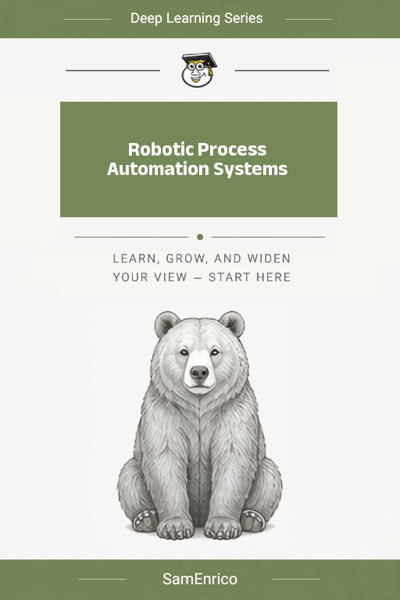
Robotic Process Automation Systems eBook
A Coursebook on Robotic Process Automation Systems
A Coursebook on Robotic Process Automation Systems
Formats
Free sample
Chapter 1: Your Secret Digital Workforce...--–- On a quiet Tuesday afternoon in a Chicago insurance office, a claims processor named Maria watched her screen move by itself. Fields populated. Dropdowns selected. PDFs opened, read, and closed. An email sent itself to a customer she had never met.
Maria’s hands were in her lap, her coffee growing cold, yet her work was being done at a speed no human could match. She was not afraid. She was relieved. For the first time in three years, she left the office at 5:00 PM to pick up her daughter from soccer practice.The robot that worked beside Maria did not have arms, legs, or a friendly face. It was a piece of software—a collection of instructions that lived on her company’s servers and awakened each morning to log into the same six systems Maria used.
It clicked where she clicked, typed what she typed, and followed rules she had documented on a yellow legal pad during a two-hour meeting with an automation specialist. That robot was her secret digital workforce. And it changed everything.This book is the story of how that robot came to life, how you can build one just like it, and how organizations around the world are quietly deploying millions of these digital workers to reshape the nature of office work. The technology is called Robotic Process Automation, or RPA. It is not artificial intelligence in the science‑fiction sense.
It is not a physical robot bolted to a factory floor. It is something simpler, more practical, and, for the working professional, more immediately useful than almost any other enterprise technology developed in the past twenty years.Before we write a single line of code, before we design a single workflow, before we even install software, we must understand what RPA is, where it came from, how it differs from everything else in the technology landscape, and why it has become the fastest‑growing enterprise software category on the planet. This chapter gives you that foundation. By the end, you will not only define RPA in your own words—you will see three automation opportunities in your own daily work that you missed this morning.The Unspoken Crisis of Office Work To understand why RPA exploded onto the scene, we must first confront a quiet crisis that has been building for thirty years. Office workers spend an average of sixty‑eight percent of their workweek on repetitive, rule‑based tasks that require no human judgment.
They copy data from spreadsheets into web forms. They move customer records from one database to another. They open emails, download attachments, and retype the same information into three different systems because those systems were never designed to talk to each other.In the 1990s, enterprise software vendors promised that integrated systems would eliminate this drudgery. Companies bought expensive Enterprise Resource Planning systems from SAP, Oracle, and Microsoft. They hired armies of consultants to connect everything through application programming interfaces.
Yet two decades later, the average Fortune 500 company still uses more than nine hundred separate software applications, and fewer than thirty percent of them have any API integration at all. The remaining seventy percent are what automation experts call “dark systems”—applications that were installed, customized, and then abandoned by the IT department, left running on old servers with no way to connect them except through the same slow, manual process that humans have always used.Consider a simple example. A mid‑sized logistics company receives two thousand invoices per day via email. Each invoice must be entered into the accounting system, checked against a purchase order in the procurement system, validated for tax compliance in a third system, and then filed in a shared network drive. The company’s ERP system has an API that could theoretically accept invoice data, but the procurement system was built by a vendor that went bankrupt in 2012, and the tax compliance system is a web portal that requires a human to click through five screens.
No API exists. No integration is possible without rewriting the tax system from scratch, at a cost of three million dollars and eighteen months of development.This is the crisis. Companies are drowning in data but starving for integration. They have the systems they need but cannot make them work together. The traditional IT response has always been the same: build more APIs, replace legacy systems, or hire more people to do the manual work.
Each of these solutions is expensive, slow, or both.RPA offers a fourth path. Instead of changing the underlying systems, RPA teaches software to use those systems exactly as a human would. It logs in. It clicks. It types.
It reads screens. It follows rules. And because it operates at the user interface layer, it works with any application—old or new, web‑based or desktop, API‑enabled or completely closed. RPA does not require cooperation from the systems it automates. It simply watches what humans do and then does the same thing, faster, without mistakes, and without sleeping.Defining RPA: The Non‑Technical Explanation Robotic Process Automation is software that mimics human interactions with digital systems to execute repetitive, rule‑based business processes.
The “robotic” part refers not to a physical machine but to the software’s behavior: deterministic, predictable, and capable of following precise instructions without deviation. The “process” part reminds us that RPA is not about automating random keystrokes but about automating complete workflows—sequences of steps that accomplish a meaningful business outcome.Think of RPA as a digital mimic. If you can describe a task as a list of steps (“open the customer record, copy the account number, paste it into the billing system, click ‘generate invoice,’ save the PDF to the desktop”), then an RPA bot can execute that list. The bot does not need to understand what an invoice is. It does not need to learn or improve over time.
It simply needs to follow the rules you give it, with the same fidelity every time.This fidelity is the superpower of RPA. Humans make mistakes. We transpose digits. We skip steps when we are tired. We close the wrong browser tab.
We forget to save before navigating away. An RPA bot never makes any of these errors. It executes the same sequence of actions with perfect accuracy, millions of times, until someone tells it to stop. When a bot processes ten thousand invoices, the tenth thousand is exactly as correct as the first.Of course, perfection comes with a trade‑off. Bots cannot handle ambiguity.
If a step says “if the invoice total exceeds ten thousand dollars, send for manager approval,” the bot will do exactly that. But if the instruction says “use your judgment to decide whether this invoice seems suspicious,” the bot will fail. Judgment, intuition, creativity, empathy—these remain the exclusive domain of humans. RPA automates the predictable, not the insightful.This distinction is crucial because it tells us where RPA belongs. Automate the repeatable.
Leave the exceptional for human judgment. The most successful RPA implementations do not eliminate human work; they eliminate the boring parts of human work, freeing people to focus on…
This is the end of the free sample. Get the eBook to keep going. Buy now
About this book
Details
- Author
- Taggart Margart
- Publisher
- SamEnrico
- Language
- English
- Genre
- Non-Fiction, Informative, Educational
- Released
- 2026-05-11
- Pages (approx.)
- 158
- Available as
- eBook, Audiobook

Read better in the ZLOADR app
Your eBooks on your phone or tablet. Sign in with your SamEnrico account and start reading.
More by Taggart Margart
 The Effortless Achievement GuideTaggart Margart$11.99
 Loneliness for ParentsTaggart Margart$11.99
 Procrastination and Stress CycleTaggart Margart$11.99
 Speculative Sentiment IndexTaggart Margart$11.99
 The Bridge That Shouldn’t Have Fallen: The 2016 Minato Mirai CollapseTaggart Margart$11.99
 How to Produce Baby FurnitureTaggart Margart$11.99
 Kanban Swimlane Design HandbookTaggart Margart$12.99
 How to Start a Photographic Studio Business (Beginners Guide)Taggart Margart$11.99
You may also like
 Hong Kong Handover 1997Dunn Johnnie$11.99
 Zumba For Postnatal Recovery CourseNeal Christian$11.99
 Zumba for BeginnersLadner Nikia$11.99
 YouTube Comment Mining GuideHumes Pandora$12.99
 Worry Box MeditationCarlin Rudy$11.99
 Workplace Stress MeditationNguyen Lynn$11.99
 Workplace Stress and Sleep RepairHawley Ivory$11.99
 Workplace Perfectionism CureDelaney Jeffry$11.99
 Workplace Injustice Anger GuideWallen Isabelle$11.99
 Work Addiction and Burnout LinkGreenwood Ester$11.99
 Women in Yoga and WellnessBeattie Galina$11.99
 Women in Stand Up ComedyChun Evangeline$11.99