
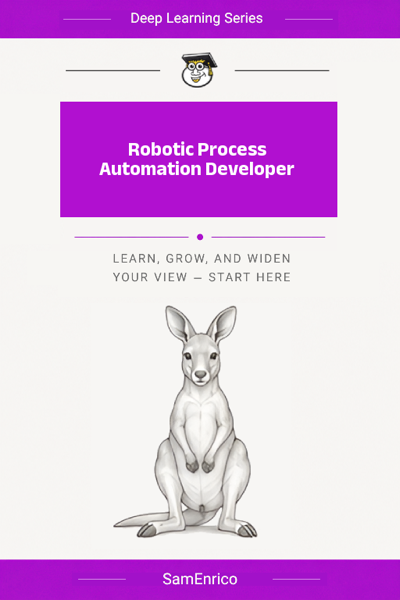
Non-FictionInformativeEducational
Robotic Process Automation Developer eBook
A Coursebook on Robotic Process Automation Develop
A Coursebook on Robotic Process Automation Developer
Formats
Free sample
Chapter 1: The Digital Workforce...-- The phone rang at 2:17 AM. Sarah, a senior accountant at a mid-sized logistics firm, groggily answered to find her regional controller on the line. "We have a problem," he said. "The monthly reconciliation report isn't ready, and the CFO needs it by 8 AM. Three people have been manually copying data between our shipping system and our accounting software for the past six hours.
They're only halfway done." Sarah rubbed her eyes, opened her laptop, and stared at the same two windows she'd been looking at for five years—the same screens, the same fields, the same soul-crushing repetition. That night, she didn't find a solution. But she asked a question that would eventually transform her career: "Why can't the computer just do this?"That question—innocent, frustrated, profoundly obvious in retrospect—is the seed from which the entire field of Robotic Process Automation grew. And it is the same question that will drive your journey from curious reader to job-ready RPA developer.Welcome. You are about to learn how to build digital workers.The Great Misunderstanding: What RPA Actually Is Before we write a single line of automation logic, before we install any software, before we even open a development environment, we must establish a shared and precise understanding of what Robotic Process Automation truly means.
The term "robot" misleads. It conjures images of mechanical arms on assembly lines or humanoid machines walking among us. RPA has nothing to do with physical robots. The "robot" in RPA is a software agent—a piece of code that interacts with computer systems exactly the way a human does, using the same mouse clicks, keyboard inputs, and screen-reading behaviors.Let me give you a concrete example. Imagine you need to move customer contact information from an Excel spreadsheet into a customer relationship management (CRM) system.
As a human, you would open Excel, select the first row of data, copy the customer's name, switch to the CRM, paste it into the name field, return to Excel, copy the email address, return to the CRM, paste it, click "Save," and repeat for hundreds or thousands of rows. An RPA robot does exactly the same thing—except it does it without getting bored, without making typos, and without needing to sleep.This is the central insight of RPA: automation through imitation, not integration. Traditional software integration connects systems using application programming interfaces (APIs)—direct, fast, machine-to-machine channels. RPA, by contrast, works at the user interface layer. It uses the same buttons, menus, and text fields you do.
This makes RPA simultaneously powerful and fragile. Powerful because it can automate any application that has a user interface, regardless of whether that application was designed for automation. Fragile because it relies on the stability of those user interfaces—a button that moves a few pixels or a field that changes its name can break an RPA bot.Why does this distinction matter to you as a developer? Because choosing between API integration and RPA is one of the most important architectural decisions you will make. Use APIs when they exist and are well-documented; they are faster, more reliable, and cheaper to maintain.
Use RPA when APIs do not exist, when the cost of API development exceeds the cost of RPA, or when you need to automate across legacy systems that no one wants to modify. RPA is not a replacement for proper integration. It is a pragmatic alternative when proper integration is impossible or impractical.The Two Tribes: Attended and Unattended Robots Every RPA robot falls into one of two categories, and understanding this taxonomy is essential for designing solutions that actually solve business problems.Attended robots work alongside human employees, sharing control of the computer. A human triggers them—usually with a hotkey or a button in a desktop toolbar—and the robot executes a predefined sequence of actions while the human watches, intervenes when necessary, and handles exceptions the robot cannot resolve. Attended robots are digital co-pilots.
They excel at tasks that require human judgment for edge cases but are otherwise highly repetitive.Consider a customer service representative who handles refund requests. The representative receives an email, opens a customer account in three different systems, verifies order history, checks inventory, calculates the refund amount, and processes the refund. An attended robot could do every step except the final approval, which requires human judgment about whether the refund is justified. The representative clicks a button, the robot does the grunt work in seconds instead of minutes, and the representative makes the decision. The representative's productivity triples without any reduction in quality.Unattended robots, by contrast, operate autonomously on virtual machines or dedicated servers.
No human watches them work. No human clicks "go." They are triggered by schedules (3:00 AM every night), by events (a new file arriving in a shared folder), or by API calls from other systems. Unattended robots handle high-volume, batch-oriented processes: generating thousands of invoices, reconciling daily sales data across multiple systems, or synchronizing customer records between an e-commerce platform and a warehouse management system.The distinction has profound implications for how you design, deploy, and maintain your automations. Attended robots must be fast (because a human is waiting), tolerant of interruptions (because the human might take control), and lightweight (because they run on employee workstations). Unattended robots must be extremely robust (because no human will intervene when something goes wrong), logged comprehensively (because you need to audit their actions), and scalable (because you might run dozens or hundreds of them simultaneously on server clusters).Throughout this book, you will learn to build both types—and, more importantly, to recognize which type a given business problem requires.
A complete exploration of attended versus unattended architecture, including real-world use cases, deployment strategies, and licensing implications, appears in Chapter 8.A Brief History of Automating the Unautomatable To understand where RPA is going, you must understand where it came from. The technology did not emerge from a vacuum. It evolved through several distinct eras, each solving a specific problem with the tools available at the time.The 1960s–1980s: Terminal Emulation and Green Screens. The earliest form of what we might call RPA emerged in mainframe environments. Banks, insurance companies, and airlines used "terminal emulators" to connect modern computers to ancient mainframes.
These emulators could capture the character-based screens of the mainframe and, with careful scripting, extract data and send keystrokes. This was screen scraping in its most primitive form—brittle, difficult to maintain, but better than nothing.The 1990s: Windows Automation and Macro Recorders. As Windows became the dominant desktop operating system, power users discovered the macro recording features in Microsoft Office. An accountant could record a sequence of actions in Excel—select cell A1, type a formula, press Enter, copy the result—and replay it with a keyboard shortcut. This was automation, but it was trapped inside individual applications.
You could automate Excel, but you could not automate a workflow that moved data from Excel to Outlook to SAP.The 2000s: Test Automation Tools Repurposed. Software testers had long used tools like HP Quick Test Professional (now UFT) to automate the testing of Windows applications. Smart developers realized these same tools could…
This is the end of the free sample. Get the eBook to keep going. Buy now
About this book
Details
- Author
- Ramey Elisabeth
- Publisher
- SamEnrico
- Language
- English
- Genre
- Non-Fiction, Informative, Educational
- Released
- 2026-05-09
- Pages (approx.)
- 137
- Available as
- eBook, Audiobook

Read better in the ZLOADR app
Your eBooks on your phone or tablet. Sign in with your SamEnrico account and start reading.
More by Ramey Elisabeth
 Influencer Induced Inadequacy GuideRamey Elisabeth$11.99
 Hopelessness In Persistent DepressionRamey Elisabeth$11.99
 Congress Member Retirement PlanningRamey Elisabeth$11.99
 Executive Hostage Survival Field GuideRamey Elisabeth$11.99
 Self Hypnosis Labor PainRamey Elisabeth$11.99
 The Velvet Underground’s Exploding Factory: Warhol, Nico, and the Birth of PunkRamey Elisabeth$11.99
 The Curse of the Black Pharaoh: Tutankhamun’s Tomb and the Race for Ancient SecretsRamey Elisabeth$11.99
 Circular Supply Chain ModelsRamey Elisabeth$12.99
 Middlesex University DubaiRamey Elisabeth$12.99
 Understanding Congenital MegaloureterRamey Elisabeth$17.99
 How to Become a Cell TesterRamey Elisabeth$11.99
You may also like
 Hong Kong Handover 1997Dunn Johnnie$11.99
 Zumba For Postnatal Recovery CourseNeal Christian$11.99
 Zumba for BeginnersLadner Nikia$11.99
 YouTube Comment Mining GuideHumes Pandora$12.99
 Worry Box MeditationCarlin Rudy$11.99
 Workplace Stress MeditationNguyen Lynn$11.99
 Workplace Stress and Sleep RepairHawley Ivory$11.99
 Workplace Perfectionism CureDelaney Jeffry$11.99
 Workplace Injustice Anger GuideWallen Isabelle$11.99
 Work Addiction and Burnout LinkGreenwood Ester$11.99
 Women in Yoga and WellnessBeattie Galina$11.99
 Women in Stand Up ComedyChun Evangeline$11.99