
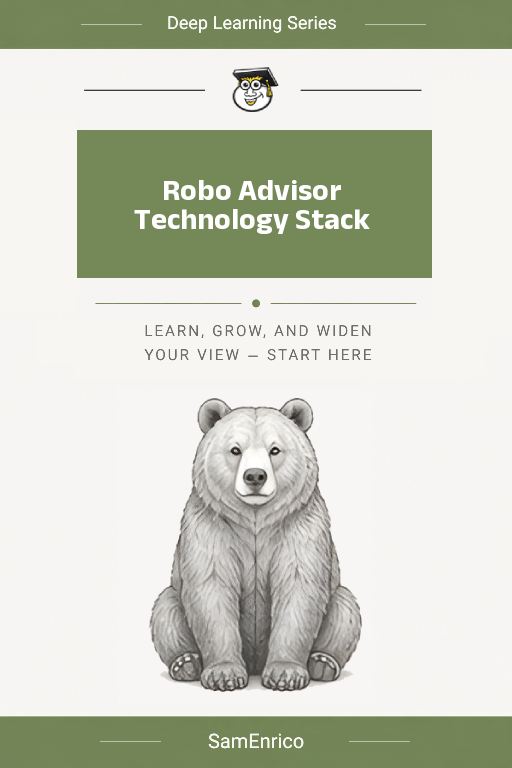
Non-FictionForecast & OutlookRobo Advisory
Robo Advisor Technology Stack eBook
Explore automated portfolio rebalancing, tax-loss
Explore automated portfolio rebalancing, tax-loss harvesting, and goal-based investing using algorithmic asset allocation models.
Formats
Free sample
Chapter 1: The Ghost in the Terminal--–- Every night, while you sleep, billions of dollars migrate across global markets without a single human clicking “buy” or “sell.” The trades are not executed by a brilliant portfolio manager in a glass-walled corner office, nor by a grizzled trader on a noisy floor. They are executed by lines of code—rebalancing algorithms, tax-harvesting scripts, and optimization engines—running on servers in data centers whose locations most investors could not name. This invisible machinery, not the sleek mobile app on your phone, is the true competitive advantage of modern digital wealth management. And yet, almost nobody understands how it works.The premise of this book is deliberately provocative: the user interface of a robo-advisor is a distraction. The dropdown menus, the risk tolerance sliders, the green “rebalance now” buttons—these are theater.
The real intelligence, the proprietary value, and the mathematical rigor reside entirely in the technology stack that the client never sees. This book rips away the front-end veneer to expose the algorithmic organs beneath: automated portfolio rebalancing, tax-loss harvesting, and goal-based investing powered by asset allocation models that would have made Harry Markowitz reach for another notebook.If you are a software engineer building the next generation of wealth platforms, this is your anatomy textbook. If you are a financial advisor trying to understand what your automated competitors actually do, this is your field guide. And if you are an investor simply curious about where your money lives when it is not in your pocket, this is your flashlight in a dark room. By the time you finish this chapter—and the eleven that follow—you will see robo-advisors not as apps but as autonomous financial organisms, constantly sensing market conditions, calculating drift, harvesting losses, and adjusting for your life goals, all without once asking for permission.The Three Pillars, Now and Forever Every robo-advisor worth its fee (or lack thereof) rests on three algorithmic pillars.
These are not optional features or marketing bullet points. They are the irreducible minimum. Remove any one, and you no longer have a robo-advisor; you have a brokerage account with a nicer website.The first pillar is automated portfolio rebalancing. Markets move. If you start with a portfolio of 60% stocks and 40% bonds, a strong equity rally will push you to 70% stocks and 30% bonds.
Your risk profile has silently changed. Rebalancing is the mechanical act of selling what has done well and buying what has lagged, returning you to your target weights. A human advisor might do this quarterly. A robo-advisor checks every day, sometimes every hour, and can rebalance using nothing but the spare change in your cash sweep.The second pillar is tax-loss harvesting (TLH) . This is the most celebrated—and most misunderstood—feature of digital advice.
When a security in your taxable account falls below its purchase price, a robo-advisor can sell it, realize the loss, and immediately buy a different but highly correlated security to maintain your market exposure. The loss offsets capital gains elsewhere in your portfolio or up to 3,000ofordinaryincomeeachyear.Thealgorithmneversleeps,scanningthousandsoftaxlotsacrosshundredsofaccounts,huntingforlossesassmallas3,000 of ordinary income each year. The algorithm never sleeps, scanning thousands of tax lots across hundreds of accounts, hunting for losses as small as 3,000ofordinaryincomeeachyear.Thealgorithmneversleeps,scanningthousandsoftaxlotsacrosshundredsofaccounts,huntingforlossesassmallas50. A human cannot do this at scale. A human should not try.The third pillar is goal-based investing.
Traditional finance assumes you have one risk tolerance and one time horizon. This is fiction. You have a retirement goal (30 years, high risk tolerance), a down payment goal (3 years, low risk tolerance), and perhaps a child’s college fund (10 years but with withdrawals starting in year 5, medium risk tolerance that declines). These goals compete for the same pool of dollars. A robo-advisor treats this as a constrained optimization problem: allocate assets across goals to maximize the probability of achieving all of them, or at least the most important ones.
This is not asset allocation. This is life allocation.These three pillars do not operate in isolation. They interact, sometimes harmoniously, often in conflict. A rebalancing trigger may want to sell an appreciated asset; tax-loss harvesting wants to hold that asset to avoid realizing a gain. A goal with a high probability of success may need to sacrifice some tax efficiency to stay on track.
The art of the robo-advisor technology stack lies not in implementing each pillar perfectly but in resolving their competing demands. This chapter introduces the stack as a whole; the chapters that follow dissect each layer.From Human to Hybrid to Ghost To understand why the technology stack matters more than the interface, we must briefly traverse the evolution of investment advice. This history is not nostalgia. It is context for why algorithms won.In the beginning, there was the human advisor. You sat across a mahogany desk, perhaps with a glass of water and a brochure about “long-term value creation.” The advisor charged 1% of assets under management (AUM) annually, often plus expense ratios of 1% or more for actively managed mutual funds.
The minimum account size was 100,000,sometimes100,000, sometimes 100,000,sometimes500,000. Rebalancing happened when the advisor remembered, typically once per year. Tax-loss harvesting was a December conversation: “You have some losses in XYZ Corp. Should we sell?” The answer was usually no, because the advisor did not want to explain the wash sale rule. Goal-based investing was a sticky note: “Retirement in 2040.”Then came the crisis of 2008.
Investors watched their portfolios fall by 30–50% while still paying 1% advisory fees. The value proposition of traditional advice cratered. At the same time, a generation of investors who had grown up with online banking, then e-trade, then smartphones began asking a dangerous question: “Why can’t my investments be automated like my bill payments?”The first wave of robo-advisors—Betterment (2008), Wealthfront (2011), Schwab Intelligent Portfolios (2015)—answered that question with a radical proposition. They would charge 0.25% or less, offer unlimited rebalancing, automate tax-loss harvesting, and require no human interaction. The technology stack was not an add-on; it was the entire business.
These firms built their own rebalancing engines, their own tax-lot databases, their own order routing systems. The user interface was almost an afterthought—clean, yes, but deliberately simple because the complexity was all backend.Hybrid models emerged. Vanguard Personal Advisor Services (2015) offered human advisors plus digital tools at 0.30% AUM. Schwab added human backup to its robo offering. But the pure plays proved that a fully automated stack could manage tens of billions of dollars with a fraction of the staff of a traditional wealth manager.
As of 2025, robo-advisors globally manage over $2 trillion. The ghost in the terminal had become the market.The lesson for our purposes is this: the winners were not the firms with the prettiest charts or the most engaging onboarding quizzes. The winners were the firms that built the most reliable, most tax-efficient, most scalable technology stacks. Wealthfront’s direct indexing feature, which harvests losses on individual S&P 500 stocks rather than ETFs, required solving a computational problem with 500 tax lots per account. Betterment’s “retail rebalancing” algorithm, which uses client cash flows to rebalance without selling, required rewriting the standard rebalancing logic from first principles.
These were not interface improvements. They were engineering breakthroughs.The Engineering Trade-Offs Nobody Talks About Every decision in a robo-advisor stack…
This is the end of the free sample. Get the eBook to keep going. Buy now
About this book
Details
- Author
- Walling Nanette
- Publisher
- SamEnrico
- Language
- English
- Genre
- Non-Fiction, Forecast & Outlook, Robo Advisory
- Released
- 2026-05-30
- Pages (approx.)
- 130
- Available as
- eBook, Audiobook

Read better in the ZLOADR app
Your eBooks on your phone or tablet. Sign in with your SamEnrico account and start reading.
More by Walling Nanette
 NA Step Working HandbookWalling Nanette$11.99
 Anger Trigger Frequency TrackerWalling Nanette$11.99
 Project Time Blocking MethodWalling Nanette$11.99
 PNE App Patient GuideWalling Nanette$11.99
 The Hollow Hill: A Druid's Last Stand Against the Iron AgeWalling Nanette$11.99
 The Poisoner's Apprentice: The Untold Story of Graham YoungWalling Nanette$11.99
 Understanding HyperornithinemiaWalling Nanette$17.99
 Corporate Career Stability PrimerWalling Nanette$12.99
 A Beginners Guide to Baseball (Volume 1)Walling Nanette$11.99
 Surgical First AssistantWalling Nanette$11.99
You may also like
 Hong Kong Handover 1997Dunn Johnnie$11.99
 Zumba For Postnatal Recovery CourseNeal Christian$11.99
 Zumba for BeginnersLadner Nikia$11.99
 YouTube Comment Mining GuideHumes Pandora$12.99
 Worry Box MeditationCarlin Rudy$11.99
 Workplace Stress MeditationNguyen Lynn$11.99
 Workplace Stress and Sleep RepairHawley Ivory$11.99
 Workplace Perfectionism CureDelaney Jeffry$11.99
 Workplace Injustice Anger GuideWallen Isabelle$11.99
 Work Addiction and Burnout LinkGreenwood Ester$11.99
 Women in Yoga and WellnessBeattie Galina$11.99
 Women in Stand Up ComedyChun Evangeline$11.99