
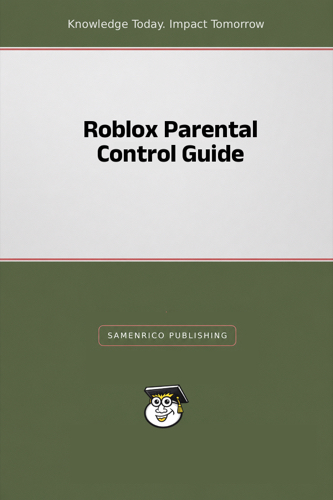
Non-FictionSelf-HelpParenting Gaming
Roblox Parental Control Guide eBook
Helps parents set limits on child's gameplay witho
by Dion Rheba
Helps parents set limits on child's gameplay without causing rebellion.
Formats
Free sample
Chapter 1: Beyond On-Off...--–- The tablet hits the kitchen counter with a sharp crack. Your eleven-year-old’s face crumples, then hardens. “You don’t understand,” they mutter, storming upstairs. The bedroom door slams. You stand alone in the kitchen, wondering how a simple request—“Please turn off Roblox, dinner is ready”—turned into World War III.
You were not being mean. You gave a five-minute warning. You even offered to save their progress. And yet, here you are: the villain. Again.If this scene feels familiar, you are not failing as a parent.
You are simply missing a crucial piece of psychology that most parenting guides ignore. And once you understand it, everything changes.The Psychology You Were Never Taught Every human being, from toddler to grandparent, has a deep-seated need for autonomy—the sense that we are in control of our own choices. When someone threatens that autonomy, we react. Sometimes calmly. Often not.
Psychologists call this reactance theory, first described by Jack Brehm in 1966. Reactance is the motivational state we experience when we perceive that our freedom is being taken away. And crucially, reactance does not make us accept the loss. It makes us fight to restore the freedom, often by wanting the forbidden thing even more.Here is what reactance looks like in everyday life. A teenager whose parents forbid them from seeing a certain romantic partner suddenly finds that partner irresistible.
A shopper told “limit one per customer” suddenly wants to buy a dozen. A child told “no cookies before dinner” becomes obsessed with the cookie jar. And a child told “turn off Roblox, right now” becomes desperate to keep playing—not necessarily because the game is that compelling, but because the shutdown triggers a freedom alarm in their brain.Most parenting books treat excessive Roblox play as a simple discipline failure. “Set clear boundaries,” they say. “Be consistent.
Enforce consequences.” This advice assumes that your child’s attachment to Roblox comes from the game itself—the bright colors, the reward systems, the addictive design. But that is almost never the primary driver.The primary driver is this: Every time you say “no” without context, you trigger reactance. And reactance makes the forbidden thing more valuable. You are not extinguishing a behavior. You are pouring gasoline on a fire.Roblox Is Not What You Think It Is To understand why reactance hits so hard with Roblox specifically, you have to understand what Roblox actually is.
Most parents—and I was one of them—think of Roblox as a game. It is not. It is a platform that hosts millions of user-created “Experiences.” But more importantly, it is the primary social space for millions of children aged seven to fifteen.Imagine your neighborhood street on a summer afternoon. Children ride bikes, play tag, build forts in the backyard, and sit on porch swings gossiping. Now imagine that you grounded your child from that street entirely.
No explanation. No warning. Just “You cannot go outside today.” Your child would not accept this calmly. They would rage. Because you have not taken away a game.
You have taken away their friends, their social standing, their inside jokes, their plans for the afternoon, and their sense of belonging.Roblox is the digital equivalent of that street. When your child says “I’m playing Roblox,” they might mean “I am building a virtual house with my best friend,” or “I am competing against my cousin who lives three states away,” or “I am showing off the rare pet I saved three months to afford.” The game mechanics are secondary. The social connection is primary.This is why “just turn it off” backfires every single time. You are not interrupting a solo activity. You are pulling your child out of a living, breathing social world.
And they will resent you for it—not because they are addicted, but because you are being rude. Would you walk into a room where your child was laughing with three friends and announce “Time’s up, everyone leave”? Probably not. So why do we do the digital equivalent without a second thought?The FOMO Reality, Not the Addiction Myth Let us address the concern that keeps parents up at night: Is my child addicted to Roblox?True screen addiction is rare. The World Health Organization recognizes “Gaming Disorder” as a mental health condition, but the criteria are stringent.
To qualify, a person must show impaired control over gaming (they cannot stop even when they desperately want to), increasing priority given to gaming (they abandon hobbies, friendships, and hygiene), and continuation despite negative consequences (failing grades, lost jobs, physical decline). These symptoms must persist for at least twelve months.Does your child meet that bar? Probably not. Most children who love Roblox are not addicted. They are experiencing something else: FOMO, or Fear Of Missing Out.FOMO is not addiction.
FOMO is social anxiety. Your child is not desperate to play Brookhaven RP because the roleplaying mechanics are neurologically addictive. They are desperate because their friends are all in a private server right now, and if they miss tonight’s session, they will be excluded from tomorrow’s inside jokes. In the hyper-social world of middle childhood, that feels catastrophic.When you reframe your child’s behavior through the lens of FOMO rather than addiction, your entire strategy changes. You stop asking “How do I get them off the screen?” and start asking “How do I help them manage their social life without letting it consume all their time?” That shift—from adversary to coach—is the most important move you will make.The Convert, Don’t Confront Framework Here is the single most practical tool in this chapter.
I call it the Convert, Don’t Confront framework. It has three components, each backed by research in compliance psychology.Component One: Always Lead With “Because”Never issue a command without a reason. The reason does not have to be elaborate. It just has to exist. Studies dating back to the 1970s show that adding the word “because” to a request significantly increases compliance, even when the reason is circular (“because I need you to do it”).
But a real reason is better.Compare these two statements:“Turn off Roblox. Now.”“Turn off Roblox because dinner is in ten minutes and we eat together as a family.”The first statement triggers reactance. It is an unexplained demand, a freedom threat. The second statement provides context. It frames the request not as an arbitrary exercise of parental power, but as a logical consequence of the family schedule.
Your child may still be annoyed. But they are far less likely to rebel.Component Two: Replace Prohibition With Trade“No Roblox today” is a prohibition. It communicates only loss. The child hears: “Something you value is being taken from you.” That loss triggers reactance.Instead, offer a trade: “Let’s finish your homework now so you have forty-five minutes before dinner to join your friends.” This reframes the situation. You are not taking something away.
You are offering a deal: complete this task, and you earn this reward. The psychology shifts from reactance (fighting against a loss) to motivation (working…
This is the end of the free sample. Get the eBook to keep going. Buy now
About this book
Details
- Author
- Dion Rheba
- Publisher
- SamEnrico
- Language
- English
- Genre
- Non-Fiction, Self-Help, Parenting Gaming
- Released
- 2026-06-07
- Pages (approx.)
- 126
- Available as
- eBook, Audiobook

Read better in the ZLOADR app
Your eBooks on your phone or tablet. Sign in with your SamEnrico account and start reading.
More by Dion Rheba
 Self Esteem for Union WorkDion Rheba$11.99
 DoorDash Delivery EfficiencyDion Rheba$11.99
 The Tool Library CreatorDion Rheba$11.99
 The Next Level After Death ClaimDion Rheba$11.99
 Growth Mindset for EngineersDion Rheba$11.99
 The Codebreaker's Labyrinth: Alan Turing and the Enigma of TimeDion Rheba$11.99
 Silent Echoes: The Unseen Artistry of Latin America's Mime RevolutionDion Rheba$11.99
 Service Providers Guide to Delivery ServiceDion Rheba$11.99
 How to Produce a JetheadDion Rheba$11.99
 A Collector's Handbook to the Jensen 541sDion Rheba$11.99
 Venture Debt for BootstrappedDion Rheba$12.99
 Batch Processing API BlueprintDion Rheba$12.99
You may also like
 Hong Kong Handover 1997Dunn Johnnie$11.99
 Zumba For Postnatal Recovery CourseNeal Christian$11.99
 Zumba for BeginnersLadner Nikia$11.99
 YouTube Comment Mining GuideHumes Pandora$12.99
 Worry Box MeditationCarlin Rudy$11.99
 Workplace Stress MeditationNguyen Lynn$11.99
 Workplace Stress and Sleep RepairHawley Ivory$11.99
 Workplace Perfectionism CureDelaney Jeffry$11.99
 Workplace Injustice Anger GuideWallen Isabelle$11.99
 Work Addiction and Burnout LinkGreenwood Ester$11.99
 Women in Yoga and WellnessBeattie Galina$11.99
 Women in Stand Up ComedyChun Evangeline$11.99