
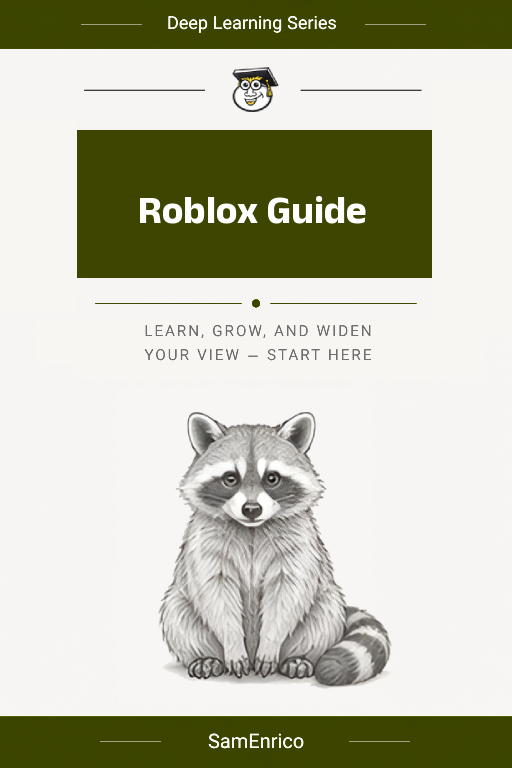
Roblox Guide eBook
Explore creator community hiring, gaming culture,
by Negron Dung
Explore creator community hiring, gaming culture, and developer relations for user-generated content.
Formats
Free sample
Chapter 1: The Permissionless Door--The most dangerous word in the Roblox ecosystem isn't a swear word filtered by the chat bot. It isn't "hack" or "exploit" or even "bypass." The most dangerous word is actually a question, and it's the first question every aspiring creator asks themselves when they open Roblox Studio for the very first time."Can I?"Can I build a game that competes with the ones on the front page? Can I make money doing this? Can I, a fourteen-year-old with no degree, no funding, and no industry connections, actually turn this hobby into something real? That question, innocent as it sounds, carries an invisible weight—the weight of every adult who has ever told you that video games are a waste of time, that you should focus on school, that you need a "real job." The weight of every failed project you've started and abandoned.
The weight of the algorithm that favors established studios with marketing budgets over solo developers building in their bedrooms.This book exists to replace that question with a different one. Not "Can I?" but "How do I?"Because here is the truth that the bestselling Roblox guides won't tell you, the truth that separates the creators who cash out their Dev Ex for the first time from the ones who quit after their game gets twelve visits: Roblox is not a game development platform. It is a permissionless economy disguised as a game development platform.Understanding that sentence is the difference between building a hobby and building a career.The Great Misunderstanding Let’s start with a clarification that will annoy some people and liberate others. Roblox is not a game. You have heard this before, perhaps in a You Tube video essay or a conference keynote, but you have likely dismissed it as philosophical wordplay.
It is not. It is a structural reality that dictates every design decision, every hiring choice, and every monetization strategy that actually works.A game has a beginning, a middle, and an end. Super Mario Bros. has World 1-1 and a flagpole. The Legend of Zelda has a dungeon, a boss key, and a credits sequence.
Even massive open-world games like Grand Theft Auto have a final mission, a point after which the story resolves and the player is left to wander a completed world.Roblox has none of this. Not because Roblox games are unfinished—many are exquisitely crafted—but because the platform itself is architected around a different unit of value. The unit of value on Roblox is not the completed level or the defeated boss. The unit of value is the concurrent user minute. Every time a player chooses to spend sixty seconds inside your experience instead of someone else's, you accrue a tiny fraction of attention that can, if you know what you're doing, be converted into Robux, and then into dollars, and then into rent money, college tuition, or a down payment on a car.This shifts the goalposts dramatically.
If you are building a traditional game, your success metric is completion rate. What percentage of players saw the credits? If you are building a Roblox experience, your success metric is retention. What percentage of players who joined yesterday are still playing today? And next week?
And next month?The developers of Adopt Me! understood this before anyone else. When they launched their game in 2017, it was a simple baby-sitting simulator. You picked up a virtual infant, fed it, changed its diaper, put it to bed. That was it.
By traditional game design standards, this was not a game at all. There were no levels, no bosses, no win condition. And yet, within two years, Adopt Me! was generating hundreds of millions of Robux monthly and pulling concurrent user counts that made traditional MMOs look like ghost towns.What did they understand that everyone else missed? They understood that players don't want to win.
They want to belong.The Experience Economy, Explained Badly (Then Well)In 1999, business strategists Joseph Pine and James Gilmore published a book called The Experience Economy. Their argument was simple but, at the time, radical. They proposed that economic value has evolved through four stages. First came commodities—raw materials like grain or coal. Then came goods—manufactured products like bread or steel beams.
Then came services—activities performed for you, like lawn mowing or tax preparation. And finally, emerging at the end of the twentieth century, came experiences—memorable events that engage the customer in a personal way.Pine and Gilmore gave the example of a birthday cake. A commodity is the flour and sugar. A good is the cake mix in a box. A service is the bakery that bakes the cake for you.
An experience is throwing a birthday party where the cake is presented with candles and singing.Roblox has made the experience economy scalable in ways that Pine and Gilmore never imagined. Every successful Roblox game is not selling you a commodity (polygons), a good (a finished level), or even a service (matchmaking). It is selling you an experience—and more specifically, it is selling you the memory of an experience that you will want to repeat.Take Brookhaven RP. Objectively, there is almost nothing to do in that game. You spawn in a house.
You can walk to a car dealership and buy a virtual vehicle. You can drive to a furniture store and redecorate your living room. You can stand in the town square and type messages to strangers. That is the entire feature set. By any traditional metric, Brookhaven RP should have died within weeks of its launch.Instead, it became the most visited game on Roblox for two consecutive years.Why?
Because Brookhaven RP is not a game. It is a stage. The players are the actors. The chat box is the script. Every session produces a unique, un-replicable social story—the time someone roleplayed as your long-lost sibling, the impromptu wedding in the park, the argument over who scratched whose virtual car.
These are not game mechanics. These are memories. And memories drive retention better than any progression system ever invented.This is the Experience Economy Crash Course: On Roblox, you are not a game developer. You are a memory manufacturer. Your product is not levels or loot or leaderboards.
Your product is the feeling players get when they tell their friends, "You should have been there last night."The Gen Z Expectation Stack If you are over the age of twenty-five, you likely grew up with a specific relationship to video games. You inserted a cartridge or a disc. You pressed Start. You navigated a menu. You played through levels designed by professionals in a studio far away.
You reached an ending. You put the game back on the shelf. This was a consumer relationship—you consumed what others created.The generation born after 2010 has never known that world. They grew up with i Pads in their cribs, with You Tube tutorials teaching them how to mod Minecraft before they could tie their shoes, with Roblox Studio installed alongside Tik Tok and Discord. For them, the boundary between "playing a game" and "creating a game" is not…
This is the end of the free sample. Get the eBook to keep going. Buy now
About this book
Details
- Author
- Negron Dung
- Publisher
- SamEnrico
- Language
- English
- Genre
- Non-Fiction, Strategic Atlas, Talent Intelligence
- Released
- 2026-05-29
- Pages (approx.)
- 137
- Available as
- eBook, Audiobook

Read better in the ZLOADR app
Your eBooks on your phone or tablet. Sign in with your SamEnrico account and start reading.
More by Negron Dung
 Conversation Confidence CourseNegron Dung$11.99
 The Laureate's WorkshopNegron Dung$11.99
 Pay to Win Spending HabitsNegron Dung$11.99
 The Micromanagement Anger GuideNegron Dung$11.99
 Parent Guide Gaming AddictionNegron Dung$11.99
 The Sun King's Grandeur: Versailles and the Art of Absolute PowerNegron Dung$11.99
 Understanding Pulmonary Veno-occlusive DiseaseNegron Dung$17.99Understanding Pulmonary Veno-occlusive DiseaseNegron Dung$17.99
 Flight EngineerNegron Dung$11.99
 Print Advertising One Page PlanNegron Dung$12.99
 How to Start a Ornamentation Fitting Work Business (Beginners Guide)Negron Dung$11.99
You may also like
 Zapier GuideGallardo Alica$12.99
 Toast GuidePacheco Lorina$12.99
 Stripe Early Talent GuideHendrick Santo$12.99
 SpaceX Hiring GuideObryan Kyung$12.99
 Snap GuidePeak Berenice$12.99
 Salesforce GuideCuster Cruz$12.99
 Rippling GuideMcinnis Josefine$12.99
 Reddit GuideHolton Danyelle$12.99
 Pinterest GuideLindgren Solange$12.99
 Palantir GuideBarrera Shonda$12.99
 OpenAI GuideFay Zack$12.99
 Nvidia GuideOtero Michiko$12.99