
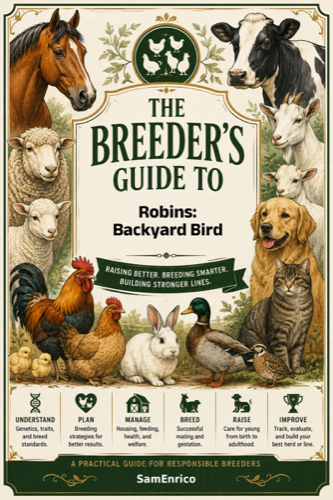
Non-FictionInformativeEducational
Robins: Backyard Bird eBook
This wildlife publication, published by SamEnrico,
by Spear Pilar
This wildlife publication, published by SamEnrico, covers Robins: Backyard Bird
Formats
Free sample
Chapter 1: The Parking Lot Portal...--–- It begins, as so many unexpected things do, in a place you would never think to look. Not in a cathedral of old-growth forest, not on a pristine mountain trail, not beside a rushing stream in a national park. No, the transformation I am about to offer you—the shift from seeing to truly noticing—starts in a strip mall parking lot. Specifically, the one with the discount grocery store on the left, the nail salon with the flickering sign, and the teenager vaping outside the dollar store. That parking lot.
The one with cracked asphalt, a single exhausted maple tree growing through a concrete island, and a puddle of something that might be rainwater or might be old soda. That is where the robin will find you. Or, more accurately, that is where you will finally see the robin.I remember exactly when it happened to me. I was walking back to my car, arms full of grocery bags, mentally calculating how many emails I could answer before dinner. A robin landed on the hood of a parked sedan.
Not a picturesque branch, not a dewy morning lawn. A sedan. Beige. Slightly dented. The robin tilted its head, looked at its own reflection in the windshield, and then—with what I can only describe as calculated indifference—plucked a french fry from the gutter and flew off.
In that moment, I realized something that has haunted me ever since: I had seen ten thousand robins in my life, but I had never actually watched one.That is the purpose of this book. Not to turn you into an ornithologist with a hundred-thousand-dollar spotting scope and a field notebook full of Latin binomials. But to do something far more radical: to convince you that the bird you have dismissed as common, ordinary, background noise is, in fact, one of the most remarkable creatures you will ever meet. The American Robin (Turdus migratorius) has been hiding in plain sight your entire life. This book is the key to finally seeing it.The Tyranny of the Ordinary We have a problem with common things.
It is not our fault, exactly; it is the way human brains are wired. We are novelty-seeking creatures, designed to notice what is different, unusual, or potentially dangerous, while filtering out whatever is familiar and safe. This is called habituation, and it is one of the most powerful forces in human perception. The first time you see a robin, if you are a child or a new arrival to North America, it is genuinely remarkable: that red breast! That song!
The way it runs across the lawn and then stops, tilts its head, and stabs the ground like a tiny feathered fencer. But by the hundredth robin, your brain has filed it away. Seen it. Moving on. Nothing to report.This is the tyranny of the ordinary.
The more common something is, the less we see it. And the robin, by any measure, is extraordinarily common. Its population is estimated at 310 million individuals in North America, making it one of the most abundant land birds on the continent. It ranges from the treeline of Alaska and Canada all the way south to Guatemala. It thrives in forests, farms, suburbs, cities, and—yes—strip mall parking lots.
It is so successful, so adaptable, so utterly everywhere, that we have stopped paying attention.Here is the secret that this book will teach you: common does not mean simple. Common does not mean boring. Common does not mean understood. The robin is not ordinary because it is abundant; it is abundant because it is extraordinary. Its success is the result of millions of years of evolutionary refinement, a suite of adaptations so elegant and effective that this single species has conquered an entire continent.
The robin is not the pigeon of the thrush family—it is the masterpiece.A Brief Confession (And a Promise)I should confess something before we go any further. I am not a professional ornithologist. I do not have a Ph D in avian biology. I am, like most of the people who will read this book, simply a person who learned to look. I started where you are now: seeing robins but not watching them.
Then, slowly, over years of patient observation, I began to notice the patterns behind the appearances. I learned that the robin on my lawn in July is not the same robin that was there in April. I learned that the cheerful song has different verses for different occasions. I learned that the nest in my neighbor's downspout was not a random accident but a carefully calculated architectural decision. And I learned that every single one of these discoveries was available to me—and to you—without a research grant, without a field station, without anything more than curiosity and a willingness to sit still.That is the promise of this book.
By the time you finish these twelve chapters, you will never see a robin the same way again. You will be able to identify males from females at a glance, interpret their vocalizations, predict their behavior by season, understand their nesting strategies, and recognize the signs of their hidden lives. You will also, I hope, develop a deeper appreciation for the wildness that persists in our most human-dominated landscapes. The robin is not a visitor to our world; it is a permanent resident, and its world overlaps with ours in ways we are only beginning to understand.Why the Robin? A Gateway Species There is a concept in environmental education called the "gateway species." It refers to a plant or animal that is accessible, engaging, and ecologically rich enough to serve as an entry point into deeper natural history study.
For many people, that gateway is the monarch butterfly—charismatic, endangered, and the subject of dramatic migration stories. For others, it is the hummingbird—tiny, jewel-toned, and seemingly magical. For children growing up near coasts, it might be the horseshoe crab or the sea turtle.But for the vast majority of North Americans—the people who live in suburbs, cities, and suburbanizing rural areas—the ideal gateway species is already in the backyard. It is the robin.Consider the evidence. Robins are diurnal (active during the day), so you do not need special equipment or midnight expeditions to observe them.
They forage on the ground, often in open areas like lawns, parks, and schoolyards, so they are visible without binoculars. They are large enough to see clearly but small enough to feel like wild animals rather than domesticated pests. They have complex, observable behaviors: foraging, singing, nesting, mobbing predators, defending territories, migrating, and flocking. And they are present for most of the year in most of the continent, offering a continuous learning opportunity rather than a brief seasonal glimpse.This means that the robin can teach you everything you need to know to watch any bird. The observational skills you develop while studying robins—patience, attention to detail, pattern recognition, behavioral interpretation—transfer directly to warblers, hawks, herons, and hummingbirds.
If you can learn to truly see the common bird on your lawn, you can learn to see any bird…
This is the end of the free sample. Get the eBook to keep going. Buy now
About this book
Details
- Author
- Spear Pilar
- Publisher
- SamEnrico
- Language
- English
- Genre
- Non-Fiction, Informative, Educational
- Released
- 2026-06-02
- Pages (approx.)
- 141
- Available as
- eBook, Audiobook

Read better in the ZLOADR app
Your eBooks on your phone or tablet. Sign in with your SamEnrico account and start reading.
More by Spear Pilar
 Truck Driver Nap GuideSpear Pilar$11.99
 Team Brainstorming Workshop GuideSpear Pilar$11.99
 EQ For Engineers GuideSpear Pilar$11.99
 Aerospace and Defense MultiplesSpear Pilar$11.99
 Bite Mark PhotographySpear Pilar$11.99
 Ramadan Student LifeSpear Pilar$11.99
 Craniosacral TherapySpear Pilar$11.99
 Panic Attack Hypnosis GuideSpear Pilar$11.99
 Jörmungandr and the Jade Serpent: A Norse-Dragon’s LamentSpear Pilar$11.99
 Galahad’s Lost Grail: The Knight’s Forbidden RevelationSpear Pilar$11.99
 How to Become a Salvage EngineerSpear Pilar$11.99
 A Collector's Handbook to the Volkswagen Type 1 Karmann-ghia CoupèSpear Pilar$11.99
You may also like
 Hong Kong Handover 1997Dunn Johnnie$11.99
 Zumba For Postnatal Recovery CourseNeal Christian$11.99
 Zumba for BeginnersLadner Nikia$11.99
 YouTube Comment Mining GuideHumes Pandora$12.99
 Worry Box MeditationCarlin Rudy$11.99
 Workplace Stress MeditationNguyen Lynn$11.99
 Workplace Stress and Sleep RepairHawley Ivory$11.99
 Workplace Perfectionism CureDelaney Jeffry$11.99
 Workplace Injustice Anger GuideWallen Isabelle$11.99
 Work Addiction and Burnout LinkGreenwood Ester$11.99
 Women in Yoga and WellnessBeattie Galina$11.99
 Women in Stand Up ComedyChun Evangeline$11.99