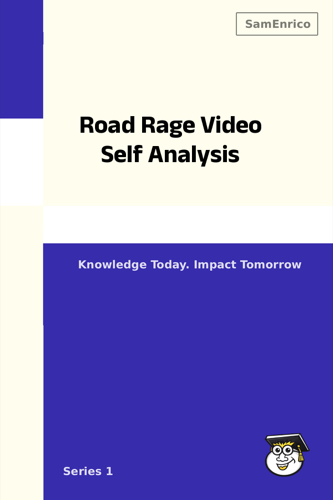
Road Rage Video Self Analysis eBook
Teaches using dashcam footage to review angry reac
Teaches using dashcam footage to review angry reactions and improve.
Formats
Free sample
Chapter 1: The Metal Cocoon--–- You are not the same person behind the wheel that you are at the dinner table. This is not a moral failing. It is a neurological fact, a mechanical inevitability, and—if you are reading this book—it is also the single most important thing you will ever learn about yourself. Before we analyze a single second of dashcam footage, before we install a driver-facing camera or complete a single video exercise, we must first understand the creature that climbs into the driver's seat every morning. That creature is not entirely human.
It is a cyborg.The word conjures science fiction: chrome plating, glowing eyes, the cold hiss of hydraulics. But the real cyborg is far more mundane and far more terrifying. You are a cyborg whenever you extend your nervous system beyond the boundaries of your skin. A person using a cane becomes a cyborg—the cane transmits tactile information about the ground directly to the brain's motor cortex. A musician playing a violin becomes a cyborg—the instrument becomes an extension of the emotional voice.
And a driver operating a two-ton vehicle becomes a cyborg the moment the engine turns over. The steering wheel is not a tool you hold. It is a hand you have grown. The accelerator pedal is not a lever you press. It is an intention you express.
The car's body is not a container you sit inside. It is a new skin, and when another driver violates the space around that skin, your brain registers a physical assault.This is not metaphor. This is neuroscience. When you drive, your brain's peripersonal space—the bubble of safety immediately surrounding your body—expands to include the car's dimensions. Studies using functional magnetic resonance imaging (f MRI) have shown that the same neural circuits that fire when someone approaches your physical body with a threatening gesture also fire when another vehicle merges too closely into your lane.
Your brain does not distinguish between a fist aimed at your face and a bumper aimed at your quarter panel. Both are attacks. Both demand a response. And that response, more often than not, is rage.But here is the paradox that this entire book exists to resolve: you did not feel that rage as an attack on your car. You felt it as an attack on you.
The other driver did not cut off a vehicle. They cut off you. They did not brake-check a hunk of metal. They disrespected you. This is the cyborg's gift to the angry driver: the seamless merging of machine and selfhood such that every traffic violation becomes a personal insult.
And because it feels personal, you retaliate as if it were personal. You honk. You tailgate. You swerve. You roll down the window and scream words you would never say to a stranger's face on a sidewalk.
You follow. You escalate. You become, in the space of seconds, a person your loved ones would not recognize.The goal of this chapter is not to shame you for that transformation. Shame is a poor teacher. The goal is to name the transformation so that you can begin to see it happening in real time.
You cannot interrupt a process you do not know is occurring. Most drivers experience road rage as a sudden explosion—a bolt from the blue, a loss of control that seems to come from nowhere. But the cyborg framework reveals the truth: the explosion is not sudden at all. It is the predictable end point of a sequence that begins the moment you fasten your seatbelt. By understanding that sequence frame by frame, you will learn to see the cyborg for what it is: a version of yourself with different rules, different reflexes, and different vulnerabilities.
And once you can see it, you can begin to drive it.The Three Layers of the Driving Cyborg To understand why your behavior behind the wheel diverges so dramatically from your behavior anywhere else, we must disassemble the driving cyborg into its three constituent layers. Each layer builds upon the last, and each layer introduces a distortion that makes rage more likely, more intense, and more justified in your own mind.Layer One: The Mechanical Extension. This is the most basic level of cyborg integration. Your hands on the steering wheel, your foot on the pedal, your eyes scanning through a windshield rather than directly observing the world. At this layer, the car is simply a tool—albeit a tool that has become so familiar that you no longer consciously operate it.
Think about the last time you drove a familiar route. You arrived at your destination with almost no memory of the intervening turns, stops, and accelerations. That is mechanical extension: the car has become so transparent to your intentions that you no longer perceive it as separate from yourself. This transparency is efficient for normal driving but dangerous for anger management. When the car is invisible to your awareness, so too is the way it changes your behavior.Layer Two: The Protective Barrier.
The car surrounds you with steel, glass, and soundproofing. This barrier serves an obvious physical function—it keeps you safe in a collision—but it also serves a profound psychological function. It anonymizes you. The other driver cannot see your face clearly. They cannot hear your voice unless you roll down the window.
They cannot know your name, your profession, your history of heart disease, or the fact that you are rushing home to a crying child. This anonymity is a release from the normal constraints of social behavior. In person, you do not scream at strangers because you can see their eyes widen, because you can feel the weight of their humanity, because you know there might be consequences. Behind the protective barrier of the car, those constraints vanish. The other driver is no longer a person.
They are a problem.Layer Three: The Amplified Self. This is the most insidious layer of the driving cyborg. The car does not just protect you from the world; it amplifies your intentions into the world. You think "go faster," and the car lunges forward with a hundred or more horsepower. You think "move over," and the car swerves with a violence that would be impossible on foot.
You feel a flash of annoyance at a slow driver, and within seconds you have tailgated them at seventy miles per hour. The car takes your small, private emotions and broadcasts them as public, dangerous actions. This amplification creates a feedback loop: the more your emotions become actions, the more those actions justify further emotion. You tailgate because you are angry, and you become angrier because you are tailgating. The cyborg feeds on itself.Together, these three layers explain the central mystery of road rage.
You are not a bad person who becomes a monster behind the wheel. You are a normal person who temporarily becomes a cyborg—and the cyborg is wired for aggression. The remainder of this chapter will explore each layer in depth, providing the conceptual foundation for every video exercise in the chapters to come. Do not skip this foundation. The dashcam footage…
This is the end of the free sample. Get the eBook to keep going. Buy now
About this book
Details
- Author
- Ainsworth Francine
- Publisher
- SamEnrico
- Language
- English
- Genre
- Non-Fiction, Self-Help, Self-Awareness
- Released
- 2026-06-12
- Pages (approx.)
- 151
- Available as
- eBook, Audiobook

Read better in the ZLOADR app
Your eBooks on your phone or tablet. Sign in with your SamEnrico account and start reading.
More by Ainsworth Francine
 The Parent Death Work LeaveAinsworth Francine$11.99
 Hypnosis for Quitting SmokingAinsworth Francine$11.99
 Child Microbiome NutritionAinsworth Francine$11.99
 Elizabeth I Poor Laws Social GovernanceAinsworth Francine$11.99
 Whispers of the Last Wild: The Secret Life of the VaquitaAinsworth Francine$11.99
 Rhythm of the Stars: How Ancient Instruments Shaped the CosmosAinsworth Francine$11.99
 Understanding B-cell LymphomasAinsworth Francine$17.99
 Automated Ledgers and Cash Flow CourseAinsworth Francine$12.99
 Payment Gateways for African MerchantsAinsworth Francine$12.99
 Ion Implantation TechnicianAinsworth Francine$11.99
 How to Start a Power-driven Planers Business (Beginners Guide)Ainsworth Francine$11.99