
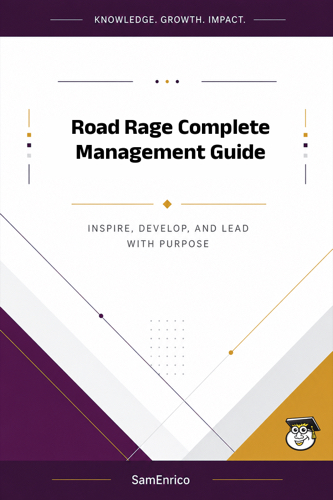
Road Rage Complete Management Guide eBook
Comprehensive strategies for all driving anger sce
by Dumas Ciera
Comprehensive strategies for all driving anger scenarios.
Formats
Free sample
Chapter 1: The Rage Spectrum--–- The first time Maria punched her steering wheel, she was sitting in standstill traffic on a 95-degree July afternoon. Her two children were in the backseat, fighting over a tablet. She had been late to pick them up from camp, which meant she would be late to her own meeting, which meant her already-frustrated boss would be even more frustrated. The car in front of her had let three cars merge from a side street. Three.
Maria felt something rise from her stomach into her throat—hot, fast, and completely undeniable. She slammed her palm against the horn, held it for four seconds, and screamed, “What is wrong with you?” Her seven-year-old went silent. Her nine-year-old started crying. Maria didn’t remember making the decision to honk or scream. It just happened.
Later that night, lying in bed, she felt shame settle over her like a wet blanket. I’m not that person, she told herself. But she was. At least in that moment, she was.Maria is not a monster. She is not a criminal.
She is not a bad mother or a dangerous driver in her daily life. But Maria has a road rage problem. And so do millions of people who would never describe themselves as “angry people.”This book begins with a simple but uncomfortable truth: road rage is not a binary condition. You do not either “have it” or “not have it.” Road rage exists on a spectrum, and most drivers occupy some point on that spectrum whether they recognize it or not. The quiet driver who silently fumes but never honks is on the spectrum.
The parent who mutters curses under their breath while their kids listen is on the spectrum. The driver who tailgates “just to send a message” is on the spectrum. And the driver who has never once raised their voice but feels their heart race and their jaw clench when someone cuts them off? Also on the spectrum.The purpose of this chapter is to help you see where you fall on that spectrum. Not to shame you.
Not to diagnose you with a disorder. But to give you an honest starting point. Because you cannot change what you will not acknowledge.The Difference Between Aggressive Driving and Road Rage Before we go any further, we need to establish a critical distinction that law enforcement, insurance companies, and mental health professionals all agree upon. There is a meaningful difference between aggressive driving and road rage, and confusing the two has led to a great deal of misunderstanding about who needs what kind of help.Aggressive driving is a behavioral pattern. It refers to the operation of a vehicle in a way that endangers others.
Speeding, tailgating, unsafe lane changes, running red lights, failing to yield, and weaving through traffic are all examples of aggressive driving. These are traffic violations. They are dangerous, they cause accidents, and they can result in fines, license suspension, or even jail time if they lead to injury or death. But aggressive driving does not necessarily involve intent to harm another person. The aggressive driver is typically focused on their own goal—getting somewhere faster, escaping a perceived delay, or satisfying an internal sense of urgency.
The other drivers on the road are obstacles, not targets.Road rage, by contrast, is a criminal act involving intent to harm. Road rage occurs when a driver uses their vehicle or an object in their possession to threaten, intimidate, or injure another person. This includes ramming another vehicle, forcing another driver off the road, brandishing a weapon, throwing objects, exiting the vehicle to confront someone physically, or making explicit threats of violence. Road rage is not a traffic violation; it is assault, battery, or worse. In recent years, road rage shootings have increased dramatically across the United States.
According to data from Everytown for Research and Policy, at least 141 people were shot and killed in road rage incidents in 2023 alone, and hundreds more were injured.Here is what makes this distinction tricky: aggressive driving can escalate into road rage in a matter of seconds. A driver who is tailgating aggressively might become enraged when the driver in front of them brakes. That enraged driver might then pull alongside and scream, which is still aggressive driving. But if that same driver then swerves into the other lane to block the vehicle, or throws a coffee cup, or follows the other driver to their destination, they have crossed the line into road rage. The behavior has shifted from reckless to criminal.Most people who will read this book are not road ragers in the criminal sense.
They have never intentionally rammed another vehicle or brandished a weapon. They are not a danger to society in the way that phrase implies. But they are drivers who experience intense anger behind the wheel, and that anger frequently leads to aggressive driving behaviors that put themselves and others at risk. They are drivers like Maria—people who are ashamed of their behavior but feel powerless to stop it in the moment.This book is written for those drivers. If you have ever frightened yourself with your own reaction to a traffic situation, this book is for you.
If you have ever said “I don’t know what came over me” after a driving incident, this book is for you. If you have ever had a passenger tell you that they feel unsafe when you drive, this book is for you.The Four Driving Personalities: A First Look Throughout this book, we will refer to a framework called the Four Driving Personalities. This framework was developed through decades of clinical observation of drivers who sought help for anger behind the wheel. While every person is unique, patterns emerge, and those patterns point to different underlying mechanisms and different solutions.Before we introduce the full assessment that will help you identify your primary personality, let me give you a brief overview of each type. As you read these descriptions, resist the urge to immediately label yourself.
We will do a systematic assessment later in this chapter. For now, simply notice which descriptions feel familiar.The Volcano The Volcano driver is explosive, reactive, and short-fused. Their anger comes on suddenly and burns hot. They are the driver who honks the millisecond the light turns green, who screams at other drivers with their windows down, who makes aggressive gestures, and who feels a powerful urge to retaliate when they have been wronged. Volcanos often feel intense shame after an episode and genuinely do not understand why they lost control.
They may apologize to passengers or even to other drivers. But the pattern repeats because the Volcano is not addressing the underlying physiological and cognitive mechanisms that trigger their explosions. For the Volcano, the primary intervention is learning to interrupt the Amygdala Hijack before it reaches full force. Chapter 5, the 3-Second Pause Protocol, was designed specifically for the Volcano driver.The Hot Spring The Hot Spring driver is silent but seething. They do not scream or gesture.
They do not honk. On the surface, they appear calm. But beneath the surface, resentment builds constantly. The Hot Spring…
This is the end of the free sample. Get the eBook to keep going. Buy now
About this book
Details
- Author
- Dumas Ciera
- Publisher
- SamEnrico
- Language
- English
- Genre
- Non-Fiction, Self-Help, Complete
- Released
- 2026-06-11
- Pages (approx.)
- 150
- Available as
- eBook, Audiobook

Read better in the ZLOADR app
Your eBooks on your phone or tablet. Sign in with your SamEnrico account and start reading.
More by Dumas Ciera
 Retirement Asset Basis GuideDumas Ciera$11.99
 Nicotine Detox Meal PlanDumas Ciera$11.99
 Diamond District Security UpgradeDumas Ciera$11.99
 Facilitating Creative ConflictDumas Ciera$11.99
 Benzo Recovery and TinnitusDumas Ciera$11.99
 Mnemonic Peg Lists HandbookDumas Ciera$11.99
 Chasteberry For PMS ReliefDumas Ciera$11.99
 Pediatric RLS ManagementDumas Ciera$11.99
 The Vanishing of Amelia Earhart: The Lost TransmissionDumas Ciera$11.99
 The Last Voyage of the Nautilus: Jules Verne's Unseen BlueprintDumas Ciera$11.99
 The Hammer of the Scots: Robert the Bruce and the Birth of a NationDumas Ciera$11.99
 The Dancer's Guide to Jove Malaj MomeDumas Ciera$11.99
You may also like
 Hong Kong Handover 1997Dunn Johnnie$11.99
 Zumba For Postnatal Recovery CourseNeal Christian$11.99
 Zumba for BeginnersLadner Nikia$11.99
 YouTube Comment Mining GuideHumes Pandora$12.99
 Worry Box MeditationCarlin Rudy$11.99
 Workplace Stress MeditationNguyen Lynn$11.99
 Workplace Stress and Sleep RepairHawley Ivory$11.99
 Workplace Perfectionism CureDelaney Jeffry$11.99
 Workplace Injustice Anger GuideWallen Isabelle$11.99
 Work Addiction and Burnout LinkGreenwood Ester$11.99
 Women in Yoga and WellnessBeattie Galina$11.99
 Women in Stand Up ComedyChun Evangeline$11.99