
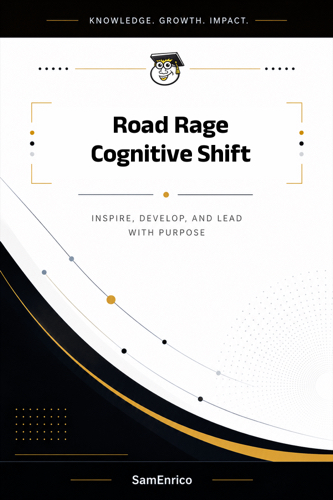
Road Rage Cognitive Shift eBook
Reframes traffic incidents as neutral events.
by Hale Shaun
Reframes traffic incidents as neutral events.
Formats
Free sample
Chapter 1: The Coffee Shop Test--–- Would you scream at a stranger in a coffee shop? Of course not. You would be mortified. You would apologize profusely if you even accidentally bumped their table. You would never look them in the eye and shout, “What is wrong with you?” over a latte.
And yet, behind the wheel of a car, you have likely done something far worse to a complete human being you have never met and will never see again. You have cursed at them. You have gestured at them. You have tailgated them. You have honked at them for the crime of hesitating at a green light for 0.7 seconds.
You have, perhaps, rolled down your window and unleashed a vocabulary your grandmother would disown you for. And here is the question that this entire book exists to answer: Why? What changes between the coffee shop and the driver’s seat? The person inside the car is the same. Their capacity for patience is the same.
Their moral compass has not suddenly malfunctioned. And yet, behind the wheel, perfectly reasonable, kind, empathetic people transform into vigilantes, prosecutors, and, occasionally, monsters. This chapter reveals the single most important psychological mechanism behind road rage—and introduces the first cognitive shift that will begin to dismantle it.The Anonymity Experiment Imagine the following scenario. You are waiting in line at a busy coffee shop. It is morning.
You are running late. The line is moving slowly because the person at the front—a middle-aged man in a gray jacket—cannot decide what to order. He stares at the menu. He asks the barista about the oat milk. He changes his mind twice.
Thirty seconds pass. Forty-five. A minute. Now, ask yourself honestly: what do you do? Do you scream at him?
Do you shout, “Move it, grandpa!” Do you lean around the person in front of you and make an obscene gesture? Of course not. You might sigh. You might shift your weight from one foot to the other. You might, if you are particularly frustrated, make eye contact with another waiting customer and exchange a silent, “Can you believe this?” look.
But you would not escalate to open hostility. The social consequences are too high. The man in the gray jacket is right there. He can see you. He can hear you.
He could turn around and say something back. He could, in theory, follow you to your car. The proximity and visibility of the other person enforce a basic level of civility. You are not a saint. You are just socially constrained.Now, change the scenario.
You are driving to work. The same man—the same middle-aged man in the same gray jacket—is now in a blue sedan in front of you. The light turns green. He hesitates. One second passes.
Two seconds. You do not see his face. You do not see his eyes. You do not know if he is looking at his phone, searching for a dropped french fry, or having a sudden medical emergency. All you see is the back of a blue box that refuses to move.
And what do you do now? If you are like most drivers, you honk. Not a gentle tap. A honk. The kind of honk that says, “I am here, and I am angry, and you are an idiot.” Maybe you add a gesture.
Maybe you mouth something. Maybe, if you are truly having a bad day, you swerve around him and glare as you pass. What changed? The man did not change. His hesitation did not change.
The only thing that changed was anonymity. In the coffee shop, you could see him, and he could see you. In the car, you cannot see him, and he cannot see you. You are each sealed inside a metal box that removes every social feedback loop that keeps human beings civilized.This is called deindividuation—the psychological state in which an individual loses their sense of personal identity and moral restraint within a context that provides anonymity. The term was coined by social psychologists in the 1970s, but the phenomenon is as old as human civilization.
Put on a uniform, a mask, or a hood, and people will do things they would never do with their name tag visible. Roll up the windows of a car, and the same principle applies. The vehicle is not just transportation. It is a disguise. It is a mask made of sheet metal and tinted glass.
And when you are disguised, you are capable of behavior that would shame you in any other context.The Man in the Blue Sedan There is a name for the man in the blue sedan. Let us call him Dave. Dave is fifty-three years old. He has two children, one of whom is going through a difficult divorce. He has a mortgage he worries about.
He has a chronic back condition that flares up in cold weather. He did not sleep well last night because his dog is sick. He is on his way to pick up a prescription for his wife, who has been fighting a sinus infection for two weeks. Dave is not a villain. Dave is not an enemy.
Dave is a tired, distracted, overwhelmed human being who, at the precise moment the light turned green, was looking down at his phone because his daughter texted him that she might need to move back home. Dave hesitated at the green light because Dave has a life that is falling apart in slow motion.You do not know any of this when you honk at him. You see a blue sedan. You see an obstacle. You see a symbol of incompetence or selfishness.
You do not see Dave. And because you do not see Dave, you feel nothing when you punish him for his hesitation. Your horn is not a safety tool in that moment. It is a weapon of anonymous judgment. And here is the uncomfortable truth: you have been Dave.
You have hesitated at a green light because your mind was elsewhere. You have drifted out of your lane because you were reaching for a water bottle. You have merged poorly because you were stressed about a work deadline. In those moments, were you a bad person? Were you trying to ruin someone’s day?
No. You were just a human being, operating a complex machine, while simultaneously managing the thousand tiny catastrophes of daily life. But when you are the one hesitating, you expect grace. When someone else hesitates, you deliver punishment. This asymmetry is the engine of road rage.The Symbol, Not the Person The cognitive shift that begins in this chapter—and that will be reinforced throughout this book—is deceptively simple: you are not angry at a person.
You are angry at a symbol. The blue sedan is not Dave. The SUV that cut you off is not a malicious adversary. The minivan crawling through the intersection is not a personal insult directed at you and your schedule. These are vehicles piloted by flawed, distracted, exhausted human beings who are, in the vast majority of cases, not thinking about you…
This is the end of the free sample. Get the eBook to keep going. Buy now
About this book
Details
- Author
- Hale Shaun
- Publisher
- SamEnrico
- Language
- English
- Genre
- Non-Fiction, Self-Help, Road Rage
- Released
- 2026-06-06
- Pages (approx.)
- 115
- Available as
- eBook, Audiobook

Read better in the ZLOADR app
Your eBooks on your phone or tablet. Sign in with your SamEnrico account and start reading.
More by Hale Shaun
 Creative Professional Self EsteemHale Shaun$11.99
 Restless Leg Syndrome Antidepressant ManagementHale Shaun$11.99
 Anger Management for First RespondersHale Shaun$11.99
 Healthcare Burnout PreventionHale Shaun$11.99
 Coen Brothers QuirkHale Shaun$11.99
 Female Rulers Alliance Management CourseHale Shaun$11.99
 Multi Tool and Gear Selection GuideHale Shaun$11.99
 Cash Flow for Wedding PlanningHale Shaun$11.99
 The Last Stand of the Iron Queen: A Siege in the SkyHale Shaun$11.99
 Silent Exodus: The Lost Colony of Roanoke’s Final WhispersHale Shaun$11.99
 The Quantum Leap: How a 1970s Math Puzzle Predicted the Future of AIHale Shaun$11.99
 Ultimate Handbook Guide to Kerman : (Iran) Travel GuideHale Shaun$11.99
You may also like
 Hong Kong Handover 1997Dunn Johnnie$11.99
 Zumba For Postnatal Recovery CourseNeal Christian$11.99
 Zumba for BeginnersLadner Nikia$11.99
 YouTube Comment Mining GuideHumes Pandora$12.99
 Worry Box MeditationCarlin Rudy$11.99
 Workplace Stress MeditationNguyen Lynn$11.99
 Workplace Stress and Sleep RepairHawley Ivory$11.99
 Workplace Perfectionism CureDelaney Jeffry$11.99
 Workplace Injustice Anger GuideWallen Isabelle$11.99
 Work Addiction and Burnout LinkGreenwood Ester$11.99
 Women in Yoga and WellnessBeattie Galina$11.99
 Women in Stand Up ComedyChun Evangeline$11.99