
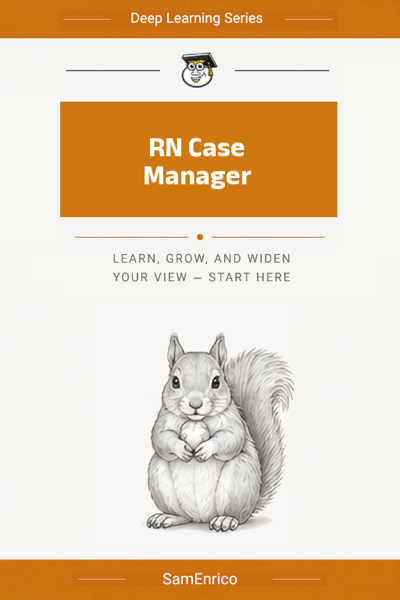
RN Case Manager eBook
A Coursebook on RN Case Manager
by Arce Jenifer
A Coursebook on RN Case Manager
Formats
Free sample
Chapter 1: The Hidden Epidemic...--–- The call came in at 7:43 AM on a Tuesday, just as Marlene Thompson, RN, was pouring her second cup of coffee. "Bed 4, Med/Surg. Mrs. Helen Foster, 78 years old, heart failure exacerbation, possible discharge today." The voice on the other end was the hospitalist's resident, efficient and rushed. Marlene scribbled the room number on a sticky note, took a breath, and walked toward the elevator.
She had been a bedside nurse for 17 years before transferring to case management six months ago. She thought she knew what she was getting into. She was wrong.The elevator doors opened on the third floor. Marlene stepped out and immediately saw the problem. Mrs.
Foster's daughter – a woman in her early fifties with dark circles under her eyes and a cardboard suitcase at her feet – was standing at the nurses' station, her voice rising with each syllable. "You're telling me my mother has to leave today? She can't even walk to the bathroom by herself. I work full-time. I have two kids.
I live in a third-floor walk-up. Where exactly is she supposed to go?"The charge nurse, a veteran named Diane who had seen everything, was doing that thing nurses do when they have no answer: nodding sympathetically while typing. Marlene stepped forward. "I'm the case manager. Let's talk."That conversation – the one Marlene had with Helen Foster and her daughter that Tuesday morning – is happening in every hospital in America, every hour of every day.
It is the hidden epidemic of modern healthcare: the silent, grinding crisis of patients caught between a system designed for acute emergencies and a reality that demands longitudinal care. And sitting at the exact center of that crisis, holding the only compass that points toward a solution, is the RN case manager.The Invisible Bridge Most people – including most nurses – misunderstand what case management actually is. They think it is paperwork, or discharge planning, or utilization review, or a step away from "real nursing." They could not be more wrong. Case management is the invisible bridge between what medicine does to a patient and what that patient actually needs to survive once the hospital gown comes off. It is the difference between a heart failure patient who returns to the emergency department every 30 days and one who lives independently for another decade.
It is the difference between a diabetic who loses a foot and one who learns to check her own blood sugar. It is, in the most literal sense, the difference between life and the revolving door.This chapter is about why that bridge exists, why it is crumbling, and why RN case managers are the only ones who can rebuild it. To understand the present crisis, you have to understand the past. And to understand the past, you have to go back to a time before DRGs, before managed care, before anyone had ever heard the phrase "value-based purchasing."The Pre-History: Public Health Nurses and the Birth of Coordination The year was 1893. In a crowded tenement on the Lower East Side of Manhattan, a nurse named Lillian Wald founded the Henry Street Settlement.
Her idea was radical: nurses would leave the hospital and go into patients' homes. They would not just treat illness; they would coordinate everything – food, fuel, housing, translation services, even burial funds. Wald understood something that modern healthcare has only recently begun to relearn: medical problems are almost never just medical. A child with asthma needs an apartment without roaches. An elderly woman with a broken hip needs someone to cook her meals.
A factory worker with tuberculosis needs to not go back to the factory.Wald's nurses were the first case managers, though no one called them that. They practiced what later generations would call "public health nursing" or "community health coordination." They kept ledgers of every patient's social circumstances alongside their vital signs. They knew which landlords refused to fix heat and which churches provided free meals. They built relationships with coal deliverymen, school principals, and police precincts. When a patient needed something – medicine, a wheelchair, a translator – the nurse made it happen.For the first half of the 20th century, this model persisted.
Hospitals were places where sick people went to die or recover. But the coordination – the actual management of chronic illness – happened in the community, led by public health nurses funded by charities and local health departments. Then came the 1960s, and everything changed.The Great Unraveling: Medicare, Medicaid, and the Hospital-Centric Model The passage of Medicare and Medicaid in 1965 was a triumph of American social policy. Millions of elderly and poor patients gained access to hospital care for the first time. But the law contained a flaw that would shape case management for decades: it paid for procedures, not coordination.
Hospitals were reimbursed for what they did – surgeries, tests, bed days – not for whether patients got better after discharge.The perverse incentives were immediate and devastating. A hospital made more money by keeping a patient an extra day, even if that day was unnecessary. A hospital made no money at all by sending a nurse to a patient's home to check if the new blood pressure medication was being taken. Coordination – the invisible bridge – had no billing code. So it was abandoned.By the 1970s, American healthcare had become a machine optimized for acute intervention and blind to everything else.
Lengths of stay stretched to two or three weeks for routine procedures. Readmission rates were not measured, let alone penalized. And patients – especially elderly patients with chronic conditions – fell through the cracks by the thousands. They would be discharged with a fistful of prescriptions, no follow-up appointment, and no one to call when the side effects started. Three weeks later, they would be back in the emergency department, sicker than before, and the cycle would begin again.The 1980s: Managed Care and the Birth of Modern Case Management The breaking point came in the early 1980s.
Medicare spending was growing at double-digit rates annually. The government was running out of money. The solution, enacted in 1983, was a radical new payment system called the Prospective Payment System (PPS), built around Diagnosis-Related Groups (DRGs). For the first time, hospitals were paid a fixed amount per diagnosis, regardless of how long the patient stayed. A heart failure patient: a flat fee.
A pneumonia patient: a flat fee. If you discharged the patient in three days, you kept the difference. If the patient stayed for two weeks, you lost money.The effect on hospital behavior was instantaneous and brutal. Lengths of stay plummeted. Discharges that once took weeks now happened in days.
And patients were sicker than ever when they left. The hospital had a new financial incentive: move patients out as fast as possible. But no one had created a system to manage those patients after discharge. The invisible bridge was not just neglected anymore; it was actively demolished.Enter the case manager. In the late 1980s, hospitals realized they needed someone to do the math: which patients could go home today?
Which ones needed a skilled nursing facility (SNF)? How could they document medical necessity to avoid Medicare denials? The first modern…
This is the end of the free sample. Get the eBook to keep going. Buy now
About this book
Details
- Author
- Arce Jenifer
- Publisher
- SamEnrico
- Language
- English
- Genre
- Non-Fiction, Informative, Educational
- Released
- 2026-05-04
- Pages (approx.)
- 120
- Available as
- eBook, Audiobook

Read better in the ZLOADR app
Your eBooks on your phone or tablet. Sign in with your SamEnrico account and start reading.
More by Arce Jenifer
 Mindfulness for Older AdultsArce Jenifer$11.99
 Swimmer Shoulder RehabArce Jenifer$11.99
 NVC Four Step Formula GuideArce Jenifer$11.99
 Cosmetic Toxin PreventionArce Jenifer$11.99
 The Pyramid Builders of the Niger: Unveiling the Lost Architects of NubiaArce Jenifer$11.99
 How to Produce Chips (Snack Food)Arce Jenifer$11.99
 Shea Butter Export to Europe HandbookArce Jenifer$12.99
 How to Start a Exhibition Stand Hire Business (Beginners Guide)Arce Jenifer$11.99