
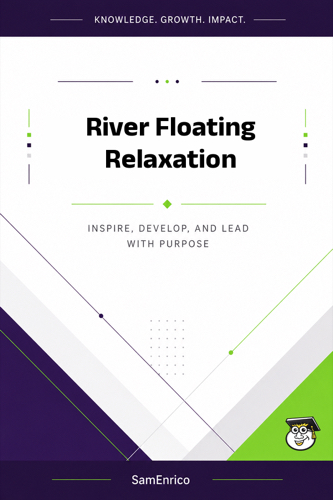
Non-FictionSelf-HelpLetting Go
River Floating Relaxation eBook
Floats down a gentle river, releasing control and
Floats down a gentle river, releasing control and trusting the current.
Formats
Free sample
Chapter 1: The Oars You’re Holding...--You are reading this book because you are exhausted.Not the good kind of exhausted—the kind that comes after a hard day of meaningful work, the kind that ends with a satisfied sigh and a deep sleep. No. You are experiencing the other exhaustion. The low-grade, humming, never-quite-done exhaustion that lives in your jaw, your shoulders, your lower back. The exhaustion that follows you to bed and greets you in the morning before you’ve even opened your eyes.You have tried everything.
You have made lists. You have optimized your morning routine. You have read articles about productivity. You have downloaded apps for meditation, for sleep tracking, for habit stacking, for time blocking. You have tried to be kinder, to be more patient, to let things go—but letting go, you have discovered, is not something you can try to do.
Trying to let go is still holding on.This is the central trap of modern life. And this book exists because someone needs to tell you the truth: the harder you try to control your life, the more your life controls you.Let me show you what I mean.The Paddle That Became an Anchor Imagine you are in a small boat on a river. You have oars in your hands. You have been told, explicitly or implicitly, that good people paddle. They make progress.
They move upstream against the current of entropy, laziness, and failure. They set goals and achieve them. They steer.So you paddle. You paddle hard.But here is what no one told you: the river has a current. It is moving in a direction—not the direction you chose, necessarily, but a direction.
And every time you paddle against that current, you burn energy. Every time you try to force the boat to go exactly where you want it to go, exactly when you want it to get there, your muscles tense. Your shoulders rise toward your ears. Your jaw clenches. Your breath shortens.You are paddling.
But you are not moving forward. You are fighting.After enough hours of this, the oars stop feeling like tools of progress. They start feeling like anchors. You are holding them so tightly that your knuckles are white. You cannot feel your fingers.
You cannot feel the river beneath you because all your attention is on the fight.This is not a metaphor for something else. This is the literal description of how most people live their lives. The oars are your plans, your worries, your shoulds and musts, your carefully constructed timelines, your desperate grip on outcomes you cannot actually control. And the river is everything else—other people, chance events, the passage of time, the weather of your own emotions, the simple fact that life does not obey your schedule.The oars you are holding so tightly? You do not need them.
Not for this river. Not for this journey.But I can hear what you are thinking. You are thinking, “If I let go of the oars, I will drift. I will be lazy. I will fail.
Nothing will get done.”That fear is the subject of this entire book. And it is wrong.The Urge You Were Born With Let us be clear about something from the very beginning. The urge to control is not a character flaw. It is not a sign of weakness or neurosis or moral failure. The urge to control is a survival instinct as ancient as your spine.Your ancestors lived in a world of predators, scarcity, and unpredictable violence.
The ones who survived were the ones who could predict, plan, and manipulate their environment. If you could figure out where the game would migrate, you ate. If you could anticipate the flood, you lived. If you could control the behavior of your tribe members, you were safer. The human brain evolved to seek control because, for most of human history, control meant survival.This is not philosophy.
This is evolutionary biology. Your brain’s default mode network—the system that activates when you are not focused on a task—is constantly scanning for threats, predicting outcomes, and running simulations of the future. It is doing this right now, as you read these words. It is asking: “Is this book worth my time? Will it actually help me?
What if I finish it and nothing changes?”That voice is not your enemy. It is your ancient guardian. It kept your ancestors alive.But here is the problem. You do not live on the savanna anymore. You are not being hunted by lions.
The threats you face are not resolved by tighter grip or more elaborate plans. The modern world is complex, interconnected, and fundamentally unpredictable. The more you try to control it, the more it reveals itself as uncontrollable. And your ancient guardian, doing its ancient job, responds to this revelation by gripping harder.The result is a feedback loop of exhaustion. You feel out of control, so you try harder to control.
Trying harder fails, so you feel more out of control. So you try even harder. Eventually, you are gripping the oars so tightly that your hands cramp, your shoulders burn, and you cannot remember why you got in the boat in the first place.This is where most self-help books make a catastrophic mistake. They tell you to let go. They tell you to surrender.
They tell you to stop caring, stop trying, stop wanting.That advice is not just unhelpful. It is impossible.You cannot decide to stop wanting. You cannot decide to stop caring. You cannot decide to stop the survival instinct that has been honed over millions of years. Telling someone to “just let go” is like telling someone to “just stop breathing.” The urge to control is not a switch you can flip.
It is a river current itself—powerful, ancient, and indifferent to your preferences.So what can you do?You can learn the difference between the urge and the behavior.The urge to control is automatic. It will arise whether you invite it or not. You will feel the impulse to plan, to predict, to grip. That is not your fault. That is your biology.But the behavior—the paddling, the overthinking, the clenched jaw, the sleepless night spent running scenarios through your head—that behavior is learned.
And what is learned can be reshaped.You cannot stop wanting to control. You can stop acting on that want in ways that destroy your peace.This is the first and most important distinction of this book. Write it down if you need to:The urge is automatic. The grip is optional.The Ocean Metaphor That Failed You Before we go any further, I need to address another book you may have read. Perhaps several of them.There is a popular genre of self-help that uses the ocean as a metaphor for life.
You have seen these books. They tell you that life is like the sea—unpredictable, powerful, full of waves. They tell you that you must learn to surf, to ride the waves, to dive under the big ones. They tell you…
This is the end of the free sample. Get the eBook to keep going. Buy now
About this book
Details
- Author
- Coulter Samual
- Publisher
- SamEnrico
- Language
- English
- Genre
- Non-Fiction, Self-Help, Letting Go
- Released
- 2026-06-08
- Pages (approx.)
- 127
- Available as
- eBook, Audiobook

Read better in the ZLOADR app
Your eBooks on your phone or tablet. Sign in with your SamEnrico account and start reading.
More by Coulter Samual
 La Ronde Circle FormatCoulter Samual$11.99
 Vicarious Trauma ApathyCoulter Samual$11.99
 Medical Terminology Memory SystemCoulter Samual$11.99
 Diabetes Care for ElderlyCoulter Samual$11.99
 Five Minute Sleep MeditationCoulter Samual$11.99
 Fear of Failure for SalesCoulter Samual$11.99
 Bioidentical Hormones ExplainedCoulter Samual$11.99
 The Book Smugglers of Sarajevo: How a Secret Library Defied War and Preserved CultureCoulter Samual$11.99
 The Battle of Algiers: Freedom's Hidden Warriors (1956-1962)Coulter Samual$11.99
 How to Produce Vehicle Jumper CablesCoulter Samual$11.99
 How to Start a Anti-roll Bars for Motor Vehicles Business (Beginners Guide)Coulter Samual$11.99
 How to Produce LacquerwareCoulter Samual$11.99
You may also like
 Hong Kong Handover 1997Dunn Johnnie$11.99
 Zumba For Postnatal Recovery CourseNeal Christian$11.99
 Zumba for BeginnersLadner Nikia$11.99
 YouTube Comment Mining GuideHumes Pandora$12.99
 Worry Box MeditationCarlin Rudy$11.99
 Workplace Stress MeditationNguyen Lynn$11.99
 Workplace Stress and Sleep RepairHawley Ivory$11.99
 Workplace Perfectionism CureDelaney Jeffry$11.99
 Workplace Injustice Anger GuideWallen Isabelle$11.99
 Work Addiction and Burnout LinkGreenwood Ester$11.99
 Women in Yoga and WellnessBeattie Galina$11.99
 Women in Stand Up ComedyChun Evangeline$11.99