
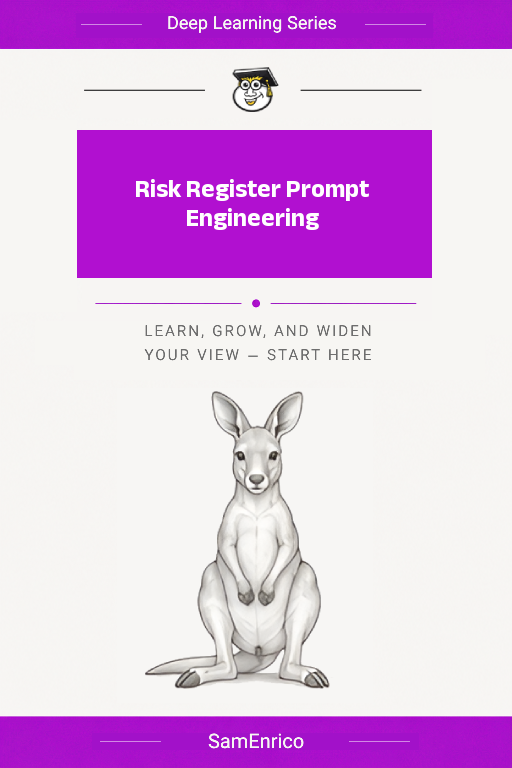
Risk Register Prompt Engineering eBook
Identify project risks, mitigation strategies, and
Identify project risks, mitigation strategies, and ownership assignments using AI prompts that structure risk categories and impact assessments.
Formats
Free sample
Chapter 1: The $100 Million Meeting--–- The conference room was silent. Fifteen executives sat around a polished mahogany table, each holding a 47-page risk register that had taken three months to produce. The project was a fintech launch—a new payments platform meant to disrupt cross-border transfers. Budget: $50 million. Timeline: 18 months.
And every single person in that room believed they had done their due diligence.The risk register was beautiful. Color-coded. Probability scores from 1 to 5. Impact assessments. Mitigation owners.
RACI charts. It had been reviewed by legal, compliance, engineering, product, and an external risk consultant who charged $800 an hour. The team had run three separate brainstorming workshops, each lasting four hours. They had used sticky notes, whiteboards, and sophisticated risk management software. They had followed the PMI framework to the letter.Three months later, the project was dead.Not because of a technical failure.
Not because of budget overrun. Because of a compliance risk that appeared in exactly zero of those 47 rows. The risk was simple: a little-known cross-border data residency regulation that had been updated six months before the project kicked off. The regulation required that all transaction data for certain jurisdictions remain on servers physically located within those borders. The project's architecture assumed a centralized cloud model.
The conflict was total. The fine: $100 million. The project was canceled the day the legal team discovered the conflict.In the post-mortem, the project manager was asked a devastating question: "Why wasn't this risk in your register?"She had no answer. She had done everything right. She had followed every best practice.
And still, she had missed the risk that killed her project.This chapter is about why that happens—and how to make sure it never happens to you.The 40% Problem Let me start with a number that should terrify you: traditional risk identification workshops miss approximately 40% of project threats.This is not an opinion. It is a replicated finding across multiple studies in project management literature. The reasons are not mysterious. They are baked into the way human brains work when sitting in a room with other humans.Groupthink is the first culprit. In any meeting, the loudest voice—or the most senior title—shapes the conversation.
A junior engineer might have a legitimate concern about a database migration, but if the VP of Engineering says "that's not a real risk," the concern evaporates. Not because it was invalid, but because humans are social animals who instinctively align with perceived authority. The risk register becomes a document of organizational politics, not operational reality.Recency bias is the second. Teams tend to focus on risks that occurred on the last project. If the previous launch failed because of a vendor delay, everyone will list vendor risks.
If the last project had a security breach, everyone will list cybersecurity risks. Meanwhile, the novel risk—the one that hasn't happened yet but is statistically likely—gets ignored. The human brain privileges memory over probability.Anchoring is the third. The first risk mentioned in a workshop sets an anchor. If someone says "supplier failure," the next ten risks will all orbit around suppliers.
Other categories—regulatory, human, environmental—never get the same attention. The risk register becomes a narrow document that reflects the first fifteen minutes of conversation, not the full landscape of threats.Optimism bias is the fourth, and perhaps the most dangerous. Teams that have worked together for years develop a shared delusion: "We've handled worse." This is often true for routine risks. But it is catastrophically false for novel risks. The same shared history that enables speed also creates blind spots.
The team assumes that because they survived something similar before, they will survive again. They are usually right—until they are spectacularly wrong.These biases are not signs of incompetence. They are features of human cognition. Every single person reading this chapter has them. So does every executive you report to.
So does every stakeholder in your next project.The question is not whether you have these biases. The question is what you are going to do about them.The Traditional Solution (That Doesn't Work)The standard project management response to these biases is more process. More workshops. More templates. More checklists.
If one brainstorming session misses risks, the logic goes, then two sessions will catch them. If a three-hour workshop is good, a six-hour workshop is better.This is wrong.More process does not fix cognitive bias—it amplifies it. The longer a workshop runs, the more groupthink solidifies. The more checklists you use, the more anchored you become. The more you review the same document, the more optimistic you get.
Process is not the enemy of bias; it is the enabler of bias disguised as rigor.Consider the typical risk identification workshop. It follows a predictable pattern:The project manager presents the charter and timeline.Someone says, "Let's start with technical risks."Someone else says, "Don't forget vendor risks."A third person adds, "And regulatory, of course."The team spends three hours listing risks that everyone already knows.The facilitator pastes the list into a template.The risk register is filed and never looked at again.This is not risk management. This is risk theater. It feels productive. It produces a document that looks professional.
But it systematically excludes the risks that actually kill projects—the unknown unknowns, the political landmines, the quiet assumptions that no one thought to question.The fintech project that failed? They ran three workshops. They had a dedicated risk manager. They followed every template. They still missed the $100 million compliance risk because no one in the room had read the updated regulation, and no process can force people to know what they don't know.This is where most books on risk management stop.
They offer better templates. More sophisticated scoring matrices. Fancier software. But they never solve the fundamental problem: the people in the room cannot see what the people in the room cannot see.You need someone—or something—outside the room.Enter the AI Co-Pilot This book is built on a simple premise: large language models (LLMs) like Chat GPT, Claude, and Gemini are not just chat toys. They are the first technology in human history capable of simulating perspectives that are not in the room.An AI has no ego.
It does not care if the VP of Engineering thinks a risk is silly. It has no memory of last project's failures. It does not anchor on the first suggestion. It does not suffer from optimism bias because it has no emotional investment in the project's success.This does not mean AI is smarter than humans. It is not.
It means AI is differently biased—and different biases are exactly what you need to break out of groupthink.Think of an AI Co-Pilot as a perspective engine. You can ask it to think like a regulator, a hacker, a burned-out employee, a competitor, a customer with a grudge. You can ask it to assume every assumption is wrong. You can ask it to list risks that would embarrass the CEO. A human stakeholder cannot do these things without social consequences.
An AI has no social consequences.The AI Co-Pilot model has three core principles:Principle 1: The AI does not decide. The…
This is the end of the free sample. Get the eBook to keep going. Buy now
About this book
Details
- Author
- Kaminski Elva
- Publisher
- SamEnrico
- Language
- English
- Genre
- Non-Fiction, AI Operator
- Released
- 2026-05-30
- Pages (approx.)
- 142
- Available as
- eBook, Audiobook

Read better in the ZLOADR app
Your eBooks on your phone or tablet. Sign in with your SamEnrico account and start reading.
More by Kaminski Elva
 Credit Card Usage ContrastKaminski Elva$11.99
 Building a Recovery Plan for Cannabis UseKaminski Elva$11.99
 Women in Classical MusicKaminski Elva$11.99
 Caregiver Burnout WorkbookKaminski Elva$11.99
 Adopted Child Psychopathy StudyKaminski Elva$11.99
 Profile Photo ChecklistKaminski Elva$11.99Profile Photo ChecklistKaminski Elva$11.99
 Dubai Student Health GuideKaminski Elva$11.99
 Imposter Syndrome Mindset ShiftKaminski Elva$11.99
 The Lion of the Andes: How Jorge Vergara Built a Football EmpireKaminski Elva$11.99
 The Iron Titans: How Isambard Kingdom Brunel and George Stephenson Forged the Modern WorldKaminski Elva$11.99
 How to Produce Slotted SpoonsKaminski Elva$11.99
You may also like
 Hong Kong Handover 1997Dunn Johnnie$11.99
 Zumba For Postnatal Recovery CourseNeal Christian$11.99
 Zumba for BeginnersLadner Nikia$11.99
 YouTube Comment Mining GuideHumes Pandora$12.99
 Worry Box MeditationCarlin Rudy$11.99
 Workplace Stress MeditationNguyen Lynn$11.99
 Workplace Stress and Sleep RepairHawley Ivory$11.99
 Workplace Perfectionism CureDelaney Jeffry$11.99
 Workplace Injustice Anger GuideWallen Isabelle$11.99
 Work Addiction and Burnout LinkGreenwood Ester$11.99
 Women in Yoga and WellnessBeattie Galina$11.99
 Women in Stand Up ComedyChun Evangeline$11.99