
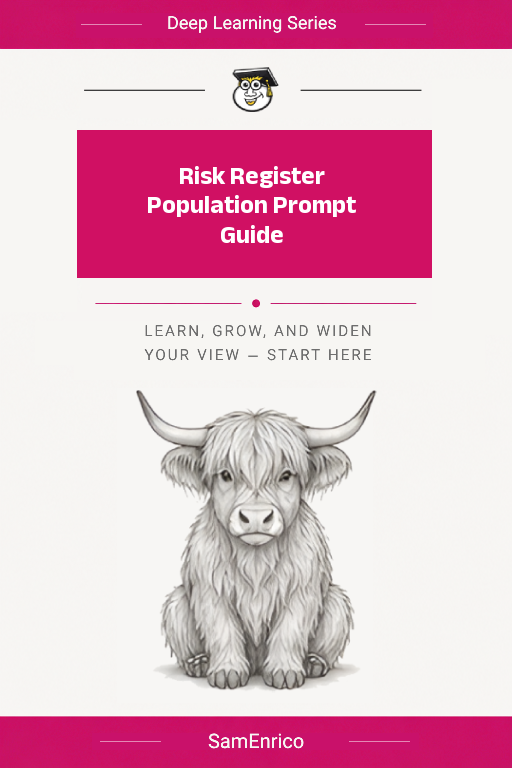
Non-FictionAI OperatorRisk RegisterGRC
Risk Register Population Prompt Guide
Generate inherent and residual risk scores from pr
Generate inherent and residual risk scores from process narratives. Auto-populate risk registers with mitigating controls and owners assigned.
Formats
About this book
Free sample
Chapter 1: The Swiss Cheese Problem--–- On a Tuesday afternoon in March, a mid-sized financial services firm called Sterling & Associates discovered that $4.7 million had vanished from a client escrow account. The money had been gone for eleven days. No one had noticed because the risk register—a meticulously maintained Excel spreadsheet with thirty-seven tabs, color-coded status flags, and quarterly executive reviews—did not contain a single row about manual wire transfer approvals. The process narrative existed, of course. It was buried in an email from the previous year, written by a compliance officer who had since left the firm.
The email described, in plain English, how a clerical assistant manually verified wire details against paper forms. That email was never converted into a risk entry. The register stayed clean. The money did not.This is the Swiss cheese problem. Not the cheese itself, but the holes.
In risk management, the Swiss cheese model—originally developed by James Reason in the 1990s—describes how disasters occur when multiple small gaps (holes) align, creating a clear path from hazard to harm. Each slice of cheese represents a defense layer: policies, controls, monitoring, audits. The holes are weaknesses or missing elements. When the holes line up, the hazard passes through all defenses. Sterling & Associates had plenty of cheese slices.
They had a risk register. They had compliance policies. They had quarterly audits. But the hole was there, gaping and unlogged, in the space between a process narrative and the register.This book is about closing that specific hole. Not all holes—that is impossible.
But the one hole that risk professionals have accepted as inevitable for decades: the gap between the way work is actually described (in emails, meeting minutes, Slack threads, and standard operating procedures) and the way risk is formally documented (in static, manually populated registers). This chapter introduces the problem, defines the core concepts that will drive the rest of the book, and makes a promise that the remaining eleven chapters will fulfill: by the time you finish Chapter 3, you will have populated a live risk register using nothing…
This is the end of the free sample. Get the eBook to keep going. Buy now
Contents
- Chapter 1
- Chapter 2
- Chapter 3
- Chapter 4
- Chapter 5
- Chapter 6
- Chapter 7
- Chapter 8
- Chapter 9
- Chapter 10
- Chapter 11
- Chapter 12
Details
- Author
- Gardner Tabitha
- Publisher
- SamEnrico
- Language
- English
- Genre
- Non-Fiction, AI Operator, Risk Register, GRC
- Released
- 2026-06-01
- Pages (approx.)
- 158
- Available as
- eBook, Audiobook

Read better in the ZLOADR app
Your eBooks on your phone or tablet. Sign in with your SamEnrico account and start reading.
More by Gardner Tabitha
 College Student Social PressureGardner Tabitha$11.99
 Financial Stress And Workplace PerformanceGardner Tabitha$11.99
 Dream Sharing With TherapistGardner Tabitha$11.99
 The Varicella Vaccine GuideGardner Tabitha$11.99
 Gaming Detox 30 Day PlanGardner Tabitha$11.99
 The Early Loss of Parent GriefGardner Tabitha$11.99
 Police Officer Stress GuideGardner Tabitha$11.99
 Imposter Syndrome At ConferencesGardner Tabitha$11.99
 Grit Research GuideGardner Tabitha$11.99
 Wings Over the Pacific: The Daring Flight of Amelia Earhart and the Forgotten Pacific PioneersGardner Tabitha$11.99
 Crypto’s Darkest Hour: The Colonial Pipeline Cyber HeistGardner Tabitha$11.99
 The Dancer's Guide to RedowaGardner Tabitha$11.99
You may also like
 Hong Kong Handover 1997Dunn Johnnie$11.99
 Zumba For Postnatal Recovery CourseNeal Christian$11.99
 Zumba for BeginnersLadner Nikia$11.99
 YouTube Comment Mining GuideHumes Pandora$12.99
 Worry Box MeditationCarlin Rudy$11.99
 Workplace Stress MeditationNguyen Lynn$11.99
 Workplace Stress and Sleep RepairHawley Ivory$11.99
 Workplace Perfectionism CureDelaney Jeffry$11.99
 Workplace Injustice Anger GuideWallen Isabelle$11.99
 Work Addiction and Burnout LinkGreenwood Ester$11.99
 Women in Yoga and WellnessBeattie Galina$11.99
 Women in Stand Up ComedyChun Evangeline$11.99