
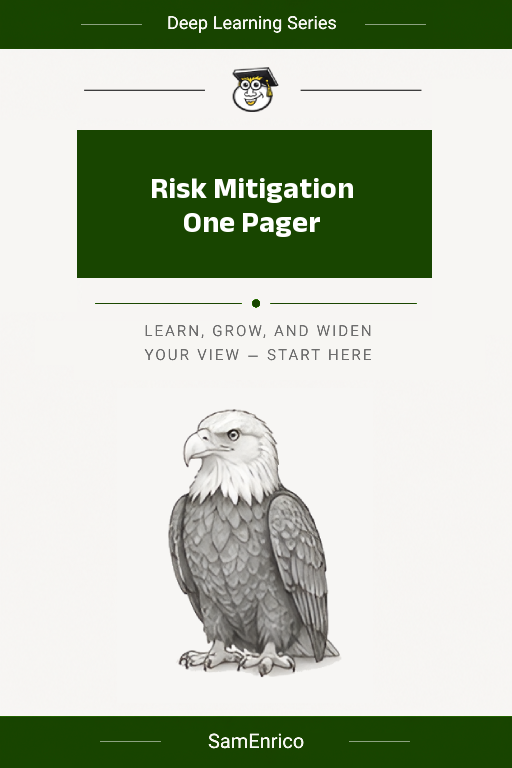
Risk Mitigation One Pager eBook
Identify top 5 business risks and countermeasures
Identify top 5 business risks and countermeasures on a single page, showing investors you've thought through worst-case scenarios.
Formats
Free sample
Chapter 1: The Blindness Epidemic--–- The email arrived at 6:47 AM on a Sunday. The subject line read, "URGENT: Customer Data Incident." The CEO of a fast-growing healthtech startup opened it while pouring his first cup of coffee. By the time he finished reading, he knew his company was in trouble. By the time he finished his coffee, he knew his career was on the line.Three million customer records. Exposed for seventy-two hours before detection.
Names, addresses, medical record numbers, and in some cases, clinical notes. The breach had not come from a sophisticated hacker or an organized cybercrime ring. It had come from a single developer who had left an internal database unsecured while testing a new feature. That developer had worked at the company for eighteen months. He was talented, hardworking, and universally liked.
He had simply forgotten to turn off public access before leaving for a long weekend.The company had a risk register. It was sixty-three rows long. It listed "data breach" as a risk, assigned it a probability of 15 percent, and noted that "security protocols are in place." That was the entire countermeasure: a statement of existence, not a plan of action.The company had a board of directors. They had reviewed the risk register at their quarterly meetings. No one had asked, "What is the specific trigger that would cause us to execute a breach response plan?" No one had asked, "Who is the backup if the lead security engineer is on vacation?" No one had asked, "What is our actual recovery time objective?"The company had investors.
Those investors had received pitch decks projecting hockey-stick growth and a clean path to an IPO. Now those same investors were receiving a different message: "We have hired a crisis PR firm. We are retaining outside counsel. We cannot provide a timeline for resolution."Within six months, the CEO was fired, the company's valuation had dropped by 80 percent, and a once-promising business was reduced to a cautionary tale taught in cybersecurity workshops.The most haunting part of this story is not the breach itself. It is what the CEO told a reporter six months later: "I knew something like this could happen.
I just never thought it would happen to us."The Universal Delusion That CEO was not uniquely foolish. He was not unusually reckless. He was, in every measurable way, a typical founder who had fallen victim to the most dangerous cognitive bias in business: the optimism bias.The optimism bias is not a personality flaw or a sign of weakness. It is a neurological feature of the human brain. Functional magnetic resonance imaging studies have shown that when people imagine positive future events, the rostral anterior cingulate cortex and the amygdala—regions associated with emotional processing—show significantly higher activity than when imagining negative future events.
In other words, your brain literally works harder to make the future look bright than to prepare for the dark.This bias evolved for good reason. Without it, our ancestors might never have ventured beyond familiar territory, planted crops before a famine, or started families despite the risks of childbirth. A dose of unwarranted optimism is what allows humans to attempt difficult things. It is the engine of progress.But the same bias that enables entrepreneurship also blinds entrepreneurs. When you are building a company, your brain is actively fighting against your ability to see what could go wrong.
Every pitch you deliver, every investor you convince, every customer you sign reinforces the neural pathway that says, "This is working. The risks are manageable. The worst case is unlikely."This is why traditional risk management so often fails. Not because the tools are bad. Not because the practitioners are incompetent.
But because the human beings creating and reviewing risk documents are neurologically incapable of giving true risks the attention they deserve.The Spreadsheet Trap Let me describe a scene that has played out in thousands of boardrooms. A founder opens a spreadsheet. Across the top, columns labeled: Risk Description, Probability, Impact, Mitigation, Owner. Down the rows, line after line of potential problems. The founder methodically fills in each cell, relying on memory, intuition, and a few templates downloaded from the internet.By the time the spreadsheet reaches fifty rows, a strange thing happens.
The founder feels a sense of accomplishment. The document is comprehensive. It covers everything from "office lease renewal" to "key supplier bankruptcy" to "foreign exchange fluctuation." Surely, this is a professional risk register. Surely, this will satisfy any investor who asks about downside scenarios.But what has actually been created? A monument to the illusion of control.
A fifty-row spreadsheet is not a tool for decision-making. It is a sedative. It makes the founder feel prepared without requiring any of the difficult choices that actual preparation demands.Consider what a fifty-row spreadsheet does not do. It does not prioritize. Every row has the same visual weight.
"Coffee machine breaks" and "co-founder dies" sit side by side, separated only by a thin grid line. The founder's brain, scanning the document, cannot distinguish the trivial from the existential.It does not require specificity. "Data breach risk mitigated by security protocols" is not a plan. It is a placeholder. But in a fifty-row spreadsheet, placeholders look exactly like real countermeasures.
There is no mechanism to force the founder to answer: What specific protocols? Tested when? Last updated by whom?It does not require triggers. When does a risk become an action? The spreadsheet has no column for "trigger condition." It assumes that the founder will somehow know when to stop monitoring and start responding.
But in a crisis, no one knows anything. Without a predetermined trigger, response is always reactive, always late, always panicked.The spreadsheet trap is seductive because it feels productive. Filling rows is easy. Copying templates is easy. Sending a fifty-row spreadsheet to an investor and receiving a polite "thank you" is easy.
But easy is not effective. And in risk management, effective is the only acceptable standard.The One-Page Revolution Every successful risk management system in high-stakes environments follows the same principle: simplicity at the point of action.Commercial airline pilots do not consult fifty-row checklists during an engine failure. They have a single card, laminated, with the critical steps printed in large type. Everything else is training and automation. The one-page checklist is not a summary of a larger document.
It is the document. Everything that matters fits on one page. Nothing else is needed.Emergency room trauma teams do not review comprehensive risk registers when a patient arrives with a gunshot wound. They have a one-page protocol: ABCDE (Airway, Breathing, Circulation, Disability, Exposure). The simplicity forces focus.
The focus enables speed. The speed saves lives.Nuclear power plant operators do not scroll through spreadsheets during an anomaly. They have a one-page decision flow chart that tells them, in binary terms, whether to escalate, contain, or evacuate. The page is not comprehensive. It is the opposite.
It is a filter that separates the critical from the noise.The Risk Mitigation One Pager is built on the same principle. It is not a summary. It is the artifact. It does not replace deeper analysis; it…
This is the end of the free sample. Get the eBook to keep going. Buy now
About this book
Details
- Author
- Estrella Magaly
- Publisher
- SamEnrico
- Language
- English
- Genre
- Non-Fiction, First 30 Days
- Released
- 2026-05-30
- Pages (approx.)
- 148
- Available as
- eBook, Audiobook

Read better in the ZLOADR app
Your eBooks on your phone or tablet. Sign in with your SamEnrico account and start reading.
More by Estrella Magaly
 Remote Work Focus EnvironmentEstrella Magaly$11.99
 Youth Sports Coach LegendEstrella Magaly$11.99
 Waterproof Gear PFAS DangerEstrella Magaly$11.99
 Success Without Burnout for CreativesEstrella Magaly$11.99
 Major Depressive Disorder Explained for FamiliesEstrella Magaly$11.99
 Loving Kindness for AcupunctureEstrella Magaly$11.99
 Digital Resilience TrainingEstrella Magaly$11.99
 Middle Passage Packing MethodsEstrella Magaly$11.99
 The Dubai Mirage: The Billion-Dollar Pyramid Scheme That Shook the Middle EastEstrella Magaly$11.99
 The Butcher of the Outback: Australia’s Most Disturbing Highway KillerEstrella Magaly$11.99
 Service Providers Guide to Office OrganizersEstrella Magaly$11.99
 International Student Application EssaysEstrella Magaly$12.99
You may also like
 Hong Kong Handover 1997Dunn Johnnie$11.99
 Zumba For Postnatal Recovery CourseNeal Christian$11.99
 Zumba for BeginnersLadner Nikia$11.99
 YouTube Comment Mining GuideHumes Pandora$12.99
 Worry Box MeditationCarlin Rudy$11.99
 Workplace Stress MeditationNguyen Lynn$11.99
 Workplace Stress and Sleep RepairHawley Ivory$11.99
 Workplace Perfectionism CureDelaney Jeffry$11.99
 Workplace Injustice Anger GuideWallen Isabelle$11.99
 Work Addiction and Burnout LinkGreenwood Ester$11.99
 Women in Yoga and WellnessBeattie Galina$11.99
 Women in Stand Up ComedyChun Evangeline$11.99