
Non-FictionSelf-HelpRisk Management
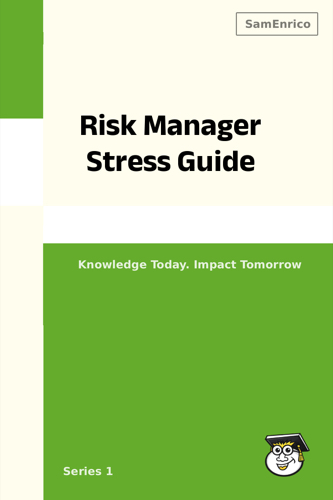
Risk Manager Stress Guide eBook
Handle enterprise risk, board oversight, and mitig
Handle enterprise risk, board oversight, and mitigation planning.
Formats
Free sample
Chapter 1: The Silent Scream--–- You have been in this meeting before. The boardroom is too warm. The coffee on the table has been sitting there for an hour, a skin forming on its surface. The CEO is standing at the front, pointer in hand, walking the board through an aggressive growth strategy. Revenue targets are going up.
Timelines are accelerating. Everyone is nodding.You are sitting in the corner, third seat from the end, your laptop open to a risk register that no one else has read. You have been listening for forty-five minutes. And somewhere in the back of your mind, a warning light is flashing.You raise your hand. Not enthusiastically.
You have learned not to be enthusiastic. "Have we considered the supply chain implications of expanding into that region? The political situation there is unstable, and we would be reliant on three suppliers who all source from the same port."The CEO waves his hand without looking at you. "We'll manage it. Next slide."The CFO nods along.
The board members glance at their watches—not because they are rude, but because they have another meeting in twenty minutes. The head of business development picks up where the CEO left off, showing hockey-stick projections that assume nothing will ever go wrong.You sit back down. You close your laptop. You wonder why you bother.This is the silent scream. The moment when you see the iceberg, you point at it, and everyone tells you to keep rowing.
It happens in boardrooms, in strategy offsites, in risk committee meetings that have been reduced to fifteen minutes because "we have more important things to discuss."You are a risk manager. You are paid to see what others do not want to see. You are hired to protect the organization from itself. And yet, when you do your job well—when you identify risks before they materialize, when you raise concerns that turn out to be justified, when you build frameworks that actually work—you are often dismissed as pessimistic, obstructionist, or, worst of all, irrelevant.Until something goes wrong.Then everyone wants to know why you did not warn them. Why the risk was not on the register.
Why the mitigation plan was insufficient. Why you let this happen.The silent scream is the gap between the warning and the hearing. It is the space between your raised hand and the CEO's dismissive wave. It is the reason you lie awake at 2:00 AM, running scenarios through your head, wondering if you should have spoken louder, said more, attached more data, tried harder.This chapter is about that scream. Not to depress you—you already know it well.
But to name it. To validate it. And to begin building the tools that will transform you from the person who says "no" to the person who helps the organization say "yes" more intelligently.The Paradox at the Heart of the Profession Let us start with an uncomfortable truth that most risk management books dance around but rarely state directly: your organization does not want risk management. It wants risk avoidance disguised as management. It wants a checkbox that satisfies the auditors and the regulators, but it does not want to change how it makes decisions.This is not malice.
It is not a conspiracy against you personally. It is human nature.Humans are wired for optimism bias. We believe that bad things happen to other people, not to us. We believe that our plans will succeed where similar plans have failed. We believe that the worst case is unlikely, so we plan for the best case and hope for the middle.
This bias is not a flaw in individual leaders; it is a feature of how the human brain works. It is what allows entrepreneurs to start companies, explorers to cross oceans, and executives to bet on growth when the data says maybe not.The risk manager's job is to inject realism into this optimism. But realism is not popular. It is not rewarded. And it is certainly not celebrated.Consider the research.
Behavioral economists have documented dozens of cognitive biases that work against risk management. Overconfidence bias makes leaders believe they are better at predicting outcomes than they actually are. Confirmation bias makes them seek out information that supports their existing beliefs and ignore information that contradicts them. Normalcy bias makes them assume that because things have been stable in the past, they will remain stable in the future. The planning fallacy makes them underestimate how long things will take and how much they will cost.These biases are not signs of stupidity.
They are signs of humanity. And the risk manager who ignores them will fail, because the organization will continue making the same biased decisions regardless of your risk register. But the risk manager who fights them head-on will also fail, because you cannot win an argument against a cognitive bias any more than you can win an argument against gravity. The only path to success is to work with human nature—to design risk processes that account for bias, to communicate risk in ways that land emotionally as well as rationally, and to position risk management as a partner to strategy, not an obstacle.The Four Sources of Stress That Keep You Up at Night If you are feeling stressed in your role, you are not alone. Research on risk professionals consistently identifies four primary sources of stress.
Naming them is the first step to managing them.Source One: Isolation Most risk managers sit outside the main flow of decision-making. You are consulted, but rarely at the beginning of a process. You are informed, but rarely during the critical window when decisions are still malleable. You are expected to protect the organization, but you are not given a seat at the table where the risks are created.This isolation has a name in the academic literature: the CRO paradox. The Chief Risk Officer is expected to have enterprise-wide visibility into risks, to see across silos, to connect dots that no one else is connecting.
But the CRO is often excluded from the strategy discussions where those risks are born. You cannot see what you are not in the room for. And you are not in the room for most of the decisions that create the risks you are later asked to manage.The isolation is not always intentional. It is structural. The risk function is often positioned as a second-line defense, separate from the first line of business units.
But that separation comes with a cost. You are not in the daily scrum. You are not in the strategy retreat. You are the person who shows up at the end to ask "did you consider the risks?" when the answer is already locked in.Source Two: Responsibility Without Authority You are responsible for risk management. But you do not control the business units that create the risks.
You cannot stop a project because the risk assessment is incomplete. You cannot force a business unit to implement controls. You cannot hire or fire the people who are taking the risks. You can only advise, recommend, and escalate.When…
This is the end of the free sample. Get the eBook to keep going. Buy now
About this book
Details
- Author
- Hildreth Mercy
- Publisher
- SamEnrico
- Language
- English
- Genre
- Non-Fiction, Self-Help, Risk Management
- Released
- 2026-06-08
- Pages (approx.)
- 138
- Available as
- eBook, Audiobook

Read better in the ZLOADR app
Your eBooks on your phone or tablet. Sign in with your SamEnrico account and start reading.
More by Hildreth Mercy
 TM for Body Image IssuesHildreth Mercy$11.99
 Jealousy in ParentingHildreth Mercy$11.99
 Affirmations for JealousyHildreth Mercy$11.99
 The Pet Loss and Insomnia GuideHildreth Mercy$11.99
 The Fire That Forged a Masterpiece: The Great London Fire of 1966 and the Birth of a Nobel LaureateHildreth Mercy$11.99
 Free Canva Validation GuideHildreth Mercy$12.99
 Export Invoice Factoring GuideHildreth Mercy$12.99
 How to Become a Drying-oven AttendantHildreth Mercy$11.99
 Shipping and Receiving Dock AssociateHildreth Mercy$11.99
You may also like
 Hong Kong Handover 1997Dunn Johnnie$11.99
 Zumba For Postnatal Recovery CourseNeal Christian$11.99
 Zumba for BeginnersLadner Nikia$11.99
 YouTube Comment Mining GuideHumes Pandora$12.99
 Worry Box MeditationCarlin Rudy$11.99
 Workplace Stress MeditationNguyen Lynn$11.99
 Workplace Stress and Sleep RepairHawley Ivory$11.99
 Workplace Perfectionism CureDelaney Jeffry$11.99
 Workplace Injustice Anger GuideWallen Isabelle$11.99
 Work Addiction and Burnout LinkGreenwood Ester$11.99
 Women in Yoga and WellnessBeattie Galina$11.99
 Women in Stand Up ComedyChun Evangeline$11.99