
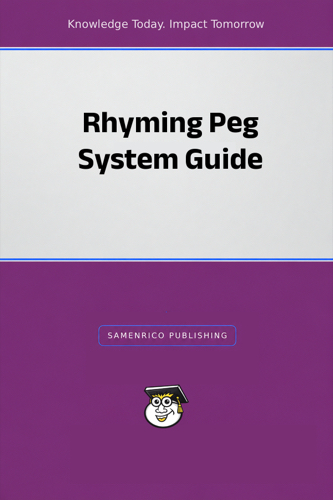
Non-FictionSelf-HelpMental Math
Rhyming Peg System Guide eBook
Connect numbers to rhyming words to create a durab
Connect numbers to rhyming words to create a durable retrieval system for lists.
Formats
Free sample
Chapter 1: The Forgetting Curve Trap--–- You are standing in the grocery store aisle, staring at your shopping cart, gripped by a sinking feeling. You know you came here for three specific items. You can feel the shape of them in your memory—the weight of a milk jug, the cold of a butter box, the crunch of an apple. But the actual names have vanished. You grab milk, butter, and apples anyway, then drive home, only to discover that what you actually needed was dish soap, trash bags, and coffee filters.
This has happened to you before. It will happen again. And every time it does, you tell yourself the same lie: “I just have a bad memory.”That lie is the most expensive belief you currently hold. Not because it is cruel, but because it is wrong. And because it is wrong, it has been quietly stealing from you for years.
It steals your time when you re-read the same book chapter three times. It steals your confidence when you blank on a colleague’s name during an introduction. It steals your credibility when you deliver a presentation that should have been sharp but came out scattered because you tried to read from notes instead of speaking from a prepared mind. The belief that memory is a fixed trait—like height or shoe size—is not just inaccurate. It is the single greatest obstacle between you and a more capable, less anxious, more impressive version of yourself.This book exists because that belief is a trap.
And the door out of that trap is not a pill, a smartphone app, or a superhuman genetic gift. The door is a simple, ancient, profoundly elegant technique called the rhyming peg system. Before we build that door, however, you must first understand why you forget in the first place. You cannot solve a problem you refuse to diagnose.The Scientific Reality of Forgetting In the late nineteenth century, a German psychologist named Hermann Ebbinghaus did something no one had thought to do before. He decided to study memory scientifically, not anecdotally.
He created lists of nonsense syllables—meaningless three-letter combinations like RUR, ZOF, and MIB—and tested his own ability to recall them over time. What he discovered became the foundation of modern memory research. He called it the Forgetting Curve.The Forgetting Curve is not a theory. It is a measurement. And it says this: within one hour of learning a list of new information, your brain will have discarded roughly 50 percent of it.
Within 24 hours, that number rises to 70 percent. Within one week, if you have done nothing to intervene, you will retain less than 10 percent of what you originally learned. This is not a design flaw. It is a design feature. Your brain is not a hard drive.
It is a survival organ. It prioritizes threats, shelter, food, and social bonds over grocery lists, historical dates, or the three points you wanted to make in your morning meeting. From an evolutionary perspective, remembering where you left your car keys has never once helped anyone escape a predator. Remembering which berry caused vomiting last summer, however, kept your ancestors alive. Your brain is optimized for danger and reward, not for to-do lists.That is the bad news.
The good news is that the Forgetting Curve is not destiny. It is a pattern, and patterns can be interrupted. The people who seem to have “photographic memories” are not born that way. They have simply learned to interrupt the Forgetting Curve before it erases their work. They use techniques that force the brain to treat ordinary information as if it were dangerous or rewarding.
And the most accessible, beginner-friendly, immediately useful of those techniques is the rhyming peg system.Rote Memorization Is a Trap Within a Trap Before we go any further, we need to name the enemy. The enemy is not your brain. The enemy is rote memorization. Rote memorization is the method you were taught in school: repeat something over and over until it sticks. Read the same paragraph five times.
Write the vocabulary word ten times. Say the multiplication table out loud until your throat is sore. This method feels like work, which is why we trust it. We have been conditioned to believe that if learning is painful, it must be effective. But rote memorization is the least efficient learning strategy ever devised, and science has known this for over a century.When you repeat information without attaching it to anything meaningful, you are using your brain’s short-term “loop” system.
This system is called the phonological loop, and it can hold information for approximately 15 to 30 seconds. After that, unless the information is rehearsed again, it vanishes. Rote repetition is just continuous rehearsal. It keeps the information in the loop longer, but it never moves that information into long-term storage. The moment you stop rehearsing, the Forgetting Curve takes over.
This is why you can cram for an exam the night before, pass it, and remember almost nothing a week later. You never actually learned the material. You just borrowed it temporarily.The rhyming peg system works because it bypasses the phonological loop entirely. Instead of repeating information, you translate it into images. And images are processed by a completely different part of your brain: the visual-spatial system, which has vastly larger storage capacity and much slower decay rates.
Once an image is encoded, it can last for decades. You remember your childhood bedroom not because you repeated its layout ten thousand times, but because you saw it, felt it, and lived in it. The rhyming peg system forces ordinary, forgettable information to take a ride on that same powerful visual-spatial network.Two Families of Memory Techniques All professional memory techniques belong to one of two families. Understanding the difference between them is essential because the rhyming peg system sits at the intersection of both.The first family is called Link Systems. In a link system, you take a list of items and chain them together into a single story or sequence of interacting images.
Item one touches item two, which touches item three, and so on. Link systems are excellent for short lists where order matters but where you do not need to access items out of sequence. If you need to remember a shopping list of five items, a link system will work fine. But if someone asks you, “What was the third item on that list?” a link system forces you to mentally walk through items one and two before you can reach three. That takes time and introduces errors.The second family is called Peg Systems.
A peg system works by pre-memorizing a set of permanent “hooks.” Each hook is tied to a number. Once the hooks are locked in, you can hang any item onto any hook, instantly, in any order. Need to remember what was on hook seven? You go directly there. No walking through hooks one through six.
This is called random access retrieval, and it is the difference between a rolodex and a long scroll of paper. Peg systems are faster, more flexible, and more durable than link systems…
This is the end of the free sample. Get the eBook to keep going. Buy now
About this book
Details
- Author
- Spearman Pamala
- Publisher
- SamEnrico
- Language
- English
- Genre
- Non-Fiction, Self-Help, Mental Math
- Released
- 2026-06-11
- Pages (approx.)
- 105
- Available as
- eBook, Audiobook

Read better in the ZLOADR app
Your eBooks on your phone or tablet. Sign in with your SamEnrico account and start reading.
More by Spearman Pamala
 Road Rage Confrontation De escalationSpearman Pamala$11.99
 Cocaine Recovery for PerformersSpearman Pamala$11.99
 Diamond Heist Copycat CrimesSpearman Pamala$11.99
 The Team Brainwriting HandbookSpearman Pamala$11.99
 RMD Estate Planning GuideSpearman Pamala$11.99
 Cigarette Budget Freedom PlanSpearman Pamala$11.99
 RLS Kidney Disease LinkSpearman Pamala$11.99
 The River That Broke Them: The Forgotten Tragedy of the Congo ExpeditionsSpearman Pamala$11.99
 Magnesium For PMS GuideSpearman Pamala$11.99
 Crown & Controversy: How King Charles III Redefined the Monarchy in His First YearSpearman Pamala$11.99
 The Mathematicians of the Nile: Unlocking the Secrets of Ancient Egyptian GeometrySpearman Pamala$11.99
 How to Start a Medical Claims Billing Service BusinessSpearman Pamala$11.99
You may also like
 Hong Kong Handover 1997Dunn Johnnie$11.99
 Zumba For Postnatal Recovery CourseNeal Christian$11.99
 Zumba for BeginnersLadner Nikia$11.99
 YouTube Comment Mining GuideHumes Pandora$12.99
 Worry Box MeditationCarlin Rudy$11.99
 Workplace Stress MeditationNguyen Lynn$11.99
 Workplace Stress and Sleep RepairHawley Ivory$11.99
 Workplace Perfectionism CureDelaney Jeffry$11.99
 Workplace Injustice Anger GuideWallen Isabelle$11.99
 Work Addiction and Burnout LinkGreenwood Ester$11.99
 Women in Yoga and WellnessBeattie Galina$11.99
 Women in Stand Up ComedyChun Evangeline$11.99