
Non-FictionInformativeEducational
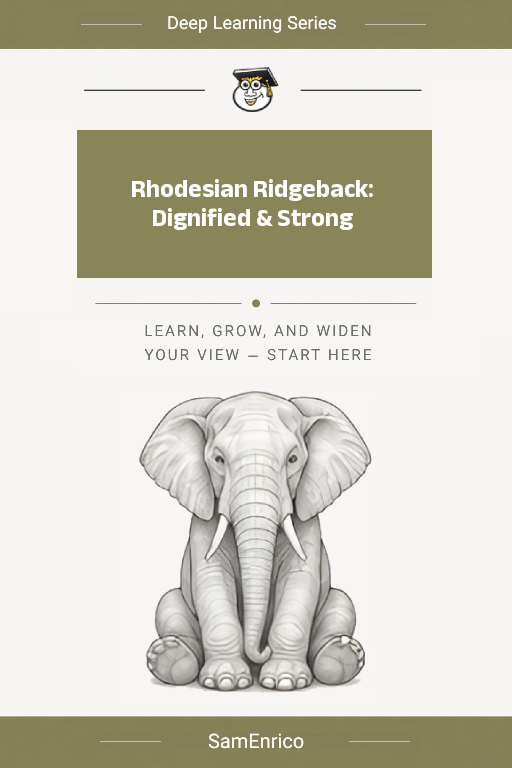
Rhodesian Ridgeback: Dignified & Strong eBook
This publication, published by SamEnrico, covers R
by Hager Ethan
This publication, published by SamEnrico, covers Rhodesian Ridgeback: Dignified & Strong
Formats
Free sample
Chapter 1: The Lion’s Bloodline...–- In the mid-18th century, deep in the rugged highveld of Southern Africa, a group of European settlers watched in disbelief as their mixed-breed hunting dogs did something no mastiff or greyhound had ever done in Europe. A wounded lioness, cornered in a thicket of thorn trees, charged the pack with a fury that would have scattered any other canine. But these dogs did not flee. They did not recklessly attack. Instead, they formed a loose, intelligent crescent around the enraged cat, dodging her swipes, staying just out of reach, and barking with a rhythm that froze the lioness in place.
For twenty minutes, they held her there—baying, not fighting—until the hunters arrived on horseback to deliver the final shot. That day, a legend was born.The First Ridgebacks: Accident or Design?The dogs those settlers relied upon were not a formal breed. They were a functional mix—descendants of European imports crossed with a strange, semi-wild African dog that carried a distinct ridge of backward-growing hair along its spine. That ridge, now the hallmark of the Rhodesian Ridgeback, was not a cosmetic quirk. It was a survival trait, preserved by generations of natural and human selection in one of the harshest environments on earth.This chapter does not merely recount history.
It argues that you cannot understand the Ridgeback of today—not its stubborn dignity, not its quiet courage, not its infuriating independence—without first walking the rocky paths of 17th-century Southern Africa. The past is not a prologue for this breed. It is a living instruction manual.The Khoikhoi Dog: Africa’s Original Ridgeback Long before any European set foot on the Cape of Good Hope, the Khoikhoi people (whom early Dutch settlers called “Hottentots”) maintained a unique population of domestic dogs. These were not the pampered companions of European nobility. They were semi-wild animals, lean and heat-resistant, with short coats and a distinctive ridge of hair running down their spines in the reverse direction from the rest of their coat.Early colonial records describe these dogs as “courageous to the point of recklessness” and possessing “a silence that unsettles horses.” Unlike European hunting hounds that announced their presence with baying, the Khoikhoi dogs hunted with strategic silence, using terrain and wind direction to approach prey undetected.
This ability to work independently—without constant human direction—would become the Ridgeback’s most defining psychological trait.The precise origin of the ridge remains debated among canine geneticists. Some argue it appeared as a spontaneous mutation, like the curl in a pug’s tail or the merle pattern in Australian shepherds. Others suggest it was selectively reinforced by the Khoikhoi, who may have valued ridged dogs for ceremonial or practical reasons. What is not debated is the ridge’s persistence. When European settlers arrived in the mid-1600s, they found ridged dogs already thriving across the Cape region.The Great Crossing: Europe Meets Africa The Dutch East India Company established a refreshment station at the Cape of Good Hope in 1652.
Soon after, settlers—Dutch, German, and French Huguenot—brought their own dogs to the strange new land. These were not lapdogs. They were working animals: Great Danes for guarding estates, Mastiffs for raw power, Bloodhounds for trailing, and Greyhounds for speed.The crossing of European and African dogs was not a planned breeding program. It was the inevitable result of isolation and necessity. Settlers needed dogs that could withstand African heat, travel long distances on minimal water, and confront wildlife that would have terrified any European wolf.
Their imported dogs, however, wilted in the sun, suffered from heat exhaustion on hunting trips, and lacked the genetic resilience to survive tick-borne diseases.The solution was pragmatic: cross the European stock with the local Khoikhoi dogs. The offspring combined the size and power of the European breeds with the heat tolerance, disease resistance, and ridged backs of the African dogs. These crosses were known simply as “the lion dogs”—not because they killed lions, but because they were the only dogs brave enough to track and bay them.Cornelius van Rooyen: The Breed’s Unlikely Architect The Ridgeback as we recognize it today would not exist without a single, obsessive hunter named Cornelius van Rooyen. In the 1870s, van Rooyen operated in Rhodesia (now Zimbabwe), where lion hunting was not a sport but a necessity. Lions regularly killed cattle, and cattle were currency.
A pack of dogs that could reliably find, track, and bay lions until the hunter arrived was worth more than gold.Van Rooyen was not a scientist. He was a pragmatist. He spent decades crossing his existing pack with every breed he believed would improve their performance. His breeding records—some of which survive in Zimbabwean archives—show introductions of Greyhounds for speed, Bulldogs for tenacity, Collies for herding instinct, and even Terriers for fearlessness. But he always crossed back to the ridged Khoikhoi type, preserving the ridge and the heat tolerance that made the dogs functional.The result was a dog of extraordinary ability: fast enough to keep pace with horses, brave enough to track lions into thick cover, and intelligent enough to harass a lion without closing to killing distance.
Van Rooyen’s dogs did not attack lions. That would have been suicide. They bayed—a controlled, rhythmic barking that distracted and confused the lion, holding it in place without triggering its full predatory response.The Myth of the “Lion Killer”One of the most persistent and damaging myths about the Rhodesian Ridgeback is that it was bred to kill lions. This is false. A single lion can kill a pack of Ridgebacks in seconds.
Adult male lions weigh 400-500 pounds, possess claws that can disembowel a dog with one swipe, and have evolved specifically to fight large, dangerous prey. No domestic dog, regardless of breeding, reliably kills adult lions.Van Rooyen’s dogs were lion baits, not lion killers. Their job was to locate the lion, chase it until it stopped running (lions tire quickly but fight ferociously when cornered), and then hold it at bay by circling and barking. The hunter, on horseback, would then approach and shoot the lion from a safe distance. The dogs that survived multiple hunts were those with impeccable judgment—knowing exactly how close to get, when to feint, and when to retreat.This role explains the Ridgeback’s modern independence.
European hunting dogs, such as bloodhounds or pointers, were bred to work closely with handlers, responding to whistles, hand signals, and voice commands. Van Rooyen’s dogs, however, often worked out of sight of their handlers, tracking lions over miles of broken terrain. A dog that waited for permission would lose the lion. A dog that made its own decisions and was usually correct survived.That genetic legacy remains. Today’s Ridgeback does not look to its owner for permission before investigating a scent.
It does not wait for a command before deciding whether a stranger is a threat. It processes information independently, weighing its own instincts against your signals. When you call a Ridgeback and it ignores you, it is not being stubborn in the way a terrier is stubborn.…
This is the end of the free sample. Get the eBook to keep going. Buy now
About this book
Details
- Author
- Hager Ethan
- Publisher
- SamEnrico
- Language
- English
- Genre
- Non-Fiction, Informative, Educational
- Released
- 2026-05-09
- Pages (approx.)
- 152
- Available as
- eBook, Audiobook

Read better in the ZLOADR app
Your eBooks on your phone or tablet. Sign in with your SamEnrico account and start reading.
More by Hager Ethan
 The Opposite Action SkillHager Ethan$11.99
 Self Hypnosis for Fear of WealthHager Ethan$11.99
 British East Africa DecolonizationHager Ethan$11.99
 CIA Officer Operational StressHager Ethan$11.99
 Coach Hypnosis Training GuideHager Ethan$11.99
 Child Loss After Organ DonationHager Ethan$11.99
 Shotgun MetagenomicsHager Ethan$11.99
 Alcohol Recovery for VeteransHager Ethan$11.99
 The Grand Illusion: The Rise and Fall of the Taj Mahal Hotel DynastyHager Ethan$11.99
 Love, Letters, and Literary Wars: The Divorce That Shook Latin America's Boom GenerationHager Ethan$11.99
 How to Produce SealsHager Ethan$11.99
 How to Start a Extracts of Aromatic Products Business (Beginners Guide)Hager Ethan$11.99
You may also like
 Hong Kong Handover 1997Dunn Johnnie$11.99
 Zumba For Postnatal Recovery CourseNeal Christian$11.99
 Zumba for BeginnersLadner Nikia$11.99
 YouTube Comment Mining GuideHumes Pandora$12.99
 Worry Box MeditationCarlin Rudy$11.99
 Workplace Stress MeditationNguyen Lynn$11.99
 Workplace Stress and Sleep RepairHawley Ivory$11.99
 Workplace Perfectionism CureDelaney Jeffry$11.99
 Workplace Injustice Anger GuideWallen Isabelle$11.99
 Work Addiction and Burnout LinkGreenwood Ester$11.99
 Women in Yoga and WellnessBeattie Galina$11.99
 Women in Stand Up ComedyChun Evangeline$11.99