
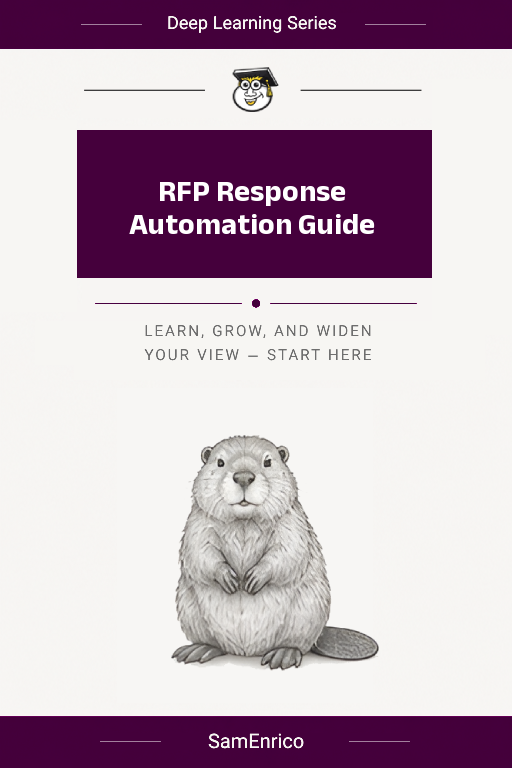
Non-FictionAI OperatorRFP ManagementDocument Parsing
RFP Response Automation Guide eBook
Parse requirement documents and map answers to you
Parse requirement documents and map answers to your knowledge base. Generate compliant, tailored RFP responses with traceable sourcing.
Formats
Free sample
Chapter 1: The $100 Million Typo--–- On a Tuesday afternoon in March, a 147-page PDF landed in Sarah’s inbox. She was a senior proposal manager at a mid‑sized cybersecurity firm that had spent eighteen months chasing a federal contract worth $400 million over five years. The team had already survived two rounds of shortlisting, a site visit, and a pricing negotiation. Only the final Request for Proposals stood between them and the largest deal in company history.Sarah opened the attachment. It was dense, as expected.
Over 300 discrete requirements, fifty‑three compliance checkboxes, a thirty‑page security appendix, and an evaluation matrix that awarded points for everything from “past performance” to “key personnel resumes.” She had done this before. She knew the ritual: forward sections to Legal, to Security, to Product, to Sales Ops. Wait for each to return their piece. Stitch it all together. Pray nothing contradicted.The team worked seventy‑two hours that week.
They pulled answers from three previous proposals, a six‑month‑old security white paper, and a pricing spreadsheet that had last been updated before a major acquisition changed their product architecture. Nobody noticed that the disaster recovery answer came from the old infrastructure. Nobody caught that the legal indemnification clause referenced a subsidiary that no longer existed. And crucially, nobody saw that two different people—one in Security, one in Sales Operations—answered the same question about data retention differently. Page 47 said “logs retained for seven years.” Page 112 said “logs retained for twelve months.”The buyer noticed.The contract went to a competitor.
When the debrief call came, the government procurement officer offered only a single line of explanation: “Your proposal contained material inconsistencies that raised concerns about organizational alignment and quality control.”Sarah’s company lost $400 million because of two sentences that didn’t match. That is not an outlier. It is the ordinary, quiet catastrophe of manual RFP response.The True Cost of Copy‑Paste Every year, organizations collectively waste over 200 million person‑hours responding to requests for proposals, requests for quotes, and security questionnaires. According to time‑tracking studies published by the Association of Proposal Management Professionals (APMP), a single complex RFP consumes between 80 and 120 hours of cross‑functional team time. That is two to three full work weeks for a team of four—before a single dollar of revenue is booked.But the hours tell only part of the story.
The real damage is invisible because it lives inside proposals that are submitted, evaluated, and rejected without the buyer ever explaining the true reason. Buyers rarely say, “You lost because your page 4 answer contradicted your page 47 answer.” They say, “Your proposal did not fully meet our requirements” or “We selected a vendor whose solution better aligned with our needs.” The specific, traceable failure—the contradictory sentence, the outdated compliance claim, the promise of a feature that no longer exists—gets buried in generic rejection language.This chapter establishes the business case for automation by quantifying what manual processes actually cost. Not just in hours, but in win rates, in employee burnout, and in the silent accumulation of risk that can surface during an audit or a legal dispute. We will examine time‑tracking studies, error‑rate analyses, and real‑world examples like the one above to understand why the traditional approach is not merely inefficient—it is structurally broken.The Frankenstein Proposal The single most common output of manual RFP response is what this book calls the Frankenstein proposal: a document stitched together from disparate paragraphs pulled from old responses, security appendices, product sheets, legal templates, and whatever else happened to be on the shared drive. Like Mary Shelley’s creature, it is assembled from mismatched parts.
Also like the creature, it tends to turn on its creators.A Frankenstein proposal exhibits three characteristic defects:Defect One: Inconsistent Messaging. The same capability described differently in different sections. The security team writes, “Our encryption uses AES‑256 with hardware security modules.” The sales team, unaware of that language, writes, “We protect your data with bank‑grade encryption.” Both are true, but the inconsistency creates a perception of sloppiness. The buyer, who reads the proposal sequentially, sees two different voices and infers two different standards of care.Defect Two: Outdated Compliance Language. A compliance claim that was true six months ago may no longer be accurate after a software update, a policy change, or a regulatory shift.
Manual proposals have no automatic mechanism for refreshing content. An answer that passed legal review in Q1 can become a material misrepresentation by Q4. In regulated industries—healthcare, financial services, government contracting—this is not merely a quality issue; it is a legal liability.Defect Three: Contradictory Technical Claims. The most dangerous defect, because it is the easiest to miss. Two different subject matter experts, working in isolation, produce answers that cannot both be true.
The technical appendix promises 99.999% uptime. The SLA section, written by a different author, promises 99.9% uptime. Neither author sees the other’s work until the proposal is assembled, at which point correcting the error means reopening the entire review cycle—assuming anyone notices at all.In the case of Sarah’s $400 million loss, the contradictory answers were five pages apart. Both had been written by competent professionals. Neither had access to the other’s work.
And there was no systematic check to catch the mismatch before submission.The 80/20 Rule of RFP Waste When proposal teams track their time at the task level, a consistent pattern emerges. Across dozens of studies in both commercial and government sectors, the distribution of effort looks roughly like this:– 70% of time is spent searching for answers that already exist somewhere in the organization. Finding the right security paragraph. Locating the most recent pricing matrix. Verifying that a product claim from a 2022 proposal still holds true.
This is waste—not because searching is valueless, but because it is repeatable waste. The same search happens again and again for every RFP.– 20% of time is spent on mechanical tasks: copying, pasting, reformatting, converting between file types, updating headers and footers, and renumbering sections. This is also waste, and it is almost entirely automatable.– 10% of time is spent on actual value‑added work: tailoring messaging to the specific buyer, crafting a unique win theme, positioning the proposal to address the buyer’s unstated concerns.The implication is stark. If you could eliminate the 70% search waste and the 20% mechanical waste, you could produce the same quality proposal in one‑tenth the time. Or—and this is the strategic insight—you could produce a better proposal in the same time by reinvesting those hours into tailoring and strategy.But most organizations do not take that path.
Instead, they accept the waste as inevitable and hire more people to keep up with volume. This is the trap of manual response: it scales linearly, not exponentially. Double the RFP volume, double the headcount. No learning. No compounding efficiency.Automation Versus Optimization Before we go further, a critical distinction must be drawn.
The RFP technology market is crowded with tools that promise speed. They offer templates, libraries, and search engines that make it faster to find an old answer and paste it into a new document.…
This is the end of the free sample. Get the eBook to keep going. Buy now
About this book
Details
- Author
- Brunson Esmeralda
- Publisher
- SamEnrico
- Language
- English
- Genre
- Non-Fiction, AI Operator, RFP Management, Document Parsing
- Released
- 2026-06-01
- Pages (approx.)
- 144
- Available as
- eBook, Audiobook

Read better in the ZLOADR app
Your eBooks on your phone or tablet. Sign in with your SamEnrico account and start reading.
More by Brunson Esmeralda
 Social Media Listening ValidationBrunson Esmeralda$11.99
 Summer Break Stress GuideBrunson Esmeralda$11.99
 Fasting and InflammationBrunson Esmeralda$11.99
 Affirmations for Success MindsetBrunson Esmeralda$11.99
 Group Idea MashupBrunson Esmeralda$11.99
 Prime Time Performance AccelerationBrunson Esmeralda$11.99
 Slow Productivity Movement GuideBrunson Esmeralda$11.99
 Malaysian Green Tax CreditsBrunson Esmeralda$11.99
 Habit Stacking MethodBrunson Esmeralda$11.99
 The Djinn and the Scholar's Lamp: A Pact of KnowledgeBrunson Esmeralda$11.99
 Whispers of the First Fleet: The Untold Stories of Australia’s Forgotten ArrivalsBrunson Esmeralda$11.99
 The Dancer's Guide to Odissi AKA OrissiBrunson Esmeralda$11.99
You may also like
 Hong Kong Handover 1997Dunn Johnnie$11.99
 Zumba For Postnatal Recovery CourseNeal Christian$11.99
 Zumba for BeginnersLadner Nikia$11.99
 YouTube Comment Mining GuideHumes Pandora$12.99
 Worry Box MeditationCarlin Rudy$11.99
 Workplace Stress MeditationNguyen Lynn$11.99
 Workplace Stress and Sleep RepairHawley Ivory$11.99
 Workplace Perfectionism CureDelaney Jeffry$11.99
 Workplace Injustice Anger GuideWallen Isabelle$11.99
 Work Addiction and Burnout LinkGreenwood Ester$11.99
 Women in Yoga and WellnessBeattie Galina$11.99
 Women in Stand Up ComedyChun Evangeline$11.99