
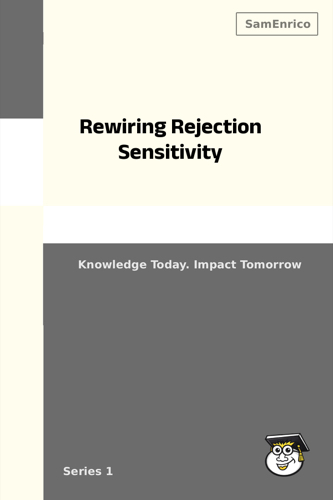
Rewiring Rejection Sensitivity eBook
Replace they don't like me with this feels painful
Replace they don't like me with this feels painful and I will be okay.
Formats
Free sample
Chapter 1: The Ambiguity Trap--–- Three hours. That is how long a single unanswered text message held you hostage last week. Three hours of refreshing. Three hours of rereading your own message, searching for the hidden offense you must have committed. Three hours of constructing elaborate narratives about why they had not responded—none of them neutral, all of them catastrophic.
And then, at 6:47 PM, your phone buzzed. "So sorry, crazy day. What's up?" Just like that, the hostage crisis ended. The relief was immediate. And so was the shame.
Shame for the hours you lost. Shame for the story you built. Shame for the certainty you felt about a reality that turned out to be fiction. This chapter is about that gap—the space between what actually happens and what your brain tells you is happening. Because in that gap, everything you need to know about rejection sensitivity is hiding in plain sight.The text message scenario is not an isolated incident.
It is a template. The same architecture appears every time you walk into a room and interpret a sideways glance as disgust. Every time your partner sighs and you hear the beginning of the end. Every time your boss says "we need to talk" and you spend the next four hours updating your resume. Every time you post something on social media and measure your worth by the number of likes.
The trigger changes, but the structure remains identical: ambiguous stimulus plus rejection-sensitive brain equals catastrophe.This chapter is called The Ambiguity Trap because ambiguity is not your enemy. Ambiguity is simply uncertainty—the absence of complete information. And the absence of complete information is the normal condition of human life. You will never know exactly what someone else is thinking. You will never have perfect certainty about whether you are liked, valued, or included.
The question is not how to eliminate ambiguity. The question is how to stop your brain from treating ambiguity as an emergency.The Architecture of Ambiguity Let us define our terms carefully. Ambiguity, in the context of social interaction, refers to any situation where the available information is incomplete or open to multiple interpretations. A delayed text is ambiguous because it could mean dozens of things: they are busy, they forgot to respond, they saw the message and got distracted, they are angry, they are hurt, they are anxious, they are dead (your brain will go there, too). A flat tone of voice is ambiguous because it could mean boredom, exhaustion, distraction, sadness, or contempt.
A missed invitation is ambiguous because it could mean oversight, limited space, a simple mistake, or deliberate exclusion.The human brain hates ambiguity. This is not a personality quirk; it is a neurological feature. Uncertainty is computationally expensive. Your brain consumes enormous amounts of energy trying to predict what will happen next because accurate prediction increases survival. When information is missing, your brain fills in the gaps.
It has to. The alternative is paralysis. The problem is not that your brain fills gaps. The problem is what it fills them with.For most of human evolutionary history, filling gaps with threat-based assumptions was adaptive. Imagine you are walking through tall grass and you hear a rustling sound.
The sound is ambiguous—it could be a predator, or it could be the wind. If you assume predator and you are wrong, you have wasted some energy on alertness. If you assume wind and you are wrong, you are dead. The brain that assumed predator survived to pass on its genes. We are descended from the anxious ancestors, not the chill ones.The same logic applies to social threats.
In a small tribal environment, being ostracized was a death sentence. If you sensed that the group might be turning against you, your survival depended on detecting that threat early and correcting your behavior. The brain that assumed the worst and changed its behavior survived. The brain that assumed everything was fine and got exiled did not. This is why your brain defaults to catastrophic interpretations of ambiguous social information.
It is not trying to make you miserable. It is trying to keep you alive using software that was last updated ten thousand years ago.The problem is that we no longer live in a small tribal environment. We live in a world of mass media, social networks, text-based communication, and complex social hierarchies. The number of ambiguous social signals we process daily is staggering. Every text, every email, every social media post, every glance, every sigh, every pause in conversation—each one is an opportunity for your ancient threat-detection system to misfire.
And misfire it does, constantly, because the system was calibrated for a world where a single ambiguous signal could mean death. Now it means a busy friend, a tired colleague, or a partner with indigestion.The Automatic Negative Interpretation Psychologists have a term for what happens next: Automatic Negative Interpretation (ANI). This is the brain's default setting when it encounters ambiguity. Without any conscious effort, without any deliberate reasoning, your brain provides an explanation for the ambiguous event. And that explanation is almost always negative, personal, and global.Negative means the interpretation assumes something bad is happening.
"They ignored me" rather than "They got distracted." Personal means the interpretation assumes the event is about you. "They think I'm annoying" rather than "They have something on their mind." Global means the interpretation assumes the event reflects a stable, enduring quality of your character or relationships. "I am unlikeable" rather than "This one person was in a bad mood."The speed of this process is what makes it so difficult to interrupt. The Automatic Negative Interpretation does not announce itself. It does not say, "Hello, I am an interpretation, and you are welcome to consider alternative possibilities." It arrives as perception.
It feels like seeing, not thinking. You do not believe your friend hates you because you have evidence; you believe it because it feels obviously, self-evidently true. The interpretation has fused with reality in your mind.This fusion is the heart of the ambiguity trap. When interpretation and reality fuse, you lose the ability to distinguish between what happened and what you think happened. The story becomes the fact.
And once the story is a fact, your emotional response is not just reasonable—it is inevitable. Of course you feel devastated when someone hates you. Of course you feel worthless when you are unlikeable. The problem is that no one actually hates you. No one actually thinks you are unlikeable.
But your brain has already filed the story as evidence, and your body is already responding to a threat that does not exist.The 90-Second Lie Here is where the neurochemistry gets interesting—and where you can begin to find leverage. The raw physiological component of an emotion lasts approximately ninety seconds. That is not a metaphor or a motivational slogan. It is a finding from neuroscientific research on the duration of autonomic nervous system responses. When your amygdala detects a threat, it triggers a cascade of stress hormones that surge through your body.
That surge takes about ninety seconds to peak and begin to dissipate—if you do not add fuel to the fire.The…
This is the end of the free sample. Get the eBook to keep going. Buy now
About this book
Details
- Author
- Swisher Carli
- Publisher
- SamEnrico
- Language
- English
- Genre
- Non-Fiction, Self-Help
- Released
- 2026-06-05
- Pages (approx.)
- 141
- Available as
- eBook, Audiobook

Read better in the ZLOADR app
Your eBooks on your phone or tablet. Sign in with your SamEnrico account and start reading.
More by Swisher Carli
 The Breath Loving Kindness ComboSwisher Carli$11.99
 Corporate Attorney Stress ReliefSwisher Carli$11.99
 Mountain Top Calm ScriptSwisher Carli$11.99
 Performance Review PalaceSwisher Carli$11.99
 North Sea Oil Rig StoriesSwisher Carli$11.99
 Non Standard Contract AI HandlingSwisher Carli$11.99
 Eye of Horus GuideSwisher Carli$11.99
 Couples Emotion RegulationSwisher Carli$11.99
 The Silent Bridge: How a Forgotten Treaty Saved MillionsSwisher Carli$11.99
 Anansi Weaves the Stars: The Spider’s Grand DeceptionSwisher Carli$11.99
 Ratko Mladić: The Butcher of Bosnia and the Fall of YugoslaviaSwisher Carli$11.99
 Advanced Project Management TechniquesSwisher Carli$11.99
You may also like
 Workplace Stress MeditationNguyen Lynn$11.99
 Volcano Monitoring ScientistCox Alexis$11.99
 The Tech Professional NetAguiar Nevada$11.99
 The Morning Metta RitualCanales Anya$11.99
 The Chunking Memory TechniqueClanton Hyacinth$11.99
 The Beginner Mistake FixAmmons Cassondra$11.99
 Surrendering to What IsGrimm Reatha$11.99
 Self Hypnosis for Fear of FireBillups Eli$11.99
 Road Rage for Professional DriversBrackett Janise$11.99
 Psychiatric Ward Nurse StressDunning Wyatt$11.99
 Observation vs Evaluation NVCTimmons Alda$11.99
 Networking for Nonprofit ProfessionalsPoole Jesse$11.99