
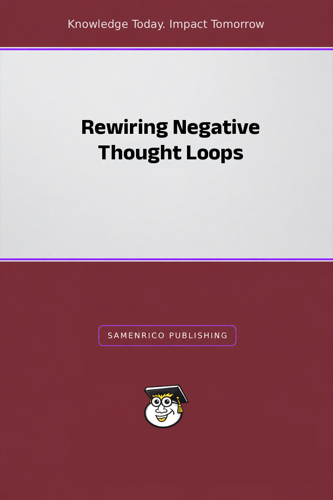
Rewiring Negative Thought Loops eBook
Break repetitive pessimistic patterns using cognit
Break repetitive pessimistic patterns using cognitive restructuring and affirmations.
Formats
Free sample
Chapter 1: The Superhighway in Your Head--–- It is 3:00 AM. You are awake. Your mind is replaying a mistake you made at work yesterday. The mistake was small—you sent an email to the wrong person, a minor error that was corrected within minutes. But in the quiet dark, the mistake has grown.
Your boss will think you are incompetent. You will be passed over for promotion. Your career is over. Your family will suffer. You will die alone.
All from a misdirected email.This is the spiral. This is the loop. And if you are like most people, you know this experience intimately. You have your own version of it. Maybe it is not a work mistake.
Maybe it is a conversation that went wrong, a comment someone made that you cannot stop dissecting, a future scenario that has not happened yet but already feels catastrophic. The content changes. The shape is the same.You have tried to stop. You have told yourself to think about something else. You have scrolled through your phone.
You have gotten up and gotten a glass of water. Nothing works. The thought comes back. It always comes back. And with each return, it feels more true, more inevitable, more like a fact about the world rather than a story your brain is telling you.Here is the truth that most self-help books will not tell you.
You cannot just "stop thinking about it." The effort to suppress a thought makes it stronger. The more you try not to think about a pink elephant, the more you think about a pink elephant. This is not a character flaw. It is neurology. And until you understand the neurology, you will keep fighting a battle you cannot win.This chapter is about that neurology.
It is about why your brain does this to you, why it is not your fault, and why the solution is not elimination but rewiring. By the end of this chapter, you will understand the architecture of your own loops. You will have a framework for distinguishing between helpful negative thinking and harmful loops. And you will take the first step toward building a new superhighway in your head.The Architecture of a Loop Before we can break a loop, we need to understand what a loop actually is. Let me define three terms that will be used consistently throughout this book.A thought is a single mental event.
"I made a mistake." That is a thought. It lasts a moment. It passes.A loop is a sequence of repeating thoughts that reinforce each other. "I made a mistake. That mistake proves I am incompetent.
Because I am incompetent, I will fail at everything. Because I will fail at everything, my career is over." Each thought triggers the next. The sequence loops back on itself. The mistake proves incompetence. The incompetence predicts failure.
The failure confirms the original mistake was meaningful. Around and around.A pattern is a habitual loop that has become automatic. You do not notice it starting. You are just suddenly in the middle of it. The pattern has been traveled so many times that your brain defaults to it without conscious effort.
It is like a path through a forest. The first time you walk it, you push through branches and stumble over roots. The hundredth time, it is a worn trail. The thousandth time, it is a superhighway.Most people who struggle with negative thinking are not dealing with single thoughts. They are dealing with superhighways.
The path is so worn that the brain does not even consider alternatives. It simply defaults to the familiar route, the same way water flows downhill along the path of least resistance.This is not a metaphor. It is biology.The Neuroscience of Repetition The human brain is made up of approximately 86 billion neurons. Each neuron connects to thousands of others, forming a vast, interconnected network. When you have a thought, a specific pattern of neurons fires together.
The first time you have that thought, the connection is weak. The neurons barely know each other.But here is the key. Every time you have that thought again, the same neurons fire together again. And when neurons fire together repeatedly, they wire together. This is Hebb's Law, named after the Canadian psychologist Donald Hebb who first proposed it in 1949: "Neurons that fire together wire together."Think of it like a path through a field of tall grass.
The first person who walks through pushes the grass aside, but it springs back. The second person walks in the same path, and the grass bends a little more. By the hundredth person, the grass is flattened. By the thousandth person, it is not even grass anymore. It is a dirt road.
By the ten-thousandth person, it is a paved highway.Your negative thought loops are paved highways. You have traveled them so many times that your brain does not have to think about the route. It just goes. The thought appears, and before you know it, you are at the end of the loop, feeling anxious, ashamed, or hopeless, with no memory of how you got there.This is not a sign of weakness. It is a sign of a brain doing exactly what brains evolved to do: conserve energy by automating frequently used pathways.
Your brain is not trying to make you miserable. It is trying to be efficient. Unfortunately, it has become efficiently miserable.The Negativity Bias Why do negative thoughts become superhighways more easily than positive ones? Why does one criticism stick with you for days while ten compliments fade within hours? The answer lies in the negativity bias.The human brain evolved over millions of years in an environment where the primary goal was survival.
For your ancestors, missing a threat was far more dangerous than missing an opportunity. A berry bush that was not there meant a missed meal. A predator that was not seen meant death. The brain that prioritized negative information—that assumed the rustle in the grass was a lion rather than the wind—was the brain that survived to pass on its genes.You are the descendant of ancestors who were very good at worrying. Their worry kept them alive.
But the environment that shaped your brain no longer exists. You are not being hunted by predators. A critical email is not a lion. A social slight is not a threat to your survival. But your brain does not know that.
It is using ancient software to process modern problems.The negativity bias means that negative experiences are processed more thoroughly, remembered more vividly, and recalled more easily than positive ones. This is why you can remember an embarrassing moment from middle school as if it happened yesterday, but you cannot remember what you had for breakfast three days ago. The embarrassing moment was a threat to social belonging, and your brain treated it as a survival event.The negativity bias is not a flaw. It is a feature. It kept your ancestors alive.
But it is a feature that causes enormous suffering in the modern world, where most of the threats we face are…
This is the end of the free sample. Get the eBook to keep going. Buy now
About this book
Details
- Author
- Palumbo Amina
- Publisher
- SamEnrico
- Language
- English
- Genre
- Non-Fiction, Self-Help
- Released
- 2026-06-07
- Pages (approx.)
- 130
- Available as
- eBook, Audiobook

Read better in the ZLOADR app
Your eBooks on your phone or tablet. Sign in with your SamEnrico account and start reading.
More by Palumbo Amina
 Incubation For IBS Gut Problems GuidePalumbo Amina$11.99
 Jealousy Myths DebunkedPalumbo Amina$11.99
 TM for Job Interviews GuidePalumbo Amina$11.99
 The Senior Pet Loss GuidePalumbo Amina$11.99
 Shadows of the Aegean: The Secret War of the Peloponnesian ConflictPalumbo Amina$11.99
 How to Become a Leather CoaterPalumbo Amina$11.99
 Peru Invoice Factoring GuidePalumbo Amina$12.99
 Free Gumroad Validation GuidePalumbo Amina$12.99
 Understanding Thyroid, Renal and Digital AnomaliesPalumbo Amina$17.99
 Security Systems TechnicianPalumbo Amina$11.99
You may also like
 Hong Kong Handover 1997Dunn Johnnie$11.99
 Zumba For Postnatal Recovery CourseNeal Christian$11.99
 Zumba for BeginnersLadner Nikia$11.99
 YouTube Comment Mining GuideHumes Pandora$12.99
 Worry Box MeditationCarlin Rudy$11.99
 Workplace Stress MeditationNguyen Lynn$11.99
 Workplace Stress and Sleep RepairHawley Ivory$11.99
 Workplace Perfectionism CureDelaney Jeffry$11.99
 Workplace Injustice Anger GuideWallen Isabelle$11.99
 Work Addiction and Burnout LinkGreenwood Ester$11.99
 Women in Yoga and WellnessBeattie Galina$11.99
 Women in Stand Up ComedyChun Evangeline$11.99