
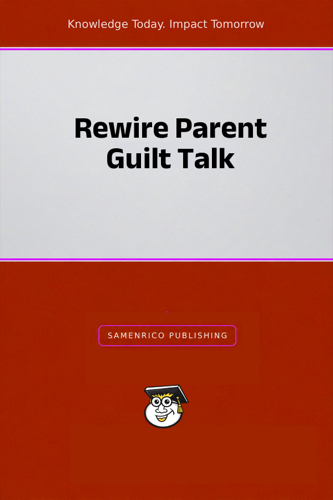
Rewire Parent Guilt Talk eBook
Change harsh self criticism about parenting choice
Change harsh self criticism about parenting choices and imperfections.
Formats
Free sample
Chapter 1: The Grammar of Guilt--If I told you that a single word could change the architecture of your brain, you might think I was selling something expensive. But here we are, on page one, and I am about to prove it to you using nothing but your own internal monologue.Think back to the last time you lost your patience with your child. Maybe it was this morning when they refused to put on their shoes. Maybe it was last night during the bedtime resistance campaign that lasted forty-seven minutes longer than your nervous system could tolerate. In that moment, you did something.
You raised your voice. You said something sharp. You walked away and closed the door harder than you meant to. And then, in the silence that followed, a voice inside your head began to speak.That voice used specific words. And those words are the subject of this entire book.Most parenting books will tell you that the problem is what you did.
They will give you strategies to stop yelling, to be more patient, to regulate your emotions, to respond instead of react. And those strategies are not wrong. But they are incomplete. Because before you can change your behavior, you have to change the voice that narrates your failures. And that voice does not speak in behaviors.
It speaks in grammar.The words you use to describe your parenting mistakes are not innocent. They are not neutral. They are neural triggers that reinforce shame pathways in your brain every single time you utter them. Words like should, just, always, never, if only, and can't believe are not descriptive tools. They are weapons aimed at your own sense of worth.
And the worst part is that you have been using them so automatically, for so many years, that you have mistaken them for reality.This chapter is going to teach you something that will feel almost too simple at first. It will feel like a trick. But I promise you it is not. Here it is: Parental guilt lives not in the events of parenting but in the sentence structure you use to narrate those events. Change the grammar, and you change the guilt.
Not because you are denying what happened, but because you are finally seeing what actually happened instead of the shame-amplified version your inner critic has been broadcasting on repeat.Let me show you what I mean.The Twelve Phrases That Are Keeping You Stuck Before we can rewire anything, we have to know what we are rewiring. So I want you to do something that might feel uncomfortable. I want you to recognize yourself in the following list.These are the twelve most common guilt-laden phrases that parents use. They come from thousands of hours of clinical work, parent coaching sessions, and support group conversations. Read each one slowly.
Notice if your body tightens, if your breath shortens, if your jaw clenches. That physical response is your nervous system recognizing a familiar pattern.One: "I should have been more patient."Two: "I should have known better."Three: "I just lost it again."Four: "I always do this."Five: "I never learn."Six: "A good mom would never lose her temper."Seven: "A good dad would not have said that."Eight: "I can't believe I did that."Nine: "If only I had more patience."Ten: "Why can't I just stay calm?"Eleven: "I'm so tired of messing up."Twelve: "What kind of parent yells at their child like that?"Do you see what these phrases have in common? They are not factual descriptions of behavior. They are not even accurate accounts of what happened. They are judgments disguised as observations.
They take a single moment of imperfection and transform it into a statement about your entire identity as a parent.Here is the truth that will set you free, but only if you let it: The difference between "I yelled" and "I am a parent who yells" is the difference between guilt and shame, between repair and paralysis, between growth and stagnation. One is a fact. The other is a fiction you have repeated so many times that it has become neural wallpaper.The Content Versus Grammar Distinction Every parenting book on the market focuses on content. What did you do? How can you do it differently next time?
What strategy can you implement? What skill can you learn? These are all valuable questions. But they miss something fundamental.Let me give you an example.Imagine two parents. Both yelled at their child this morning.
Both feel terrible about it. Both want to change. Parent A says to herself, "I yelled at my child. That hurt him. I want to figure out what triggered me so I can respond differently next time." Parent B says to himself, "I always yell.
I never learn. A good dad would not have done that. What is wrong with me?"The content of what happened is identical. The grammar is completely different.Parent A used descriptive language. She stated a fact, acknowledged the impact, and expressed a desire to change.
Her sentence structure leaves room for growth, for learning, for repair. Parent B used judgmental language. He turned a behavior into an identity, a moment into a life sentence. His sentence structure leaves no room for anything except more shame.Here is what the research on neuroplasticity tells us: Every time you repeat a thought, you strengthen the neural pathway that produces it. The brain does not distinguish between true and false.
It distinguishes between repeated and not repeated. So when Parent B says "I always yell" for the thousandth time, his brain literally builds a superhighway for that belief. It becomes easier and faster to access. It becomes harder to question. It starts to feel like reality.But it is not reality.
Reality is that Parent B yelled this morning. Reality is not that he "always" yells. The word "always" is not a fact. It is a grammatical structure that amplifies guilt and blocks learning. And you have been treating it like the weather.This entire book is built on a single, radical proposition: You can change your brain by changing your sentences.
Not by pretending you did not yell. Not by lowering your standards. Not by making excuses. But by learning to speak accurately about what actually happened, without the amplification of shame-laden grammar.The Anti-Perfectionism Lens: Why "Not Enough" Is a Language Disorder There is a reason so many parents speak this way to themselves. It is not because you are uniquely broken or unusually self-critical.
It is because you live in a culture that has sold you a version of perfectionism that is actually a language disorder.Perfectionism, as it is commonly understood, is the belief that you should be flawless. But that is not quite right. Perfectionism is not a belief about outcomes. It is a repetitive loop of "not enough" that keeps you striving for an unattainable standard while punishing yourself for every deviation. And that loop is made of words.Think about the messages you have absorbed, not just from your family of origin, but from social media, from parenting forums, from…
This is the end of the free sample. Get the eBook to keep going. Buy now
About this book
Details
- Author
- Quintana Jerlene
- Publisher
- SamEnrico
- Language
- English
- Genre
- Non-Fiction, Self-Help, Parenting
- Released
- 2026-06-09
- Pages (approx.)
- 134
- Available as
- eBook, Audiobook

Read better in the ZLOADR app
Your eBooks on your phone or tablet. Sign in with your SamEnrico account and start reading.
More by Quintana Jerlene
 Daniel Loeb Third PointQuintana Jerlene$11.99
 Convenience Store Spending CycleQuintana Jerlene$11.99
 Medicine Nobel Breakthroughs GuideQuintana Jerlene$11.99
 The Physics Nobel LasersQuintana Jerlene$11.99
 Swallowing Hard Stress SignalQuintana Jerlene$11.99
 Anapanasati in NatureQuintana Jerlene$11.99
 Amy Schumer LeatherQuintana Jerlene$11.99
 The Lost Gold of Lima: A Million-Dollar Heist from the DeepQuintana Jerlene$11.99
 Shadows Over Saigon: The CIA's Secret War in LaosQuintana Jerlene$11.99
 The Last Stand of the Entebbe Hostages: A Delta Force MiracleQuintana Jerlene$11.99
 How to Produce Body ScrubQuintana Jerlene$11.99
 Growing ConicosiaQuintana Jerlene$11.99
You may also like
 Hong Kong Handover 1997Dunn Johnnie$11.99
 Zumba For Postnatal Recovery CourseNeal Christian$11.99
 Zumba for BeginnersLadner Nikia$11.99
 YouTube Comment Mining GuideHumes Pandora$12.99
 Worry Box MeditationCarlin Rudy$11.99
 Workplace Stress MeditationNguyen Lynn$11.99
 Workplace Stress and Sleep RepairHawley Ivory$11.99
 Workplace Perfectionism CureDelaney Jeffry$11.99
 Workplace Injustice Anger GuideWallen Isabelle$11.99
 Work Addiction and Burnout LinkGreenwood Ester$11.99
 Women in Yoga and WellnessBeattie Galina$11.99
 Women in Stand Up ComedyChun Evangeline$11.99