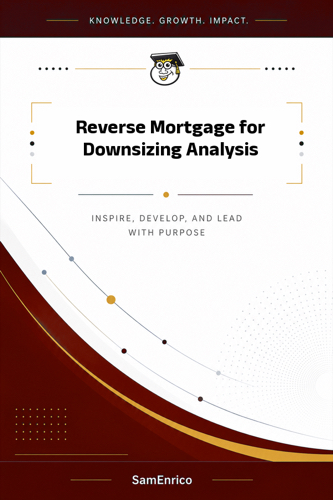
Reverse Mortgage for Downsizing Analysis eBook
Determine if a reverse mortgage could fund a downs
Determine if a reverse mortgage could fund a downsized home purchase or renovation.
Formats
Free sample
Chapter 1: The $127,000 Mistake...--–- Margaret’s hands trembled as she signed the closing documents. Not from fear or doubt, but from the quiet satisfaction of finally doing what every financial expert had told her was the “responsible” thing. At seventy-four years old, she was selling the four-bedroom colonial where she had raised three children and buried one husband. She was buying a tidy two-bedroom ranch house twenty minutes closer to her daughter’s family. She was paying cash.
No mortgage. No debt. Free and clear.The real estate agent had congratulated her. Her daughter had hugged her. Her son-in-law had called it a “smart financial move.” Margaret felt proud.
She had done the right thing.Three years later, Margaret sat alone in her new living room, staring at a medical bill she could not pay. Her knee replacement had required six weeks of in-home physical therapy. Her savings were depleted. Her daughter had quietly mentioned that the grandkids needed help with college tuition. And Margaret’s $400,000 nest egg—the one she had worked forty-two years to accumulate—was now a $280,000 nest egg.
She had spent $120,000 of it on the difference between her old home’s sale price and the new home’s purchase price, plus moving costs, plus taxes, plus the unexpected renovation of a bathroom that had hidden mold.She had done everything right. And she was running out of money.Margaret’s story is not a cautionary tale about poor planning. It is a story about conventional wisdom that has not been updated for the twenty-first century. It is a story about what happens when well-meaning advice collides with the mathematics of longevity, interest rates, and opportunity cost. And it is the reason you are holding this book.You have been told a lie.
The lie is that the safest, smartest, most responsible way to downsize in retirement is to pay cash for your next home. The lie is delivered by financial advisors who do not understand housing wealth. It is reinforced by adult children who confuse “no debt” with “no risk.” And it is repeated by real estate agents who simply want the easiest possible transaction.The truth—backed by fifteen years of retirement income research, actuarial tables, and portfolio performance data—is that paying cash for a downsized home is often the most expensive way to move. Not sometimes. Not in rare edge cases.
Often.This book is going to show you a different path. It is a path that uses a financial tool you have probably dismissed as a “last resort” for desperate people. That tool is the reverse mortgage. But not the reverse mortgage your uncle took out in 1995. Not the reverse mortgage you saw advertised on late-night television by a grinning actor.
The modern reverse mortgage—specifically the Home Equity Conversion Mortgage for Purchase, or HECM for Purchase—is one of the most misunderstood, underutilized, and potentially powerful financial instruments available to Americans over the age of sixty-two.By the time you finish this chapter, you will understand why Margaret’s “responsible” decision cost her more than $100,000 in lost opportunity. You will understand why the conventional advice to “own your home free and clear” is outdated for a generation that may live thirty more years in retirement. And you will begin to see a different possibility: a way to move into a better home, in a better location, with better features, while preserving your savings and eliminating your monthly housing payment.This is not magic. This is math.The Downsize Surprise: What the Statistics Don’t Tell You Let us start with a paradox. Every year, AARP and the National Association of Realtors survey Americans who have moved in retirement.
The data consistently show that more than half of seniors who move do so to a smaller home. The logic seems unassailable: fewer rooms to clean, lower utility bills, less yard work, and a smaller tax bill. It sounds like common sense.But here is what the headline statistics do not show. When researchers dig deeper and survey the same homeowners two or three years after their move, a significant percentage—in some studies, as high as thirty-eight percent—express regret. They regret the location.
They regret the quality of the home they bought. They regret the loss of liquidity. They regret the unexpected costs. Most of all, they regret trading a home they loved for a home that was merely “cheaper.”This is the Downsize Surprise. It happens when seniors confuse price with value.
A home that costs less money often costs more in terms of quality of life. It may be farther from medical care. It may have older plumbing or a failing roof. It may be in a neighborhood with higher crime or worse schools (which matters if grandchildren visit). It may simply be smaller in all the wrong ways—cramped kitchens, tiny closets, a single bathroom that becomes a battlefield every morning.The Downsize Surprise is not caused by bad luck.
It is caused by bad math. Specifically, it is caused by the assumption that the only way to avoid a monthly mortgage payment is to pay cash. That assumption forces retirees into a constrained set of choices: either rent (with all its inflation risks), or buy a cheaper home (with all its quality risks), or stay in an oversized home (with all its maintenance and tax risks).There is a fourth option. It requires understanding how a reverse mortgage for purchase works. And it requires unlearning almost everything you have been told about debt in retirement.The Birth of a Myth: How “Debt Free” Became the Golden Calf To understand why the conventional wisdom is wrong, you have to understand where that wisdom came from.
The idea that seniors should own their homes free and clear is not ancient history. It emerged in the post-World War II era, when the average life expectancy at age sixty-five was about twelve years. In 1950, a sixty-five-year-old American man could expect to live to about seventy-seven. A woman could expect to live to about seventy-nine.In that context, owning a paid-off home made perfect sense. You had a relatively short horizon.
You needed predictability. You wanted to reduce fixed expenses. And interest rates were high enough that borrowing money was genuinely expensive. Paying off your mortgage by the time you retired was a sensible goal.But here is the problem: you are not your grandparents. The average sixty-five-year-old today can expect to live another twenty to twenty-five years.
A healthy sixty-five-year-old woman has a fifty percent chance of living past age eighty-eight. A married couple has a fifty percent chance that one spouse will live past age ninety-two. Retirement is no longer a brief period of decline. For many, it is a three-decade chapter of active, engaged life.That changes everything. A thirty-year horizon means your home is not just a place to live.
It is a financial asset that interacts with your investment portfolio, your Social Security strategy, your long-term care planning, and your legacy goals. Treating your home as a “free and clear” static asset ignores the opportunity cost of the cash locked inside those walls.Opportunity cost is the…
This is the end of the free sample. Get the eBook to keep going. Buy now
About this book
Details
- Author
- Quezada Jillian
- Publisher
- SamEnrico
- Language
- English
- Genre
- Non-Fiction, Business Brief, Mortgage Finance
- Released
- 2026-06-10
- Pages (approx.)
- 144
- Available as
- eBook, Audiobook

Read better in the ZLOADR app
Your eBooks on your phone or tablet. Sign in with your SamEnrico account and start reading.
More by Quezada Jillian
 Stimulant Craving ManagementQuezada Jillian$11.99
 Name Memorization ScienceQuezada Jillian$11.99
 Mentoring Self Esteem GuideQuezada Jillian$11.99
 Half Sibling ReconciliationQuezada Jillian$11.99
 Senior Nap GuidelinesQuezada Jillian$11.99
 Compulsive Spender's Financial AuditQuezada Jillian$11.99
 OKRs for Engineering TeamsQuezada Jillian$11.99
 The Poisoner of Montreal: The Deadly Vendetta of Thérèse DéryQuezada Jillian$11.99
 The Lion’s Den: South Africa’s Greatest Prison BreakQuezada Jillian$11.99
 A Collector's Handbook to the Lamborghini IiQuezada Jillian$11.99
 API Reporting and Reconciliation HandbookQuezada Jillian$12.99
 Open Account Export TermsQuezada Jillian$12.99