
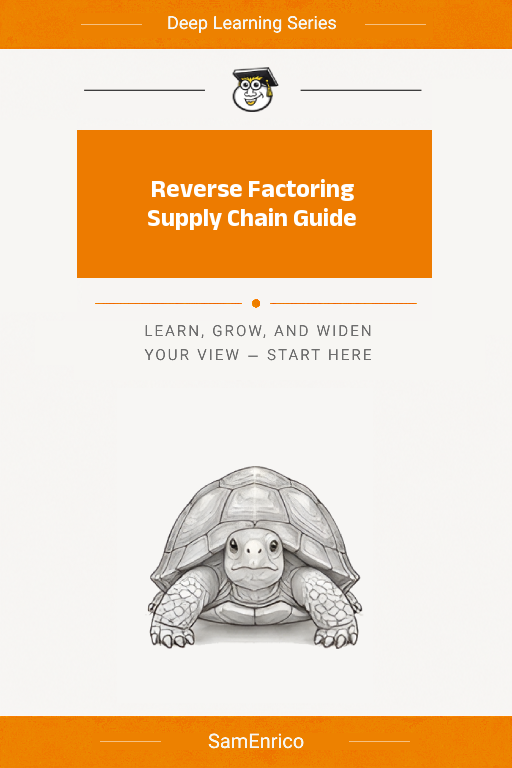
Reverse Factoring Supply Chain Guide eBook
Get early payment when large buyers arrange financ
by Royal Amie
Get early payment when large buyers arrange financing using their own credit strength to help suppliers.
Formats
Free sample
Chapter 1: The Cash Flow Trap--–- Every morning, Maria Vargas, the founder of a precision parts manufacturing company in Guadalajara, Mexico, opens her email with a specific dread. She employs 120 people, runs a certified ISO 9001 facility, and supplies critical components to a Fortune 500 automotive company in Detroit. Her relationship with that buyer is seven years old. Her product quality is excellent. And she is slowly going bankrupt.The buyer, a multinational corporation with an AA credit rating and a treasury department that manages billions in liquidity, recently extended its standard payment terms from 60 days to 90 days.
For the buyer, this extension is a triumph of working capital management. By delaying payment to thousands of suppliers like Maria's company, the buyer adds nearly $200 million in free cash flow to its balance sheet every quarter. The CFO receives a bonus tied to precisely this metric.For Maria, the math is devastating. She must purchase raw materials – steel, aluminum, specialty alloys – on delivery. She must pay her 120 employees every two weeks.
She must cover electricity, water, rent, and insurance before she ships a single part. Under the old 60-day terms, she was already borrowing from a local bank at 14% annual interest to bridge the gap between paying for materials and receiving payment from her buyer. Under the new 90-day terms, her borrowing needs have increased by 50%. The bank, seeing her stretched cash flow, has raised her rate to 18%.Maria has never missed a shipment. Her defect rate is below 0.5%.
But if something does not change, she will run out of cash in eight months. Her buyer, the Fortune 500 company, has no idea she is in distress. And if she fails, their assembly line will stop within 72 hours.This is the cash flow trap. And it is the single most destructive, least understood dynamic in modern global supply chains.The Structural Asymmetry That Breaks Suppliers The cash flow trap is not the result of malice or poor management. It is a structural feature of how large buyers and small suppliers interact in a financial system that privileges creditworthy corporations while penalizing everyone else.Consider the fundamental asymmetry.
A large buyer typically has access to capital at a weighted average cost of 3% to 6% annually. It can issue commercial paper, draw on revolving credit facilities, or tap bond markets with minimal friction. Its treasury department is staffed by professionals who optimize days payable outstanding (DPO) as a key performance indicator. Extending payment terms – moving from net 45 to net 60 to net 90 – is a direct, zero-cost way to increase free cash flow. The buyer does not need to negotiate with a bank; it simply changes its accounts payable policy.The supplier, by contrast, lives in a different financial universe.
A small or medium-sized manufacturer like Maria's company has no access to commercial paper or bond markets. Its only source of working capital is typically a commercial bank line of credit priced at prime plus a spread – often 10% to 20% annually, depending on the supplier's size, collateral, and country. If the supplier is young, has limited operating history, or operates in a perceived high-risk jurisdiction, the rate can exceed 25%. In extreme cases, suppliers resort to factoring – selling their unpaid invoices to a factor at a discount of 5% to 15% per invoice – which annualizes to an effective interest rate of 30% to 100% or more.The result is a system where the buyer's working capital improvement comes directly out of the supplier's cash flow. The buyer extends terms by 30 days and gains 30 days of free financing.
The supplier must borrow 30 days longer at 15% interest. The buyer's CFO gets a bonus. The supplier's founder gets a sleepless night.The Working Capital Trap: Why Longer Terms Eventually Hurt Buyers At this point, a skeptical reader might ask: Why should the buyer care? If suppliers are willing to accept longer terms, is this not simply efficient supply chain management?The answer, revealed through decades of supply chain failures, is that the buyer should care deeply because the cash flow trap eventually snaps back to harm the buyer. This phenomenon is called the Working Capital Trap, and it follows a predictable four-stage cycle.Stage one is Term Extension.
The buyer, under pressure to improve free cash flow, extends payment terms from 60 to 90 days. The buyer's DPO increases. Its cash conversion cycle shrinks. Quarterly earnings improve. The treasury department celebrates.Stage two is Supplier Stress.
Suppliers begin borrowing more at higher rates to cover the extended gap. Their profit margins compress. They delay maintenance, reduce inventory buffers, and stretch their own payables to subcontractors. Some suppliers become technically insolvent while still operating – paying today's bills with tomorrow's expected receipts.Stage three is Hidden Deterioration. The buyer's procurement organization notices nothing unusual.
Delivery times remain acceptable. Quality metrics hold steady. The supplier has not yet failed. But beneath the surface, the supplier is cutting corners. It is training fewer new workers.
It is letting equipment degrade. It is reducing safety stock. The buyer's risk is accumulating invisibly.Stage four is Sudden Failure. A single shock – a raw material price spike, a machine breakdown, a key employee departure, a customer bankruptcy – pushes the supplier over the edge. Production stops.
The buyer receives no warning because there was no single reportable event. The supplier simply does not ship. The buyer's assembly line goes dark.The Working Capital Trap is not theoretical. In 2017, a major European automotive manufacturer experienced exactly this pattern. Over three years, it had extended payment terms to a Tier 1 supplier of electrical components from 45 days to 105 days.
The supplier, a family-owned business with 800 employees, borrowed to cover the gap, first from its local bank, then from a more expensive alternative lender. When the supplier's largest raw material – copper – spiked 25% in six weeks, the supplier could not access additional credit. It defaulted on its bank loan. The bank seized its assets. Production at the automotive manufacturer stopped for eleven days.
The cost of the shutdown exceeded $300 million – more than ten times the working capital benefit the buyer had extracted from extended terms.Reverse Factoring: The Buyer's Credit Strength as a Supplier Lifeline This brings us to the solution that the remainder of this book will explore in exhaustive detail: reverse factoring. If the problem is that suppliers borrow at high rates while buyers borrow at low rates, the obvious solution is to allow suppliers to borrow using the buyer's credit rating. This is precisely what reverse factoring accomplishes.Reverse factoring, also known as approved payables financing or confirming in European markets, is a three-party arrangement between a buyer, a supplier, and a financial institution. The buyer approves a supplier's invoice for payment at a future date. The supplier then has the option to receive early payment from the financial institution at a discount.
The buyer pays the financial institution the full invoice amount at the original maturity date. The discount – the cost of early payment – is priced based on the buyer's credit rating, not the supplier's.To return to Maria's example: Under reverse factoring, her Fortune 500 buyer would approve her 100,000invoiceforpaymentin90days.Mariawouldlogintoasupplychainfinanceplatformandseethefollowingoffer:"Getpaid100,000 invoice for payment in 90 days. Maria would log into a supply chain finance platform and see the following offer: "Get paid 100,000invoiceforpaymentin90days.Mariawouldlogintoasupplychainfinanceplatformandseethefollowingoffer:"Getpaid99,200 in five days, or…
This is the end of the free sample. Get the eBook to keep going. Buy now
About this book
Details
- Author
- Royal Amie
- Publisher
- SamEnrico
- Language
- English
- Genre
- Non-Fiction, Business Brief
- Released
- 2026-05-30
- Pages (approx.)
- 152
- Available as
- eBook, Audiobook

Read better in the ZLOADR app
Your eBooks on your phone or tablet. Sign in with your SamEnrico account and start reading.
More by Royal Amie
 Presentation Font TypographyRoyal Amie$11.99
 Only Child Envy HealingRoyal Amie$11.99
 Dumbbell HIIT GuideRoyal Amie$11.99
 The Devil's Dollhouse: The Forgotten Accused of SalemRoyal Amie$11.99
 Phenakite MiningRoyal Amie$11.99
 How to Start a Oil Seal Business (Beginners Guide)Royal Amie$11.99
 How to Produce Chafing DishesRoyal Amie$11.99
You may also like
 Hong Kong Handover 1997Dunn Johnnie$11.99
 Zumba For Postnatal Recovery CourseNeal Christian$11.99
 Zumba for BeginnersLadner Nikia$11.99
 YouTube Comment Mining GuideHumes Pandora$12.99
 Worry Box MeditationCarlin Rudy$11.99
 Workplace Stress MeditationNguyen Lynn$11.99
 Workplace Stress and Sleep RepairHawley Ivory$11.99
 Workplace Perfectionism CureDelaney Jeffry$11.99
 Workplace Injustice Anger GuideWallen Isabelle$11.99
 Work Addiction and Burnout LinkGreenwood Ester$11.99
 Women in Yoga and WellnessBeattie Galina$11.99
 Women in Stand Up ComedyChun Evangeline$11.99