
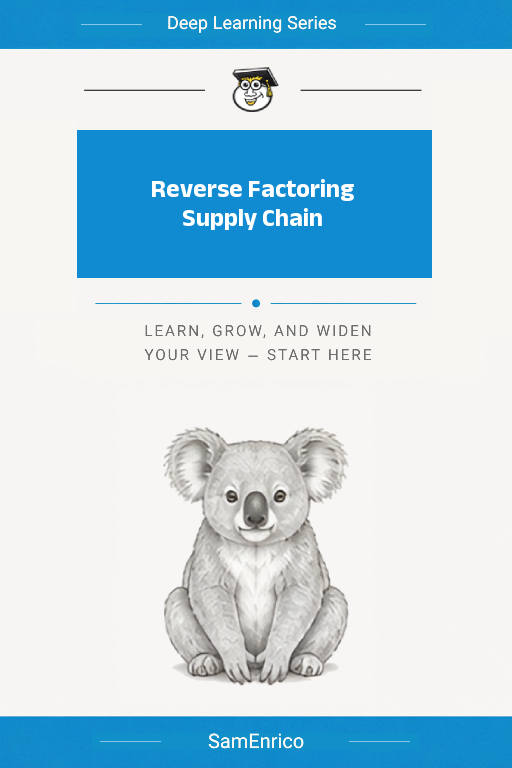
Reverse Factoring Supply Chain eBook
Get early payment when large buyers arrange financ
by Harry Bernie
Get early payment when large buyers arrange financing using their own credit strength to help suppliers.
Formats
Free sample
Chapter 1: The Silent Killer--–- Maria Gonzalez, the founder of a precision auto parts company in Monterrey, Mexico, had done everything right. She had built a reputation for flawless delivery, invested in ISO-certified quality controls, and secured a contract to supply a Fortune 500 automotive manufacturer. The contract was her golden ticket—or so she thought. Within eighteen months, her company was dead. Not because of poor quality, not because of a market crash, and not because of competition.
Her company died because her customer took 120 days to pay. "They didn't kill us," Maria told a local business journal shortly before closing her doors. "They just let us bleed out."This is not an isolated tragedy. It is a systemic failure hidden inside the engine of global commerce. Every day, millions of small and medium-sized suppliers around the world deliver goods to large buyers.
Those goods are accepted, used, and often sold to end customers long before the supplier receives a single dollar. The large buyer—the "anchor" in the supply chain—enjoys the luxury of extended payment terms. The small supplier suffers the agony of waiting for cash that should have arrived weeks ago.The result is a silent killer that destroys more small businesses than bankruptcy, more than fraud, and more than any single economic event. It is the working capital gap, and it is the single most preventable cause of supplier failure in the modern economy.The Anatomy of Asphyxiation To understand why suppliers die while buyers feast, we must first understand the basic mechanics of business cash flow. Every company operates on a cycle: purchase raw materials, transform them into products, deliver to customers, and wait for payment.
For large buyers, this cycle is a source of competitive advantage. For small suppliers, it is a source of slow suffocation.Consider a typical transaction between a large buyer—let us call them Mega Corp—and a small supplier, let us call them Precision Parts. Precision Parts receives an order for $100,000 worth of components. To fulfill that order, they must purchase raw materials, pay their workers, cover electricity and shipping costs, and maintain their machinery. These are real expenses that require real cash, often within 15 to 30 days of incurring them.Mega Corp, on the other hand, has negotiated payment terms of 90 days from the date of invoice.
In some industries—retail, automotive, and construction—120 days has become the new normal. During those 90 to 120 days, Mega Corp has already received the goods, inspected them, used them in production, and often sold the finished products to their own customers. They have generated revenue from Precision Parts' work before they have paid a single dollar for it.This is not accidental. It is deliberate financial engineering. Large companies measure their efficiency using a metric called Days Payable Outstanding (DPO) .
The longer a buyer takes to pay suppliers, the higher their DPO, and the more cash they hold on their balance sheet. Wall Street rewards high DPO. Analysts praise companies that "manage working capital effectively." Treasury departments receive bonuses for extending payment terms. The incentive structure is perfectly aligned against the small supplier.Meanwhile, Precision Parts measures its own health using Days Sales Outstanding (DSO) —the average time it takes to collect payment from customers. Every day that Mega Corp delays payment, Precision Parts' DSO rises, their cash reserves shrink, and their cost of borrowing increases.
The asymmetry is brutal: one company's efficiency is the other company's crisis.The Cost of Waiting: A Mathematical Horror Story The numbers behind this phenomenon are not abstract financial abstractions. They are the difference between survival and extinction. Let us run the math on Precision Parts to understand what waiting really costs.Precision Parts has annual revenue of 10million.Theirlargestcustomer,Mega Corp,represents4010 million. Their largest customer, Mega Corp, represents 40% of that revenue, or 10million.Theirlargestcustomer,Mega Corp,represents404 million per year. Under Mega Corp's payment terms of 90 days, Precision Parts is effectively financing 1millionof Mega Corp′sworkingcapitalatanygiventime(calculatedas1 million of Mega Corp's working capital at any given time (calculated as 1millionof Mega Corp′sworkingcapitalatanygiventime(calculatedas4 million per year divided by 4, because there are four 90-day periods in a year).
That $1 million is money that Precision Parts has spent but not yet received.Where does Precision Parts get that $1 million? They have three options, none of them good.Option One: Bank Overdraft. Precision Parts can draw on a bank line of credit at an annual interest rate of 15% to 20%. This is typical for small to medium enterprises without investment-grade credit ratings. On 1million,thatcosts1 million, that costs 1million,thatcosts150,000 to 200,000peryearininterestalone.Thatis200,000 per year in interest alone.
That is 200,000peryearininterestalone.Thatis150,000 that does not go to new equipment, worker raises, or profit.Option Two: Factoring (Selling Receivables). Precision Parts can sell their unpaid invoices to a factor at a discount. Typical factoring rates range from 2% to 5% of the invoice value per month. On a 90-day invoice, that means paying 6% to 15% of the invoice value just to get paid early. On 1million,thatis1 million, that is 1million,thatis60,000 to $150,000 in fees.Option Three: Waiting.
Precision Parts can simply wait 90 days and hope they have enough cash reserves to survive. But most small suppliers operate on razor-thin margins of 5% to 10%. If Mega Corp is paying in 90 days, Precision Parts needs to have enough cash to cover 90 days of operating expenses. With a 5% profit margin, they would need to grow revenue by a factor of 20 just to generate enough cash to cover the waiting period. This is mathematically impossible for most firms.Now add the multiplier effect.
Mega Corp is not Precision Parts' only customer. But if Mega Corp represents 40% of revenue, the other 60% likely comes from customers with similarly long payment terms. The total amount of unpaid receivables on Precision Parts' balance sheet might be 2.5millionatanygiventime.At152.5 million at any given time. At 15% interest, that is 2.5millionatanygiventime.At15375,000 per year in financing costs. For a company with 10millioninrevenueanda510 million in revenue and a 5% profit margin (10millioninrevenueanda5500,000 in annual profit), the cost of waiting consumes three-quarters of their entire profit.This is why Maria Gonzalez's company died.
She was not losing money on each transaction. She was making a reasonable margin. But the waiting period between delivery and payment created a cash flow gap that no amount of operational efficiency could bridge. She needed to borrow to survive the gap, and the interest on that borrowing erased her profits. Eventually, the bank cut off her credit line, and the death spiral began.The Anchor Buyer Paradox Here is where the story takes an unexpected turn.
Mega Corp is not indifferent to Precision Parts' suffering. In fact, Mega Corp has a powerful incentive to keep Precision Parts alive. If Precision Parts goes bankrupt, Mega Corp loses a supplier. They must find a replacement, qualify them, integrate them into production, and hope the quality is consistent. That process takes months and costs far more than the interest on a late payment.Large buyers understand this.
They call it supply chain risk, and they spend millions of dollars managing it. Yet, paradoxically, their own payment policies are one of the largest sources of that risk. Every day they extend payment terms, they increase…
This is the end of the free sample. Get the eBook to keep going. Buy now
About this book
Details
- Author
- Harry Bernie
- Publisher
- SamEnrico
- Language
- English
- Genre
- Non-Fiction, Business Brief
- Released
- 2026-05-29
- Pages (approx.)
- 158
- Available as
- eBook, Audiobook

Read better in the ZLOADR app
Your eBooks on your phone or tablet. Sign in with your SamEnrico account and start reading.
More by Harry Bernie
 Clean Energy Investment MapHarry Bernie$11.99
 Alcohol Recovery and SpiritualityHarry Bernie$11.99
 Neglect Trauma Triggers GuideHarry Bernie$11.99
 Postpartum Journaling for HealingHarry Bernie$11.99
 The IBS Food Diary MethodHarry Bernie$11.99
 Kettlebell Strength MethodHarry Bernie$11.99
 Cohort Analysis GuideHarry Bernie$11.99
 Sarcopenia Walking Speed TestHarry Bernie$11.99
 Dreaming for Career CrossroadsHarry Bernie$11.99
 The Silent Storm: Iran's Revolutionary Artillery Innovations in the Iran-Iraq WarHarry Bernie$11.99
 Into the Abyss: Borneo’s Hidden Underwater WorldsHarry Bernie$11.99
 Glitch in the System: The 2012 Apple Maps DebacleHarry Bernie$11.99
You may also like
 Hong Kong Handover 1997Dunn Johnnie$11.99
 Zumba For Postnatal Recovery CourseNeal Christian$11.99
 Zumba for BeginnersLadner Nikia$11.99
 YouTube Comment Mining GuideHumes Pandora$12.99
 Worry Box MeditationCarlin Rudy$11.99
 Workplace Stress MeditationNguyen Lynn$11.99
 Workplace Stress and Sleep RepairHawley Ivory$11.99
 Workplace Perfectionism CureDelaney Jeffry$11.99
 Workplace Injustice Anger GuideWallen Isabelle$11.99
 Work Addiction and Burnout LinkGreenwood Ester$11.99
 Women in Yoga and WellnessBeattie Galina$11.99
 Women in Stand Up ComedyChun Evangeline$11.99