
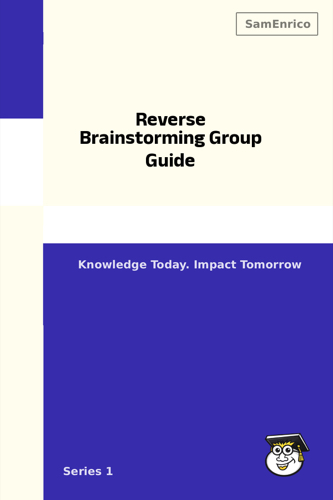
Reverse Brainstorming Group Guide eBook
Finds solutions by first imagining how to cause th
Finds solutions by first imagining how to cause the problem, then reversing it.
Formats
Free sample
Chapter 1: The Failure of Forward Thinking--Every problem-solving session begins with hope.The facilitator arrives early, arranges the chairs in a semicircle, sets out fresh markers, and writes the problem on the whiteboard in clear, optimistic letters. The participants filter in, coffee in hand, carrying the quiet expectation that today will be different. Today, they will crack the problem that has been eluding them for weeks. Today, someone will have the breakthrough insight that changes everything. Someone says, "Let's brainstorm," and the room leans forward, ready.And then the same thing happens that always happens.The first few ideas come easily.
They are obvious solutions, safe suggestions, the low-hanging fruit that everyone has already considered. Someone says, "We could hire more staff." Someone else says, "We could extend our hours." A third person offers, "We could send automated responses." The facilitator writes them down, grateful for the momentum.But then the pace slows. The easy ideas are exhausted, and the group must reach for something harder. People start repeating themselves, offering variations of ideas already on the board. The extroverts dominate the airspace while the introverts retreat into silence.
Someone suggests an idea that feels slightly risky, slightly unconventional, slightly outside the bounds of what the group has considered before. Before anyone can build on it, someone else says, "That won't work because we tried something like that last year and it failed."The energy drains from the room. People check their phones. The facilitator glances at the clock, wondering how much longer this agony must continue. The session ends with a list of ideas that are neither creative nor useful, and the problem remains stubbornly, depressingly unsolved.This scene plays out in conference rooms around the world every single day.
Not because the participants lack intelligence or creativity. Not because the facilitators are incompetent. But because traditional brainstorming has fundamental flaws that no amount of enthusiasm or fresh markers can fix.The Invention of Brainstorming In the 1940s, an advertising executive named Alex Osborn was frustrated. His creative teams were producing the same predictable ideas, recycling the same tired concepts, failing to break new ground. So he developed a method he called "brainstorming," built on four simple rules: generate as many ideas as possible, withhold criticism, welcome wild and unconventional ideas, and combine and improve upon existing ideas.On paper, these rules make perfect sense.
If you want creative ideas, you need to create a space where people feel safe sharing them. If you judge ideas too early, you shut down the creative process. If you only pursue the safe and obvious, you will never discover the innovative and transformative.Osborn's method spread rapidly through the business world. It became standard practice in corporations, nonprofits, and government agencies. It was taught in business schools, written into facilitation guides, and repeated in countless workshops.
"Let's brainstorm" became the default response to any difficult problem.But here is the uncomfortable truth that the business world has spent eighty years avoiding: brainstorming does not work the way Osborn promised. The research is clear, consistent, and damning.The Three Hidden Flaws Yale University conducted some of the earliest research on brainstorming in the 1950s, just a decade after Osborn introduced his method. The results were surprising. Students working alone generated nearly twice as many ideas as students working in groups, and independent judges rated the solo ideas as significantly more creative.Follow-up studies over the following decades confirmed the finding again and again. Groups generate fewer high-quality ideas than the same number of individuals working alone.
The social dynamics of groups—dominance, conformity, and evaluation apprehension—actively suppress creativity.But why? If Osborn's rules make intuitive sense, why do they fail in practice? The answer lies in three hidden flaws that no amount of whiteboard markers can overcome.Flaw One: The Psychological Safety Paradox Osborn's first rule—withhold criticism—addresses a real problem. People fear judgment. They hold back their most interesting ideas because they worry about looking foolish.
Creating psychological safety should, in theory, solve this problem.But here is the paradox: despite the explicit "no criticism" rule, participants know they will be judged. Their ideas will be compared, evaluated, and ultimately accepted or rejected. The facilitator may say "no criticism," but the organization will still decide which ideas to fund, which to implement, and which to abandon. The implicit pressure never disappears.This leads to what psychologists call "evaluation apprehension." Participants self-censor before they even speak, filtering out ideas that feel too risky, too unconventional, or too likely to provoke negative reactions. The ideas that make it onto the board are the safe ones, the obvious ones, the ones that no one will object to.
Creativity is filtered out before it ever sees the light.The result is a list of ideas that everyone already had—ideas that have been considered and discarded, ideas that have failed before, ideas that will fail again.Flaw Two: The Cognitive Fixedness Trap The human brain is a pattern-recognition machine. It evolved to find familiar patterns because familiar patterns kept our ancestors alive. A rustling bush might be a predator; better to assume the worst and flee. A certain berry caused sickness last time; better to avoid it forever.This pattern-recognition ability is useful for survival but disastrous for creativity. When you ask a group to solve a problem, their brains immediately reach for solutions that have worked before.
They search their mental libraries for familiar patterns, successful approaches, proven methods. This is efficient for routine problems—if you have done it before, you can probably do it again.But for creative challenges, the familiar is the enemy. A novel problem cannot be solved with familiar solutions. The very efficiency that makes the brain good at routine tasks makes it terrible at innovation. You cannot think your way to a new solution by retracing old paths.This is known as "functional fixedness"—the inability to see a problem from a fresh angle because you are trapped in familiar patterns.
Traditional brainstorming does nothing to break functional fixedness. In fact, it reinforces it. By asking "How do we solve this problem?" you direct the brain toward its existing solution patterns, not away from them.Flaw Three: The Illusion of Productivity Have you ever left a brainstorming session feeling exhausted but accomplished? The board is full of sticky notes. The flip chart has pages of ideas.
Everyone participated. It felt productive.That feeling is an illusion.Quantity is not quality. A board full of bad ideas is not progress toward a good idea. And the social dynamics of brainstorming actively work against quality.Research has identified several mechanisms that suppress quality in group brainstorming. Production blocking occurs when only one person can speak at a time; while they speak, others forget their ideas or lose the thread of their thinking.
Social loafing occurs when individuals exert less effort in a group than they would alone, assuming others will carry the weight. Conformity pressure occurs when participants align their ideas with the emerging group consensus, suppressing diversity of thought.The result is a session that feels productive but produces ideas that are less creative, less diverse, and less useful than…
This is the end of the free sample. Get the eBook to keep going. Buy now
About this book
Details
- Author
- Gaddy Celinda
- Publisher
- SamEnrico
- Language
- English
- Genre
- Non-Fiction, Self-Help, Lateral Thinking
- Released
- 2026-06-10
- Pages (approx.)
- 116
- Available as
- eBook, Audiobook

Read better in the ZLOADR app
Your eBooks on your phone or tablet. Sign in with your SamEnrico account and start reading.
More by Gaddy Celinda
 Student Networking DubaiGaddy Celinda$11.99
 Weightlifting Hypnosis WorkbookGaddy Celinda$11.99
 Dental Evidence in CourtGaddy Celinda$11.99
 One Touch RuleGaddy Celinda$11.99
 Self Hypnosis for Climate AnxietyGaddy Celinda$11.99
 Acupuncture for Women's HealthGaddy Celinda$11.99
 Massage For HeadachesGaddy Celinda$11.99
 The Mathematicians of Timbuktu: Unveiling Africa's Forgotten GeniusesGaddy Celinda$11.99
 The Lion and the Eagle: Henry V and the Forge of EnglandGaddy Celinda$11.99
 One Page Marketing Playbook for MoversGaddy Celinda$12.99
 Filipino Content Writing GuideGaddy Celinda$12.99
 Seahorses: Unique FishGaddy Celinda$11.99
You may also like
 Collaborative Lateral Thinking GuideWithrow Ellamae$11.99
 Six Thinking Hats MethodSimons Ardath$11.99
 Reverse Thinking MethodDavenport Antwan$11.99
 Assumption Reversal Team GameHuber September$11.99
 Six Thinking HatsCaraballo Barabara$11.99
 Random Input Creativity MethodCarrington Mariam$11.99
 Building on Bad IdeasFrancisco Felica$11.99