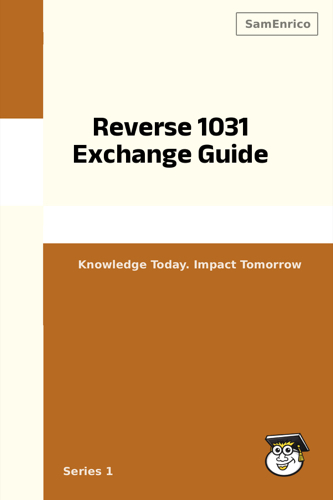
Reverse 1031 Exchange Guide eBook
Acquire new property before selling old one using
Acquire new property before selling old one using qualified intermediary.
Formats
Free sample
Chapter 1: The Dream Property Dilemma--Sarah had ninety-six hours to close a deal that would change her life.On Tuesday morning, she toured a 20-unit apartment building in a fast-growing suburb of Austin, Texas. The numbers were exceptional: a 6.2% cap rate in a market where 5% was standard, below-market rents with immediate upside, and a seller who had owned the property for thirty years and wanted out before a major roof replacement became his problem. The asking price was $3.2 million. Sarah had $1.8 million in equity from her existing portfolio and a pre-approval letter for the remaining $1.4 million.The seller gave her until Friday to sign. Not to close—just to sign.
He had a backup offer from a cash buyer who would close in ten days. Sarah's current property, a fourplex worth $1.2 million, had been listed for six weeks with no serious offers. She could sell it, eventually. But not in ninety-six hours.On Thursday, she called her real estate agent. "Can you guarantee a closing on the fourplex by next Friday?" The agent laughed.
"In this market? Maybe in sixty days. Maybe."On Friday morning, the seller accepted the backup offer. The 20-unit building was gone.Eight months later, Sarah still hadn't found another property that matched the numbers. The Austin market had appreciated another 12%.
Her $1.8 million in equity now bought only $2.9 million of property instead of $3.2 million. She had lost $300,000 in purchasing power simply because she couldn't sell her fourplex fast enough.Sarah's story is not an exception. It is the rule.The Fundamental Flaw in Traditional 1031 Exchanges The Internal Revenue Code Section 1031 exchange is one of the most powerful wealth-building tools in American tax law. It allows you to sell investment property, defer all capital gains taxes, and reinvest the full proceeds into another investment property. The government essentially gives you an interest-free loan on your tax liability indefinitely, as long as you keep exchanging.But the traditional forward exchange—the structure that 90% of investors use—has a fatal flaw.
It requires you to sell first, then buy.Here is how a forward exchange works. On Day Zero, you close the sale of your old property. That sale triggers the exchange clock. You then have forty-five days to identify potential replacement properties in writing. You then have one hundred eighty days total from the sale to close on your new property.The problem is not the timeline.
The problem is what happens before Day Zero.Before you can start a forward exchange, you must find a buyer, negotiate a contract, and close on your old property. In a hot market, that can take thirty to ninety days. In a slow market, it can take six months or more. During that entire period, you are watching the market for replacement properties. You see deals come and go.
You cannot make an offer on any of them because you do not yet have the proceeds from your sale. You do not even have the certainty of a closing date. A buyer could fall through on Day Thirty-Nine of your identification period, and you would have to start over.The forward exchange was designed for a different era. It assumes that properties trade slowly, that sellers are patient, and that you can time your sale and purchase with precision. That era is over.Three Scenarios Where Waiting Means Losing The Dream Property Dilemma manifests in three distinct scenarios.
Every investor who has ever lost a deal will recognize at least one of them.Scenario One: The Hot Market In cities like Nashville, Austin, Phoenix, and Tampa, the average time on market for quality investment properties is measured in days, not weeks. Multiple offers are common. Sellers routinely receive offers with no contingencies, all-cash terms, and ten-day closings.If you submit an offer that says "contingent on the sale of the buyer's existing property," your offer goes to the bottom of the pile. In a competitive situation, it may not even be presented. The seller's agent will tell your agent: "Call us when you have a cash offer or a non-contingent offer."The hot market scenario is the most common reason investors turn to reverse exchanges.
They are not choosing complexity. They are choosing survival.Scenario Two: The Unique Property Some properties are inherently irreplaceable. A waterfront building on a lake with limited development rights. A historic property in a designated district where new construction is prohibited. A parcel adjacent to your existing holdings that would allow you to consolidate and create economies of scale.
A property with a specific zoning variance that took the seller five years to obtain.When these properties come to market, they do not wait. The seller knows what they have. The buyer pool may be small, but it is motivated. If you are not ready to close, someone else will be.The unique property scenario is where the opportunity cost of waiting becomes staggering. If you lose a property that will never come back on the market, the cost is not measured in dollars.
It is measured in lost potential that extends across your entire investment career.Scenario Three: The Forced Move Life does not always accommodate tax strategies. A job relocation, a divorce, a death in the family, a partnership dispute, or a health issue can force you to move or sell sooner than planned. You may need the cash from your old property to buy a new home or to fund a business opportunity. You may simply want to move to a different city and cannot manage a property from a distance.In the forced move scenario, you are not choosing a reverse exchange because it is optimal. You are choosing it because it is the only way to complete a 1031 exchange at all.
If you buy first without a reverse exchange structure, the IRS treats the two transactions separately, and you pay capital gains tax on the sale of your old property. Period.The Opportunity Cost of Waiting: A Practical Worksheet Before reading further, complete this worksheet for your specific situation. The numbers will shock you.Lost Rent Calculation Estimate the net operating income of the replacement property you want to acquire. Multiply that by the number of months you expect to wait while trying to sell your old property first.Example: A twenty-unit building generates $12,000 per month in net operating income. A six-month wait costs $72,000 in lost rent.
That money is gone forever. It does not come back even if you eventually buy the property.Lost Appreciation Calculation Estimate the annual appreciation rate in your target market. Divide by twelve to get a monthly rate. Multiply by the value of the replacement property and the number of months of waiting.Example: A $3.2 million property in a market appreciating at 6% annually. Monthly appreciation is 0.5% ($16,000).
A six-month wait costs $96,000 in appreciation that you will never capture because you will buy at a higher price later.Financing Cost Calculation Interest rates move. If you wait six months to buy, you risk a rate increase. A 1% increase on a $2 million loan adds $20,000 per year in interest. Over a typical five-year hold period, that is $100,000 in additional borrowing costs.Tax Impact Calculation The worst-case scenario…
This is the end of the free sample. Get the eBook to keep going. Buy now
About this book
Details
- Author
- Conaway Kenton
- Publisher
- SamEnrico
- Language
- English
- Genre
- Non-Fiction, Business Brief, Advanced Exchanges
- Released
- 2026-06-10
- Pages (approx.)
- 131
- Available as
- eBook, Audiobook

Read better in the ZLOADR app
Your eBooks on your phone or tablet. Sign in with your SamEnrico account and start reading.
More by Conaway Kenton
 The Self Regulation CourseConaway Kenton$11.99
 Senior Public Speaking Self Esteem WorkbookConaway Kenton$11.99
 The Self Worth After Chronic Illness ChildhoodConaway Kenton$11.99
 Body Neutrality Practice ManualConaway Kenton$11.99
 Raven’s Deception: The Trickster’s Great HeistConaway Kenton$11.99
 Life Counter DesignerConaway Kenton$11.99
 Urban Logistics Warehousing GuideConaway Kenton$12.99
 Data Presentation Tool ComparisonConaway Kenton$12.99
 Understanding Macrothrombocytopenia Progressive DeafnessConaway Kenton$17.99
 A Beginners Guide to Drag boat racing (Volume 1)Conaway Kenton$11.99