
Non-FictionBusiness BriefRevenue Finance
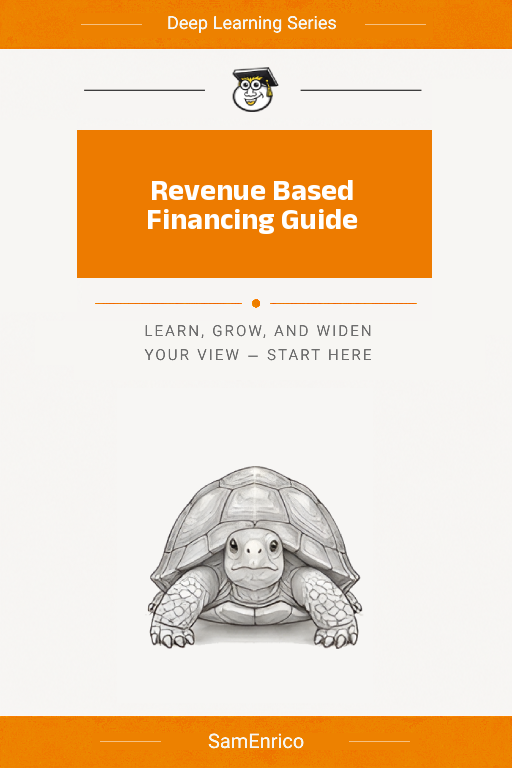
Revenue Based Financing Guide eBook
Pay back financing as percentage of future revenue
Pay back financing as percentage of future revenue instead of fixed monthly payments.
Formats
Free sample
Chapter 1: The Growth Trap--–- Maria had done everything right. Her D2C skincare brand, Terra & Co., had grown from a kitchen-table operation to a 1.2millionannualrevenuebusinessinjust18months.Her Instagramfollowingwasexploding.Herrepeatpurchaseratewastheenvyofheracceleratorcohort.Andyet,ona Tuesdaymorningin October,shefoundherselfstaringatherbankaccountwith1.2 million annual revenue business in just 18 months. Her Instagram following was exploding. Her repeat purchase rate was the envy of her accelerator cohort. And yet, on a Tuesday morning in October, she found herself staring at her bank account with 1.2millionannualrevenuebusinessinjust18months.Her Instagramfollowingwasexploding.Herrepeatpurchaseratewastheenvyofheracceleratorcohort.Andyet,ona Tuesdaymorningin October,shefoundherselfstaringatherbankaccountwith4,000 in operating cash and a $75,000 inventory order due in five days for the holiday season.She had already maxed out her credit cards.
Her bank had laughed at her loan application—two years of tax returns, they demanded, and collateral she didn't own. A VC had offered her $500,000 in exchange for 25 percent of her company, but she had done the math: if she kept growing at this rate, that 25 percent would be worth millions when she sold. Millions she would be handing over for cash she needed right now.Maria was in the Growth Trap—the single most dangerous and least-discussed threat to modern digital entrepreneurs.She is not alone.The Silent Crisis of the Growing Business Every week, thousands of founders just like Maria hit the same wall. Their businesses are working. Revenue is climbing.
Customers love the product. But the very mechanics of growth—inventory, ad spend, hiring, software subscriptions—require cash before revenue arrives. You need to buy the inventory before you can sell it. You need to run the Facebook ads before the clicks turn into purchases. You need to pay the developer before the new feature drives subscriptions.This is not a sign of failure.
It is a sign of success. And it will suffocate you faster than any unprofitable quarter ever could.The conventional wisdom of the startup world has offered founders two—and only two—paths to escape this trap. Path one: borrow money from a bank, with its rigid monthly payments, personal guarantees, and collateral requirements that most young digital businesses cannot meet. Path two: sell equity to venture capitalists or angel investors, giving up a piece of your future fortune and, more importantly, a degree of control over your company's destiny.Both paths, as Maria discovered, come with steep costs that are rarely discussed in the glossy success stories of Silicon Valley.Why Banks Say "No" to Your Growing Business Let us be frank about banks. They are not in the business of funding growth.
They are in the business of funding predictability. A bank's ideal customer is a dental practice that has been in the same location for twenty years, owns its building, and has a waiting room full of patients with dental insurance. That business will repay a seven-year term loan on a predictable schedule. The bank wins.Your e-commerce brand, Saa S company, or digital agency looks nothing like that dental practice.Here is what a bank sees when you apply for a $100,000 loan:Your revenue is volatile. Last month you did 80,000.Themonthbefore,80,000.
The month before, 80,000.Themonthbefore,120,000. The month before that, $45,000 because of a site migration. To a banker, volatility is risk. To you, volatility is the normal rhythm of a growing business.You have no collateral. Banks love hard assets—real estate, equipment, vehicles, inventory you already own.
They do not love intellectual property, customer lists, or brand equity. But for most digital businesses, those intangible assets are the business. Your code, your proprietary algorithms, your supplier relationships, your community of customers—these are your true assets, and a bank will not lend against any of them.You are too young. A typical commercial loan requires two to three years of tax returns. Most digital businesses seeking growth capital are six to eighteen months old.
They are not old enough to have two years of returns. They are not old enough to have survived a full economic cycle. They are not old enough for a banker to trust.You need a personal guarantee. Almost every small business loan requires a personal guarantee, meaning that if the business fails to repay, the bank can come after your house, your savings, your retirement accounts, and any other personal assets. This is an extraordinary risk for a founder who has already put everything on the line.And even if you clear all these hurdles, the bank loan comes with a fixed monthly payment.
If you have a slow month—and every business has slow months—you must still make that payment. Miss one, and your credit score is damaged. Miss two, and the bank starts collection proceedings. Miss three, and you could lose your personal assets.Bank debt works for stable, mature businesses with predictable cash flows. It is a terrible tool for companies in hypergrowth.The True Cost of Venture Capital (It Is Not Just the Equity)Venture capital offers the opposite trade-off.
A VC will happily fund your growth. They will write a 500,000or500,000 or 500,000or2 million check with no collateral, no personal guarantee, and no fixed monthly payments. In exchange, they want one thing: a percentage of your company.The standard deal in early-stage venture capital is that a founder gives up 15 to 30 percent of their company in exchange for the funding needed to reach the next milestone. This sounds reasonable until you understand the math of dilution and the reality of control.Consider a simple example. You start a company.
You own 100 percent of it. You raise 500,000fromanangelinvestorfor20percent.Younowown80percent.Ayearlater,youraisea500,000 from an angel investor for 20 percent. You now own 80 percent. A year later, you raise a 500,000fromanangelinvestorfor20percent.Younowown80percent.Ayearlater,youraisea2 million seed round from a venture fund for another 20 percent. You now own 64 percent.
A year after that, you raise a $5 million Series A for 20 percent. You now own approximately 51 percent—assuming no employee option pool, which will dilute you further.After three rounds of funding, you have given up nearly half your company. And this is a good scenario. In many startups, founders end up with 10 to 30 percent ownership after multiple rounds.Now let us talk about control. Venture capital is not passive money.
When you take VC dollars, you typically take a board member. That board member has fiduciary duties to the fund, not to you. They will push for growth at any cost, even if that means sacrificing profitability or your personal vision. They will push for an exit—an acquisition or IPO—within five to seven years, because their fund has a ten-year life and they need to return capital to their limited partners. They will push you to hire faster, spend faster, and grow faster, even if it means burning through cash and exhausting your team.There is nothing wrong with this model if your goal is to build a billion-dollar company as fast as possible.
But what if your goal is to build a profitable, sustainable, $10 million business that you control entirely? What if you want to grow at a pace that preserves your sanity and your relationships? What if you want the option to sell in fifteen years rather than five?Venture capital does not offer those choices. The…
This is the end of the free sample. Get the eBook to keep going. Buy now
About this book
Details
- Author
- Pollack Roxanna
- Publisher
- SamEnrico
- Language
- English
- Genre
- Non-Fiction, Business Brief, Revenue Finance
- Released
- 2026-06-01
- Pages (approx.)
- 146
- Available as
- eBook, Audiobook

Read better in the ZLOADR app
Your eBooks on your phone or tablet. Sign in with your SamEnrico account and start reading.
More by Pollack Roxanna
 Jordan Spieth Young StarPollack Roxanna$11.99
 Morning Chaos Control GuidePollack Roxanna$11.99
 MDD and Sleep DisturbancePollack Roxanna$11.99
 Challenging Should StatementsPollack Roxanna$11.99
 Wedding Sobriety GuidePollack Roxanna$11.99
 Interleaved Practice SRSPollack Roxanna$11.99
 Periodontal DiseasePollack Roxanna$11.99
 Benzodiazepine PhobiaPollack Roxanna$11.99
 The Shinto Shaman's Lament: The Forgotten Ballads of the TsukumogamiPollack Roxanna$11.99
 Blockade Runners: The Smugglers' War Beneath the WavesPollack Roxanna$11.99
 How to Produce Houseplants and Garden ProductsPollack Roxanna$11.99
 How to Become a Granulator OperatorPollack Roxanna$11.99
You may also like
 Hong Kong Handover 1997Dunn Johnnie$11.99
 Zumba For Postnatal Recovery CourseNeal Christian$11.99
 Zumba for BeginnersLadner Nikia$11.99
 YouTube Comment Mining GuideHumes Pandora$12.99
 Worry Box MeditationCarlin Rudy$11.99
 Workplace Stress MeditationNguyen Lynn$11.99
 Workplace Stress and Sleep RepairHawley Ivory$11.99
 Workplace Perfectionism CureDelaney Jeffry$11.99
 Workplace Injustice Anger GuideWallen Isabelle$11.99
 Work Addiction and Burnout LinkGreenwood Ester$11.99
 Women in Yoga and WellnessBeattie Galina$11.99
 Women in Stand Up ComedyChun Evangeline$11.99