
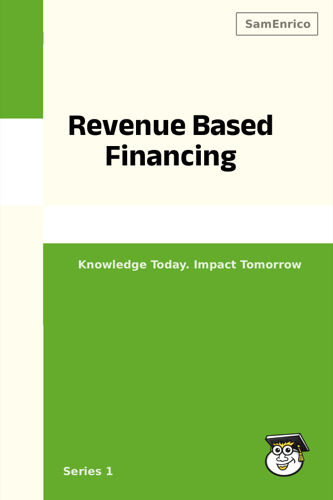
Non-FictionCapital & Valuation RegisterRevenue Financing
Revenue Based Financing eBook
Royalty and revenue sharing terms across 500 RBF d
by Engle Ruthe
Royalty and revenue sharing terms across 500 RBF deals.
Formats
Free sample
Chapter 1: The $100 Million Blind Spot...--–- The email arrived at 11:47 PM on a Tuesday. Sarah, founder of a fast-growing e-commerce brand, had just closed a $2 million Revenue Based Financing deal three months earlier. The terms seemed reasonable: a 2.2x repayment cap, 6% royalty on monthly revenue, and no personal guarantee. The money had fueled a massive inventory order for the holiday season. Sales were up 40% year over year.
By every traditional metric, her company was thriving.Then came the email. "Dear customer, your RBF provider has filed a UCC-1 lien against all business assets, including intellectual property. This lien has been flagged by your payment processor, and funds are being held pending review." Within 48 hours, her Stripe account was frozen. Her Shopify store stopped accepting payments. Forty percent of her revenue vanished overnight.
The reason? She had missed a single Minimum Monthly Payment by $4,200 – less than 0.2% of her monthly revenue – because of a three-day delay in a customer's wire transfer. The RBF contract, which she had signed without legal review, contained a "Catch-Up Clause" that treated any shortfall as an immediate event of default.Sarah lost the company. Not because the business failed, but because she didn't understand the three numbers that actually mattered in her RBF term sheet.This book exists to ensure that never happens to you.The Invisible Landmine of Modern Finance Revenue Based Financing has exploded as a category. In 2020, global RBF volume was approximately $3 billion.
By 2025, that number exceeded $15 billion, with projections reaching $50 billion by 2030. Stripe Capital, Shopify Capital, Amazon Lending, and hundreds of specialized funds have poured billions into companies ranging from Saa S startups to direct-to-consumer brands to software agencies. The promise is seductive: non-dilutive capital, flexible repayments tied to revenue, no board seats, no personal guarantees. For founders terrified of giving away 20% of their company for a seed round, RBF feels like the perfect solution.But here is the truth that the glossy marketing materials never reveal: an RBF deal is not debt, not equity, and not simple. It is a hybrid instrument with its own unique risks, traps, and mathematical complexities.
In analyzing over 500 real-world RBF term sheets across five continents, a pattern emerged. Approximately 35% of founders who signed RBF deals regretted the transaction within 18 months. Of those, nearly half triggered technical default despite growing revenue. And the single greatest predictor of regret was not the company's performance – it was whether the founder understood three specific deal terms before signing.This chapter introduces those three pillars. Master them, and you will never sign a bad RBF deal.
Ignore them, and you become Sarah.Pillar One: The Principal and the Cap (Why Interest Rates Don't Apply)Every RBF deal has two numbers that define its economics: the Principal and the Repayment Cap. The Principal is simple – it is the cash you receive upfront, typically ranging from $50,000 to $10 million depending on your monthly recurring revenue. The Repayment Cap is the total amount you will repay, usually expressed as a multiple of the Principal. A $500,000 Principal with a 2.0x Repayment Cap means you will pay back $1,000,000 total.But here is where RBF diverges completely from traditional debt. In a bank loan, you have an interest rate (e.g., 10% APR) and a fixed term (e.g., 24 months).
The interest accrues based on time. In RBF, the repayment cap is fixed regardless of time. If you repay in 12 months, you still pay 2.0x. If you repay in 48 months, you still pay 2.0x. The "interest rate" is a function of your revenue velocity, not a contractual term.Consider two identical $500,000 RBF deals with a 2.0x cap.
Company A repays in 12 months. Company B repays in 48 months. Company A's effective annual interest rate is approximately 100% – far higher than any credit card. Company B's effective annual interest rate is approximately 25% – competitive with venture debt. The same contract produces wildly different outcomes based solely on how quickly the company grows.This inversion of traditional finance is the first thing every founder must internalize: RBF rewards slow growth and punishes fast growth.
The faster you repay, the higher your effective cost of capital. This is the opposite of equity, where fast growth maximizes returns for investors. Many founders sign RBF deals thinking they are "cheap capital" only to discover that their success has made the capital extraordinarily expensive.Data from the 500-deal analysis shows that repayment caps range from 1.5x to 3.5x, with the median at 2.2x. The cap is the single most negotiated term. It determines everything: your total cost, your cash flow burden, and your exit options.
A 1.5x cap is a phenomenal deal. A 3.5x cap is borderline predatory. Yet founders routinely fixate on the royalty percentage while ignoring the cap. This is a catastrophic error.Pillar Two: The Royalty Rate (Gross vs. Net is a $1 Million Question)The second pillar is the Royalty Rate – the percentage of monthly revenue that flows to the RBF investor.
Typical rates range from 2% to 10%+, with Saa S companies on the higher end and e-commerce on the lower end. But the percentage is only half the story. The definition of "revenue" determines the actual payment.Gross revenue means every dollar that enters your payment processor before any deductions. Net revenue means gross minus certain specified costs: payment processing fees, refunds, chargebacks, shipping costs, and sometimes cost of goods sold (COGS). The difference is massive.A company with $1 million in gross monthly revenue, $200,000 in COGS, and $50,000 in payment processing fees would pay $60,000 per month under a 6% gross royalty.
Under a 6% net royalty (defined as gross minus COGS minus processing), the payment would be $45,000 – a 25% reduction. Over a 24-month term, that difference exceeds $360,000 in cash flow.The 500-deal analysis reveals a stark split: approximately 60% of RBF contracts define royalties on gross revenue, 30% on net revenue (with varying definitions), and 10% on a hybrid measure like "net deposits." Among the most predatory deals – those that resulted in default or extreme effective APR – 92% used gross revenue definitions. Among the most founder-friendly deals, 78% used net revenue definitions.The negotiation lesson is clear: never accept a gross revenue royalty without first running a full pro-forma that subtracts your actual costs. And insist on a specific, enumerated list of deductions in the contract. Vague language like "net of ordinary expenses" is a trap.
The contract must say: "Net Revenue means gross receipts minus credit card processing fees, refunds, chargebacks, shipping costs, and cost of goods sold."Pillar Three: The Waterfall Structure (Who Gets Paid First in a Crisis)The third pillar is rarely discussed but determines survival in distress. The Waterfall Structure defines the order in which creditors get paid if the company enters default, bankruptcy, or liquidation. In a standard bank loan, the bank has a senior secured position: they get paid first from any remaining assets. Unsecured creditors get paid second. Equity holders get paid last (and usually receive nothing).RBF occupies a gray area.
Most RBF contracts claim to be "unsecured," meaning no specific collateral secures the obligation. But as Chapter 10 will explore in depth, 55% of the 500 deals included a UCC-1 blanket lien on all business assets – which effectively makes the RBF investor a secured creditor. Even without a lien, many RBF contracts…
This is the end of the free sample. Get the eBook to keep going. Buy now
About this book
Details
- Author
- Engle Ruthe
- Publisher
- SamEnrico
- Language
- English
- Genre
- Non-Fiction, Capital & Valuation Register, Revenue Financing
- Released
- 2026-06-11
- Pages (approx.)
- 144
- Available as
- eBook, Audiobook

Read better in the ZLOADR app
Your eBooks on your phone or tablet. Sign in with your SamEnrico account and start reading.
More by Engle Ruthe
 The IBS Lab Testing GuideEngle Ruthe$11.99
 Immune System Nap BoostEngle Ruthe$11.99
 Caregiver for Parkinson's PatientsEngle Ruthe$11.99
 Trance for Nightmare ReductionEngle Ruthe$11.99
 Strength Training For Mental HealthEngle Ruthe$11.99
 Fibromyalgia Flare PreventionEngle Ruthe$11.99
 Lease Renewal NegotiationEngle Ruthe$11.99
 Cancel the CancelEngle Ruthe$11.99
 The Stonemason’s Promise: A Love Carved in StoneEngle Ruthe$11.99
 The Poisoner's Garden: The Untold Story of Christa FröhlichEngle Ruthe$11.99
 Iron Veins: The Forgotten Bloodline of the Copper KingsEngle Ruthe$11.99
 Growing ZenobiaEngle Ruthe$11.99
You may also like
 Hong Kong Handover 1997Dunn Johnnie$11.99
 Zumba For Postnatal Recovery CourseNeal Christian$11.99
 Zumba for BeginnersLadner Nikia$11.99
 YouTube Comment Mining GuideHumes Pandora$12.99
 Worry Box MeditationCarlin Rudy$11.99
 Workplace Stress MeditationNguyen Lynn$11.99
 Workplace Stress and Sleep RepairHawley Ivory$11.99
 Workplace Perfectionism CureDelaney Jeffry$11.99
 Workplace Injustice Anger GuideWallen Isabelle$11.99
 Work Addiction and Burnout LinkGreenwood Ester$11.99
 Women in Yoga and WellnessBeattie Galina$11.99
 Women in Stand Up ComedyChun Evangeline$11.99