
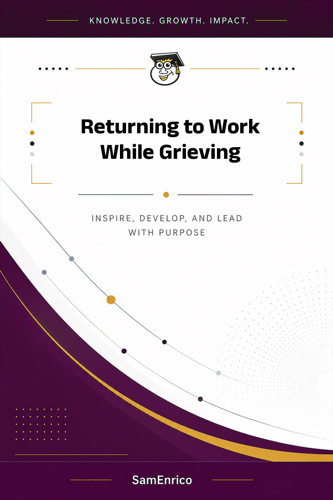
Returning to Work While Grieving eBook
Prepares for anticipatory grief in the workplace.
Prepares for anticipatory grief in the workplace.
Formats
Free sample
Chapter 1: The Griefcase You Carry...--–- You are reading this at your desk, aren’t you? Perhaps between meetings. Perhaps while waiting for a call from a doctor. Perhaps while sitting in a hospital waiting room, laptop balanced on your knees, pretending everything is normal. That is the first thing you need to understand about anticipatory grief: it does not wait for a convenient moment.
It arrives while you are writing emails, while you are sitting in performance reviews, while you are pretending to care about quarterly projections. And because it arrives before the loss, not after, no one gives you permission to stop. No one hands you bereavement leave paperwork. No one says, “Take all the time you need.” Instead, they say, “Let me know if there’s anything I can do,” which is a sentence that sounds like support but functions as a handoff. They have given you the responsibility of telling them what you need, as if you know, as if you have any energy left for translation.This chapter is called “The Griefcase You Carry” because that is the most honest metaphor we have for what you are experiencing.
Imagine a suitcase. Not a small one—one of those heavy, wheel-less bags from an earlier era of travel. Now imagine that you must carry this suitcase with you everywhere. To every meeting. To every deadline.
To every conversation by the coffee machine. The suitcase contains everything you are processing: the diagnosis, the treatment plan, the prognosis, the memories of who your loved one used to be, the terror of who they are becoming, the logistics of care, the financial strain, the guilt, the exhaustion, the love. You cannot set the suitcase down. No one else can carry it for you. And yet, you are expected to perform your job as if the suitcase does not exist.
That is the central contradiction of anticipatory grief in the workplace. You are required to function while your internal world is collapsing.The Blind Spot in Every HR Manual Let us begin with a truth that no one tells you outright: workplace policies are designed for sudden loss. Bereavement leave, typically three to five days, assumes that grief begins at the moment of death. It assumes that the week following a funeral is the hardest week. It assumes that after those three to five days, you will return to work largely functional, perhaps a little sad, but ready to contribute.
These assumptions are catastrophically wrong for anticipatory grief, but they persist because they are convenient. Sudden loss is easier to measure. Sudden loss has a clear before and after. Anticipatory grief is messy. It has no clear start date.
It bleeds across weeks and months. It does not fit neatly into HR forms.Consider the difference. In sudden loss, you receive a phone call, and your world changes in an instant. You take bereavement leave. You return.
The before and after are distinct. In anticipatory grief, you receive a diagnosis, and your world begins to change slowly, like a room filling with water. You continue working because the loss has not happened yet. You attend meetings while researching treatment options. You send emails from hospital waiting rooms.
You smile at colleagues while your mind calculates how many good days your loved one has left. And then, when the death finally occurs, you have already been grieving for months. Your bereavement leave arrives after the fact, but the hardest work—the emotional work, the caregiving work, the anticipatory work—has already been done without any formal support. This is the blind spot. This is why you feel so alone.The post-COVID era has made this blind spot more visible and more painful.
During the pandemic, prolonged illness, health anxiety, and family caregiving became normalized in ways they never had been before. Millions of employees worked while managing sick family members, while waiting for test results, while attending virtual funerals. For a brief moment, the culture acknowledged that grief and work were not separate domains. But that moment passed. Most companies have returned to pre-pandemic assumptions.
The difference is that you have not. Your experience of anticipatory grief has changed you, and the workplace has not caught up.The Difference Between Anticipatory Grief and Ordinary Stress You may have already encountered colleagues or managers who misunderstand what you are experiencing. They may say things like, “Everyone has stress,” or “You seem distracted lately,” or “Maybe you just need a vacation.” These comments are not malicious, but they are deeply misinformed. They confuse anticipatory grief with ordinary workplace stress. The two are not the same.Ordinary workplace stress is about deadlines, workload, difficult colleagues, and performance pressure.
It is unpleasant, but it operates within a predictable framework. You work late, you finish the project, the stress recedes. Anticipatory grief operates differently. It is not about a task to complete or a deadline to meet. It is about the slow, inevitable approach of a loss that you cannot prevent.
You cannot work harder to make it go away. You cannot optimize your way out of it. This is what makes it so corrosive to work performance. Your usual coping strategies—productivity, focus, willpower—are largely useless against the reality of a terminal diagnosis.The neuroscience, which we will explore in detail in Chapter 2, explains why. Your brain is not designed to sustain high alert for months at a time.
Chronic uncertainty floods your system with cortisol, which impairs executive function, memory, and emotional regulation. You are not merely stressed. You are in a prolonged state of threat activation. Your brain believes, correctly, that something terrible is coming. And because you cannot fight it or flee from it, your brain remains stuck in a loop of vigilance and exhaustion.
This is not a failure of character. This is biology.But knowing that does not make it easier to sit through a three-hour meeting. Knowing that does not help you meet your quarterly targets. This is why the first chapter of this book is not about coping strategies or time management or resilience. It is about naming what you are experiencing.
Because until you name it, you cannot ask for what you need. And until you ask for what you need, you will continue to carry your griefcase alone, in silence, while the workplace moves on without you.The Griefcase: A Closer Look Let us open the griefcase for a moment. Not because you need to dwell in its contents, but because naming what is inside is the first step toward carrying it more intentionally. Every griefcase is different, but most contain some version of the following.First, there is the weight of medical logistics. Appointments to schedule.
Medications to track. Insurance paperwork to file. Treatment decisions to research. If you are the primary caregiver or the primary point of contact for a loved one’s medical care, this logistics load is relentless. It does not respect work hours.
It arrives during your most productive morning hours, during your lunch break, during your evening wind-down. You cannot ignore it, and you cannot delegate all of it. So you carry it with you, a constant low-level…
This is the end of the free sample. Get the eBook to keep going. Buy now
About this book
Details
- Author
- Godfrey Mikaela
- Publisher
- SamEnrico
- Language
- English
- Genre
- Non-Fiction, Self-Help, Workplace
- Released
- 2026-06-06
- Pages (approx.)
- 132
- Available as
- eBook, Audiobook

Read better in the ZLOADR app
Your eBooks on your phone or tablet. Sign in with your SamEnrico account and start reading.
More by Godfrey Mikaela
 Strength Training Plateau BreakerGodfrey Mikaela$11.99
 Mismatched Libido Self EsteemGodfrey Mikaela$11.99
 The Laundry Mat ShowerGodfrey Mikaela$11.99
 Mindfulness of Body SensationsGodfrey Mikaela$11.99
 eBay Bidding Addiction GuideGodfrey Mikaela$11.99
 Oxalobacter FormigenesGodfrey Mikaela$11.99
 Assertiveness In EducationGodfrey Mikaela$11.99
 AA Preamble ExplainedGodfrey Mikaela$11.99
 Hops & High Seas: The Untold Tale of the 1840s Beer Smugglers' WarGodfrey Mikaela$11.99
 The Storm from the Steppe: Subutai's March to the Black Sea (1237-1242)Godfrey Mikaela$11.99
 The Hammer and the Harp: Elijah Wood’s Industrial SymphonyGodfrey Mikaela$11.99
 Understanding Acquired SyphilisGodfrey Mikaela$17.99
You may also like
 Spending Triggers at WorkDancy Deangelo$11.99
 Metta for Work StressBynum Isaura$11.99
 Metta for a Rival Team MemberLiu Jeane$11.99
 Empathy in the WorkplaceDurham Shantelle$11.99
 Peer Comparison ImposterHelton Stacie$11.99
 Workday Breath ResetNethery Jama$11.99
 Boss Employee Relationship StressValerio Lannie$11.99
 Emotion Regulation At WorkHardesty An$11.99
 Conversation Starters for WorkGass Viviana$11.99
 Workplace Coworker Anger GuideYoon Kattie$11.99
 The Inappropriate Joke TalkRiggins Hortencia$11.99
 Navigating Political Talks at WorkBelcher Larita$11.99