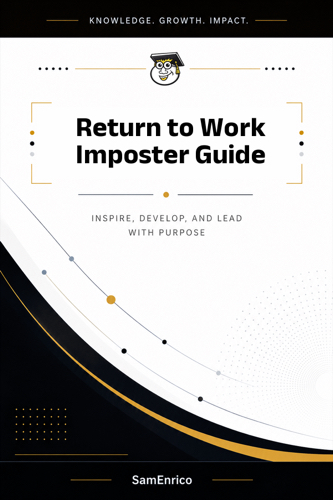
Return to Work Imposter Guide eBook
Overcome self doubt after career breaks, maternity
Overcome self doubt after career breaks, maternity leave, or sabbaticals.
Formats
Free sample
Chapter 1: The Returner's Paradox...--–- The first time Priya walked back into her office after eighteen months of maternity leave, she stood in the lobby for seven full minutes before she could bring herself to swipe her badge. She had arrived early, deliberately, to avoid the morning rush of colleagues who might stop her and say "Welcome back!"—a phrase she had come to dread because it required her to smile and say "Thank you!" while her internal monologue screamed I don't belong here. Priya was a senior marketing director with fourteen years of experience. She had led campaigns that generated eight figures in revenue. She had managed teams of twenty-five people.
She had presented to C-suites without notes. And yet, standing in that lobby, she felt less capable than an intern on their first day.The security guard, a man named Frank who had been there for a decade, recognized her. "Priya! You're back!" he said cheerfully. She smiled, swiped her badge, and walked through the turnstile.
Her heart was pounding. Her palms were sweating. She had not felt this anxious since her very first job interview out of college. And that was the crux of the problem, the paradox that this entire book is built to unravel: Priya was far more experienced and accomplished than she had been as a young graduate, yet she felt far less confident.This is the Returner's Paradox, and if you are reading this book, you almost certainly know exactly what it feels like. You have taken a career break—whether for maternity leave, paternity leave, a sabbatical, a layoff, caregiving, or a personal health journey—and now you are trying to return.
And instead of feeling grateful for your experience, you feel like a fraud. Instead of feeling prepared, you feel exposed. Instead of feeling like the competent professional you know you are, you feel like someone who has forgotten how to do everything.This chapter will explain why that happens, why it is not your fault, and why the feeling of being "rusty" is not a signal of permanent decline but a normal neurological response to a temporary pause. By the end of this chapter, you will understand the psychological mechanisms behind the Returner's Paradox, you will see why highly competent people are actually more vulnerable to this experience than beginners, and you will begin the process of reframing your career break from a liability into an asset.The Cruel Irony of Returning Let us start with a simple truth that sounds like a contradiction: the more competent you were before your break, the worse you will feel after it. This is not speculation.
It is a consistent finding in the research on imposter syndrome and career transitions. Beginners feel anxious, yes, but they also give themselves permission to be beginners. They expect to ask questions. They expect to make mistakes. They expect to learn slowly.
And because their expectations are low, every small success feels like a win.Returners, by contrast, have a completely different psychological starting point. You are not a beginner. You have done this before. You have led the meetings, closed the deals, written the reports, solved the crises. And because you have done it before, you expect to be able to do it again—immediately, effortlessly, and at the same level you achieved at your peak.
When you cannot, you do not think "I am learning." You think "I have lost it."This is the cruel irony. The beginner thinks: "I don't know how to do this yet, but that is expected." The returner thinks: "I used to know how to do this perfectly, and now I don't. Therefore, I am broken."Consider the research. A study published in the Journal of Vocational Behavior followed professionals returning to work after extended leave. Those with the highest pre-leave performance ratings reported the highest levels of post-return anxiety and self-doubt.
They were not less capable. They were more self-aware of the gap between their former peak and their current reality. And that awareness, while accurate, was devastating to their confidence.Let me give you a concrete example. Before her break, Priya could write a quarterly marketing report in two hours. It was automatic.
She had templates in her head. She knew which metrics mattered. When she sat down to write her first report after returning, it took her six hours. The report was fine—objectively, it was better than most of her colleagues' reports. But Priya did not compare herself to her colleagues.
She compared herself to her former self. And by that standard, she had failed. She was slower. She had to look up formulas she used to know by heart. She had to double-check terminology.
She finished the report feeling exhausted and humiliated, convinced that everyone would notice she was not the same.No one noticed. Her manager read the report, said "Great job," and moved on. But Priya spent the rest of the week spiraling, convinced she had lost her edge forever.If this story resonates with you, take a breath. You are not broken. You are experiencing a predictable, well-documented psychological phenomenon called skill atrophy anxiety.Skill Atrophy Anxiety: Why Your Brain Lies to You Skill atrophy anxiety is the term I use to describe what happens when a temporary pause in using a skill tricks your brain into believing the skill is gone forever.
The word "atrophy" comes from physiology—when you stop using a muscle, it weakens. But crucially, a weakened muscle is not a dead muscle. With use, it rebuilds. The same is true for skills. However, your brain does not feel this distinction the way a muscle does.
Your amygdala—the part of your brain responsible for threat detection—interprets the feeling of rustiness as evidence of permanent damage.Here is the neuroscience in simple terms. When you learn a skill deeply—let us say public speaking or financial modeling—your brain creates neural pathways. These are like trails in a forest. The more you walk the trail, the wider and clearer it becomes. When you stop walking the trail—because you are on maternity leave, or a sabbatical, or between jobs—the trail does not disappear.
It becomes overgrown. Grass grows over it. Branches fall across it. When you return, the trail is harder to find and harder to walk. But the path still exists underneath.
With a few passes, the trail becomes clear again.Your amygdala, however, does not understand overgrown trails. Your amygdala is a primitive threat-detection system designed to keep you alive in a world of predators and immediate dangers. When you try to walk a trail that used to be easy and now feels hard, your amygdala interprets that difficulty as a threat. It floods your system with cortisol and adrenaline. You feel anxious.
Your heart races. And your brain, desperate for an explanation, supplies one: You must not be capable anymore. You must have lost it. You are a fraud.This is not a personality flaw. It is not a sign that you are weak or that you lack character.
It is a normal brain response to a perceived threat. And once you understand that, you can stop treating the…
This is the end of the free sample. Get the eBook to keep going. Buy now
About this book
Details
- Author
- Rojas Viviana
- Publisher
- SamEnrico
- Language
- English
- Genre
- Non-Fiction, Self-Help, Career Reentry
- Released
- 2026-06-07
- Pages (approx.)
- 145
- Available as
- eBook, Audiobook

Read better in the ZLOADR app
Your eBooks on your phone or tablet. Sign in with your SamEnrico account and start reading.
More by Rojas Viviana
 Active Listening For ExtrovertsRojas Viviana$11.99
 The Self Talk for HolidaysRojas Viviana$11.99
 TM for Legal ProfessionalsRojas Viviana$11.99
 The Creative Envy GuideRojas Viviana$11.99
 The Silent Roar: Naoko Takahashi and the Tokyo Marathon Revolution (1997)Rojas Viviana$11.99
 Shotcut Replaces Premiere GuideRojas Viviana$12.99
 First Time Founder Business PlanRojas Viviana$12.99
 Understanding Tosti–misciali–barbareschi SyndromeRojas Viviana$17.99
 Tanzu Sales Account ExecutiveRojas Viviana$11.99
 How to Start a Canal Carrier (freight) Business (Beginners Guide)Rojas Viviana$11.99