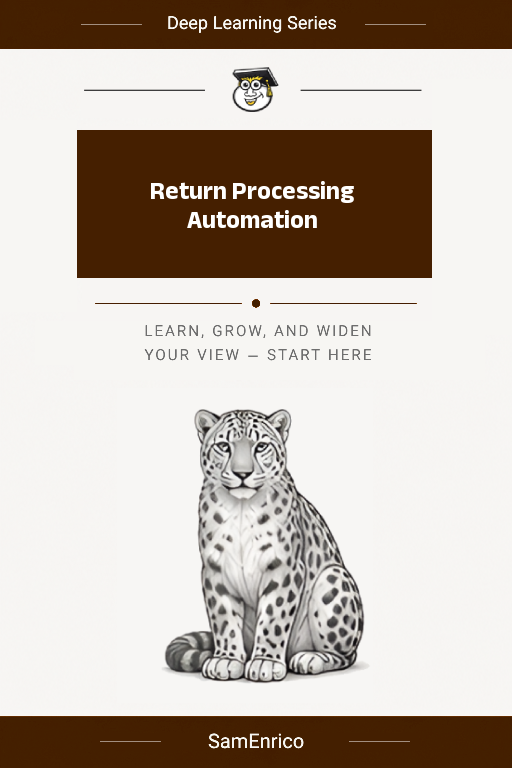
Return Processing Automation eBook
Automate product return processing and refund appr
Automate product return processing and refund approvals using AI workflows for operations teams.
Formats
Free sample
Chapter 1: The Architecture of an Automated Return--Manual return processing is not slow because people are lazy. It is slow because the process itself is broken. This distinction matters more than any technology decision you will make. Most operations leaders assume that replacing humans with software is the answer. But automating a broken process does not fix it.
It only makes the brokenness happen faster.Before you write a single line of code, before you evaluate a single vendor, before you hire an automation architect, you must understand what a healthy return process looks like. This chapter gives you that blueprint. It maps the complete return lifecycle from the moment a customer decides to return an item to the final reconciliation of funds and physical product disposition. It introduces the four pillars that every automated return system must rest on. And it provides a proprietary assessment tool that will tell you exactly where your organization stands today.Think of this chapter as the architectural drawing for a house.
You would not start hammering nails into studs without a plan. Yet most operations teams start implementing automation without a clear architecture. They buy an RPA bot here, connect an API there, and wonder why the result is still chaotic. By the end of this chapter, you will have a complete framework for understanding, designing, and measuring an automated return operation.The Complete Return Lifecycle: From Click to Close Every return follows a predictable journey. Understanding this journey in its entirety is the first step toward automation.
Most organizations have fragmented visibility into this lifecycle. The customer service team sees the initiation. The warehouse sees the physical receipt. The finance team sees the refund. But no one sees the whole thing.A complete return lifecycle consists of eight distinct stages:Stage 1: Customer Initiation The customer decides to return a product and requests authorization.
This can happen via web portal, mobile app, email, phone call, or in-store visit. The key question at this stage is whether the customer can easily provide the necessary information (order number, return reason, photos of damage) without friction.Stage 2: Policy Validation The system checks whether the return request complies with the organization's return policy. Is it within the allowed window? Is the item eligible for return? Does the customer have proof of purchase?
This stage is purely rules-based in most organizations, though AI can handle edge cases.Stage 3: Return Authorization (RMA)If the request passes policy validation, the system issues a Return Merchandise Authorization number. This RMA becomes the unique identifier for the entire return journey. It ties together the customer request, the physical item, the refund transaction, and all communications.Stage 4: Return Logistics The customer receives a return shipping label and sends the item back. The organization may offer prepaid labels, drop-off locations, or require the customer to arrange shipping. This stage ends when the item is received at the warehouse or returns processing center.Stage 5: Physical Inspection Once the item arrives, someone must examine it.
Is it in resellable condition? Is the damage consistent with what the customer reported? Is the item actually what the customer claims it is? This stage is often the biggest bottleneck in manual processes.Stage 6: Disposition Decision Based on the inspection, the organization decides what to do with the item. Restock it?
Refurbish it? Donate it? Liquidate it? Destroy it? Each disposition has different financial and operational implications.Stage 7: Refund or Exchange Processing If the customer requested a refund, the organization issues the appropriate amount back to the original payment method.
If the customer requested an exchange, the organization ships the replacement item. This stage also includes partial refunds for restocking fees or damage deductions.Stage 8: Reconciliation and Analytics The return is closed. Inventory counts are updated. Financial records are reconciled. Data from the return is fed into analytics systems to identify trends, flag potential fraud, and inform product improvements.Most automation efforts focus on only one or two of these stages.
That is the value trap we warned about in Chapter 2. You can automate return authorization to issue RMAs in seconds, but if the physical inspection stage still takes three days, your overall return time has barely improved. The architecture of an automated return must address all eight stages in an integrated way.The Four Pillars of Return Automation Through extensive research and case studies across retail, manufacturing, and e-commerce industries, we have identified four foundational capabilities that every automated return system requires. These four pillars are not optional. They are the non-negotiable building blocks of any mature return automation effort.Pillar One: Orchestration Orchestration is the central nervous system of automated returns.
It coordinates people, systems, and APIs across the entire eight-stage lifecycle. Without orchestration, you have point solutions that do not talk to each other. The RMA system issues a number, but the warehouse never receives it. The refund is processed, but the inventory count never updates.Orchestration platforms (such as Camunda, Temporal, or custom-built workflow engines) maintain the state of every return as it moves through the stages. They know that Return #10023 is waiting for inspection.
They know that Return #10024 was approved for refund but the payment gateway is down. They know that Return #10025 has been in the same stage for five days and needs escalation.Think of orchestration as the conductor of an orchestra. The violins (RMA system), the brass (payment gateway), and the percussion (warehouse system) all play their parts. But without a conductor keeping time and coordinating entries, the result is noise, not music.Orchestration also enables what we call "exception-only processing." In a well-orchestrated system, the happy path—the 80% of returns that are straightforward—flows automatically. The system only alerts a human when something unusual happens: a high-value item, a suspicious pattern, an expired return window with a loyal customer.
This is the opposite of most manual processes, where every return requires human attention.Pillar Two: Task Automation Task automation handles the repetitive, rules-based work that humans should never do. This includes data entry, label generation, email notifications, and status updates. Task automation is not intelligent. It does not make decisions. It simply executes predefined actions based on predefined triggers.In the context of returns, task automation includes:Populating return forms with customer data pulled from the OMSGenerating and emailing return shipping labels Updating ticket statuses in the helpdesk system Logging return events to audit databases Sending proactive SMS notifications at milestone events Robotic Process Automation (RPA) is one tool for task automation, particularly useful when you need to interact with legacy systems that lack modern APIs.
RPA bots simulate human keystrokes and mouse clicks to enter data into old mainframes or green-screen applications. However, RPA is not a substitute for orchestration. It is a tactical tool for specific integration challenges.Low-code workflow tools like Zapier or Make can handle simple task automation for smaller organizations. For enterprise-scale returns processing, you will likely need a combination of orchestration platform, RPA, and custom scripts.Pillar Three: Intelligent Decisioning Intelligent decisioning is where artificial intelligence enters the picture. This pillar handles the decisions that are too complex for simple rules but not complex enough to require a human.
Intelligent decisioning sits on a spectrum:Decision Type Approach Example Simple, predictable Rules-based automation"Refund items under $50 automatically"Ambiguous, nuanced AI-powered decisioning"Does…
This is the end of the free sample. Get the eBook to keep going. Buy now
About this book
Details
- Author
- Bachman Xochitl
- Publisher
- SamEnrico
- Language
- English
- Genre
- Non-Fiction, AI Operator, Returns Management
- Released
- 2026-05-30
- Pages (approx.)
- 140
- Available as
- eBook, Audiobook

Read better in the ZLOADR app
Your eBooks on your phone or tablet. Sign in with your SamEnrico account and start reading.
More by Bachman Xochitl
 Teen Self Esteem and Self CompassionBachman Xochitl$11.99
 Ayurvedic Home Remedies GuideBachman Xochitl$11.99
 Mindfulness for Imposter Syndrome HandbookBachman Xochitl$11.99
 Mindful Holiday Stress ReductionBachman Xochitl$11.99
 The Indian IT Talent Migration ForecastBachman Xochitl$11.99
 The Lioness of Dara: The Untold Story of Queen Gudit’s Strategic GeniusBachman Xochitl$11.99
 Understanding Micro SyndromeBachman Xochitl$17.99
 China Ghana Tracking and VisibilityBachman Xochitl$12.99
 Van DriverBachman Xochitl$11.99
 How to Become a Cleat FeederBachman Xochitl$11.99