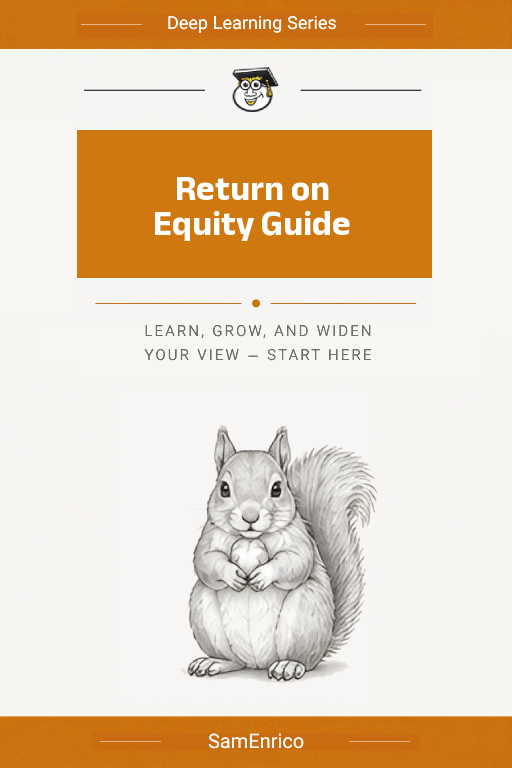
Return on Equity Guide eBook
Calculate shareholder return using Net Income divi
by Wampler Otha
Calculate shareholder return using Net Income divided by Average Shareholders' Equity.
Formats
Free sample
Chapter 1: The Shareholder’s Compass--–- Every morning, millions of investors wake up, check their brokerage apps, and look at the same number. It is not the company’s revenue. It is not its cash flow. It is not even the price of the stock itself. The number they chase, obsess over, and often make life-altering decisions based on is earnings per share or EPS.
Wall Street has trained us to believe that rising EPS is the ultimate proof of a company’s success. Analysts shout it on financial television. Press releases trumpet it in bold letters. And yet, despite all this attention, EPS has a dangerous secret. It can be manipulated, distorted, and inflated without the underlying business improving one single bit.
This chapter introduces a different compass, one that has guided the world’s best investors for decades but remains surprisingly overlooked by ordinary shareholders. That compass is Return on Equity or ROE.The Core Formula That Changes Everything At its simplest level, Return on Equity tells you how much profit a company generates for every dollar of shareholders’ money that has been invested in the business. The formula is deceptively straightforward:ROE = Net Income ÷ Average Shareholders’ Equity Net income comes from the income statement. It is the profit left over after all expenses, taxes, and interest payments have been subtracted from revenue. Shareholders’ equity comes from the balance sheet.
It represents the money that owners have put into the company plus all the profits that have been retained over the years rather than paid out as dividends. When you divide profit by equity, you get a percentage that answers a profoundly important question: How hard is my money working inside this business?If a company has a 20 percent ROE, that means for every one dollar of shareholder equity, the company generates twenty cents of profit each year. If that same company had a 5 percent ROE, it would generate only five cents per dollar. Over a decade, the difference between these two scenarios is staggering. A company with a 20 percent ROE that reinvests its profits can grow five times faster than a company with a 5 percent ROE without borrowing a single dollar.
This is why Warren Buffett has repeatedly said that Return on Equity is one of the first metrics he looks at when evaluating a potential investment. He understands that a high ROE, when achieved through genuine operational excellence, is the clearest signal of a durable competitive advantage.However, and this is crucial, a high ROE is not automatically a good thing. This book will teach you to distinguish between real ROE, which comes from pricing power and operational efficiency, and fake ROE, which comes from excessive debt or one-time accounting tricks. The chapters ahead, particularly Chapter 7 on leverage and Chapter 10 on limitations, will equip you to spot the difference. For now, understand this: ROE is a powerful lens, but like any lens, it must be focused correctly.Why Earnings Per Share Misleads More Than It Reveals To understand why ROE matters more than EPS, you must first understand how EPS is calculated and, more importantly, how it is manipulated.
The formula for basic EPS is:EPS = Net Income ÷ Weighted Average Shares Outstanding At first glance, this seems reasonable. Profit divided by the number of shares. More profit or fewer shares means higher EPS. The problem is that companies can reduce the number of shares outstanding without improving the business at all. They do this through stock buybacks.
A company borrows money or uses existing cash to purchase its own shares on the open market, retiring those shares and reducing the denominator in the EPS formula. Suddenly, EPS rises even if net income has stayed flat or even fallen slightly. Investors see a higher EPS, assume the company is growing, and push the stock price up. The executives, whose bonuses are often tied to EPS targets, collect their rewards. And the underlying business?
It has not changed at all.Consider a simplified example. Company A has net income of one hundred million dollars and one hundred million shares outstanding. Its EPS is one dollar. The company borrows five hundred million dollars and uses it to buy back fifty million shares. Now there are only fifty million shares outstanding.
Net income remains one hundred million dollars, but EPS jumps to two dollars. Double the EPS with zero improvement in profitability. This is not a hypothetical trick. It happens constantly in the real world. Between 2010 and 2020, companies in the S&P 500 spent more than five trillion dollars on stock buybacks.
Much of that money was borrowed. Much of that borrowing inflated EPS while weakening balance sheets. Investors who only watched EPS celebrated. Investors who watched ROE saw the warning signs.ROE captures this distortion automatically. When a company borrows money to buy back stock, its net income stays the same or may even decrease slightly due to the new interest expense.
But its shareholders’ equity drops dramatically because the company spent cash and took on debt to retire shares. If equity falls faster than net income, ROE actually rises. This can fool investors who rely on EPS without understanding leverage. But ROE at least includes equity in the denominator, forcing you to see that something has changed. The chapters on Du Pont analysis and debt distortion will teach you to interpret whether that change is healthy or dangerous.The Cash Cow Philosophy Throughout this book, you will encounter the concept of the cash cow.
A cash cow is a business that generates consistently high returns on equity without relying on excessive debt, without depending on one-time gains, and without manipulating its share count. Cash cows have durable competitive advantages. They might own irreplaceable brands like Coca-Cola or Apple. They might benefit from network effects like Microsoft or Visa. They might have cost advantages that competitors cannot replicate like Costco or Walmart.
Whatever the source, the result is the same: these businesses generate far more profit from each dollar of invested capital than their competitors can.The cash cow philosophy is simple. Find companies that have consistently generated high ROE for five to ten years. Verify that their high ROE comes from high profit margins or high asset turnover rather than high leverage. Confirm that their earnings are backed by strong cash flow. Then buy their shares at a reasonable price and hold them for years or decades.
This approach does not require you to predict the next hot technology or time the market perfectly. It only requires you to identify businesses that are already excellent at turning shareholder capital into profit and then get out of their way.This philosophy has been validated by decades of stock market data. Studies have shown that companies in the top quartile of ROE consistently outperform the market over long time horizons, especially when combined with reasonable valuations and low debt levels. The reason is intuitive: a business that generates high returns on its capital can grow faster without borrowing, can withstand economic downturns better, and can reward shareholders more generously than its low-ROE competitors. ROE is not a perfect predictor of future returns, but it is one of the most reliable.A Tale of…
This is the end of the free sample. Get the eBook to keep going. Buy now
About this book
Details
- Author
- Wampler Otha
- Publisher
- SamEnrico
- Language
- English
- Genre
- Non-Fiction, Student's Shortcut, Profitability
- Released
- 2026-05-30
- Pages (approx.)
- 153
- Available as
- eBook, Audiobook

Read better in the ZLOADR app
Your eBooks on your phone or tablet. Sign in with your SamEnrico account and start reading.
More by Wampler Otha
 Gout Flare ManagementWampler Otha$11.99
 Hardware Design CreativityWampler Otha$11.99
 Freelance While ParentingWampler Otha$11.99
 Blue Zone Spice GuideWampler Otha$11.99
 Wholesaling and EscrowWampler Otha$11.99
 Recurrent Pregnancy LossWampler Otha$11.99
 Gaming and ADHDWampler Otha$11.99
 Anger Restructuring for ADHDWampler Otha$11.99
 The Great Barbie Backlash: Doll Wars and Cultural ShiftsWampler Otha$11.99
 Phantom Lanterns: The Vanishing Lights of Old LondonWampler Otha$11.99
 The Essential Guide to Indian PopWampler Otha$11.99
 How to Produce Fabric Stain RemoversWampler Otha$11.99