
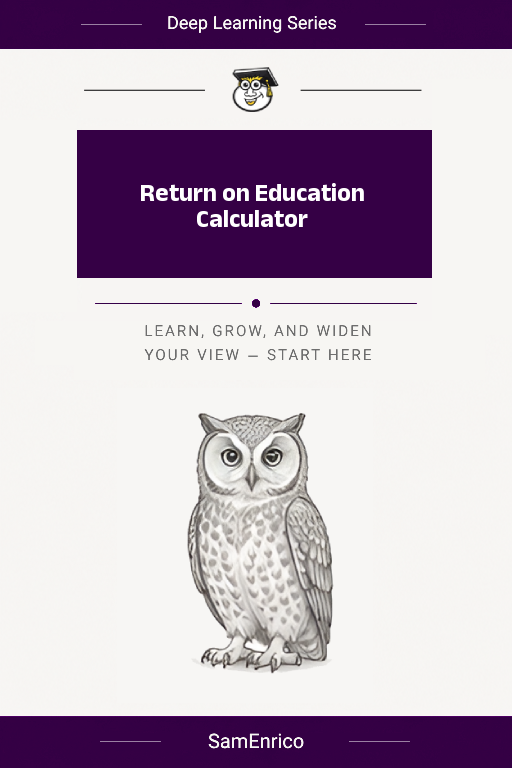
Non-FictionStudent's ShortcutFinancial Literacy
Return on Education Calculator
Compute lifetime earnings, debt payments, and oppo
Compute lifetime earnings, debt payments, and opportunity costs comparing four-year degrees to twelve-week bootcamp investments worldwide.
Formats
About this book
Free sample
Chapter 1: The Million-Dollar Lie--Every eighteen-year-old standing in a high school gymnasium in America, Britain, Canada, or Australia has heard the same promise. It comes from guidance counselors, from parents, from university brochures, and from well-meaning relatives at graduation parties. The promise sounds like certainty: go to college, earn your degree, and you will make one million dollars more over your lifetime than someone who does not.This is not a promise. It is a statistical illusion.The number comes from a real data set. The United States Bureau of Labor Statistics and the Georgetown University Center on Education and the Workforce have both published figures showing that bachelor's degree holders earn approximately one million dollars more in median lifetime earnings than high school graduates.
That calculation appears in congressional testimony, in student loan marketing materials, and in the advertising campaigns of universities from Oxford to UCLA. It is repeated so often that it has become educational gospel.But gospel is not mathematics. And when you pull apart the million-dollar statistic strand by strand, you find something unsettling: the number is true only if you ignore virtually every variable that actually matters to a real person making a real decision.The million-dollar figure averages across all majors, from neurosurgeons to preschool teachers, from petroleum engineers to philosophy professors. It averages across all institutions, from Harvard to the University of Phoenix. It averages across all economic conditions, from boom years to recessions.
And most critically, it completely ignores three factors that determine whether a specific educational investment will make you wealthy or leave you broke: the net price you actually pay, the opportunity cost of the years you spend not earning, and the very real risk that you will graduate into a job that does not require your degree at all.This chapter exists to do one thing: establish the baseline. Before you can calculate anything, you need to know what you are actually comparing. You need to know the real price of a degree versus the real price of a bootcamp. You need to know where you stand geographically, because a student…
This is the end of the free sample. Get the eBook to keep going. Buy now
Contents
- Chapter 1
- Chapter 2
- Chapter 3
- Chapter 4
- Chapter 5
- Chapter 6
- Chapter 7
- Chapter 8
- Chapter 9
- Chapter 10
- Chapter 11
- Chapter 12
Details
- Author
- Roberge Zetta
- Publisher
- SamEnrico
- Language
- English
- Genre
- Non-Fiction, Student's Shortcut, Financial Literacy
- Released
- 2026-06-01
- Pages (approx.)
- 120
- Available as
- eBook, Audiobook

Read better in the ZLOADR app
Your eBooks on your phone or tablet. Sign in with your SamEnrico account and start reading.
More by Roberge Zetta
 The Student to Worker PipelineRoberge Zetta$11.99
 Personal Ing For Success Executive GuideRoberge Zetta$11.99
 Multimodal Pain Medication PlanRoberge Zetta$11.99
 Intuitive Eating Meal Planning WorkbookRoberge Zetta$11.99
 The Eviction Notice AuthorRoberge Zetta$11.99
 Shadows of the First Dawn: The Lost Cave Paintings of BorneoRoberge Zetta$11.99
 The Vanishing of Flight 447: The Black Box That Never SpokeRoberge Zetta$11.99
 Understanding Biemond Syndrome Type 1Roberge Zetta$17.99
 Rapeseed HarvestingRoberge Zetta$11.99
 How to Start a Power-driven Mobile Lifting Frames Business (Beginners Guide)Roberge Zetta$11.99
 Expedited LLC Formation ServicesRoberge Zetta$12.99
You may also like
 Hong Kong Handover 1997Dunn Johnnie$11.99
 Zumba For Postnatal Recovery CourseNeal Christian$11.99
 Zumba for BeginnersLadner Nikia$11.99
 YouTube Comment Mining GuideHumes Pandora$12.99
 Worry Box MeditationCarlin Rudy$11.99
 Workplace Stress MeditationNguyen Lynn$11.99
 Workplace Stress and Sleep RepairHawley Ivory$11.99
 Workplace Perfectionism CureDelaney Jeffry$11.99
 Workplace Injustice Anger GuideWallen Isabelle$11.99
 Work Addiction and Burnout LinkGreenwood Ester$11.99
 Women in Yoga and WellnessBeattie Galina$11.99
 Women in Stand Up ComedyChun Evangeline$11.99