
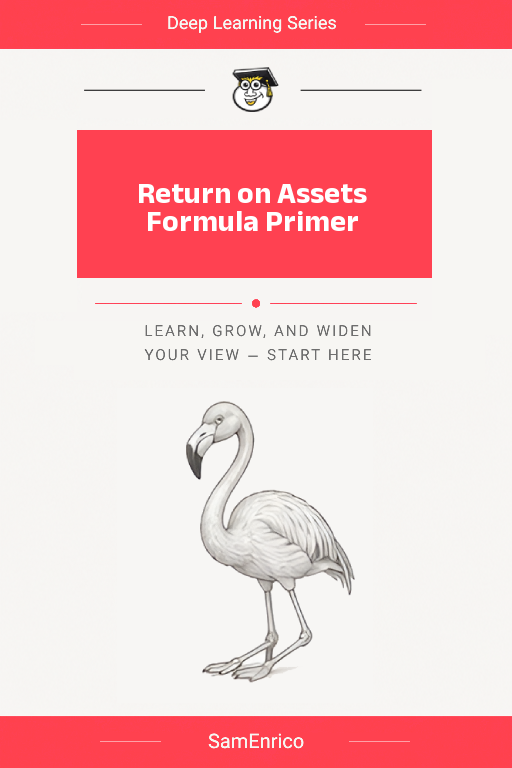
Return on Assets Formula Primer Audiobook
Divide net income by total assets to measure effic
Divide net income by total assets to measure efficiency, learning how asset-heavy industries compare to service businesses.
Formats
Free sample
Chapter 1: The One Number--What if you could look at a single number and instantly know whether a company’s management is brilliant, mediocre, or actively destroying value? What if that same number could tell you why a cutthroat discount retailer and a centuries-old luxury watchmaker might be equally well-run—and why a seemingly profitable airline could be a ticking time bomb? And what if most investors, including many professionals, routinely misread that number because they ignore the one question that matters most?That number is Return on Assets, or ROA. And the question almost everyone forgets to ask is this: *What does this company actually own—and how hard is that stuff working?Let us start with a simple exercise. Imagine two companies.
The first is a boutique consulting firm. It owns little more than laptops, software licenses, and a modest office lease. Its balance sheet shows total assets of 2million.Lastyear,itearned2 million. Last year, it earned 2million.Lastyear,itearned600,000 in net income. Do the math: 600,000dividedby600,000 divided by 600,000dividedby2 million gives an ROA of 30 percent.The second company is a regional steel mill.
It owns furnaces, rolling mills, conveyor systems, a rail spur, and a hundred acres of industrial land. Its balance sheet shows total assets of 200million.Lastyear,itearned200 million. Last year, it earned 200million.Lastyear,itearned10 million in net income. That is 10milliondividedby10 million divided by 10milliondividedby200 million—an ROA of just 5 percent.Now, which company is better managed?If you said the consulting firm with 30 percent ROA, you have just fallen into the most common trap in financial analysis. You compared two numbers that were never meant to be compared.
The consulting firm’s assets are mostly off the books (its people, client relationships, and intellectual property do not appear on the balance sheet under standard accounting rules). The steel mill’s assets are overwhelmingly on the books—every furnace, every conveyor belt, every acre of land. The consulting firm’s 30 percent ROA tells you something real about its business model. But it tells you almost nothing about whether its managers are better than the steel mill’s managers.This is the central problem that this book exists to solve. Raw ROA numbers are meaningless without context.
And context means understanding three things: what goes into the numerator (profits), what goes into the denominator (assets), and most critically, how the relationship between those two numbers…
This is the end of the free sample. Get the Audiobook to keep going. Buy now
About this book
Details
- Author
- Vanover Dominique
- Publisher
- SamEnrico
- Language
- English
- Genre
- Non-Fiction, Student's Shortcut
- Released
- 2026-06-01
- Pages (approx.)
- 155
- Available as
- eBook, Audiobook

Listen in the VoxFlicks app
Audiobooks and audio dramas wherever you go. Sign in with your SamEnrico account and press play.
More by Vanover Dominique
 Stress and Adrenal FunctionVanover Dominique$11.99
 Trauma Sensitive Sleep MeditationVanover Dominique$11.99
 Anime English Dub PioneerVanover Dominique$11.99
 The Growth Mindset for AnxietyVanover Dominique$11.99
 Job Loss Meditation GuideVanover Dominique$11.99
 Growing Older With ConfidenceVanover Dominique$11.99
 Pelvic Wand ReleaseVanover Dominique$11.99
 Fibromyalgia Master GuideVanover Dominique$11.99
 Wings of Valor: The Tuskegee Airmen's Secret Mission to BerlinVanover Dominique$11.99
 From Ashes to Ashes: The Phoenix Rise of the Phoenix SunsVanover Dominique$11.99
 How to Produce Painting CanvasVanover Dominique$11.99
 How to Produce a Corrosion InhibitorVanover Dominique$11.99
You may also like
 Hong Kong Handover 1997Dunn Johnnie$11.99
 Zumba For Postnatal Recovery CourseNeal Christian$11.99
 Zumba for BeginnersLadner Nikia$11.99
 YouTube Comment Mining GuideHumes Pandora$12.99
 Worry Box MeditationCarlin Rudy$11.99
 Workplace Stress MeditationNguyen Lynn$11.99
 Workplace Stress and Sleep RepairHawley Ivory$11.99
 Workplace Perfectionism CureDelaney Jeffry$11.99
 Workplace Injustice Anger GuideWallen Isabelle$11.99
 Work Addiction and Burnout LinkGreenwood Ester$11.99
 Women in Yoga and WellnessBeattie Galina$11.99
 Women in Stand Up ComedyChun Evangeline$11.99