
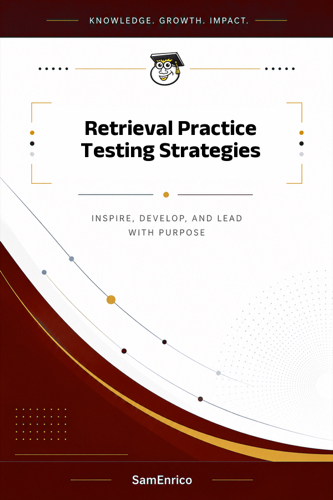
Retrieval Practice Testing Strategies eBook
Teaches how self-testing with closed books produce
Teaches how self-testing with closed books produces stronger neural pathways.
Formats
Free sample
Chapter 1: The Forgetting Paradox--–- The human brain is not a library. If it were, you could simply place a memory on a shelf, return weeks later, and find it exactly where you left it. But that is not how memory works. The brain is more like a garden overrun with weeds. Information you learn today begins to disappear almost immediately—not because you are lazy or unfocused, but because your brain is executing a design that has been honed by millions of years of evolution.
Forgetting, as it turns out, is not a flaw. It is a feature. And understanding this paradox is the first step toward mastering your own mind.Every student, professional, and lifelong learner has experienced the same sinking feeling. You spend an evening reading a chapter, highlighting key passages, and nodding along as the concepts feel clear and logical. The next morning, you try to recall what you learned.
The details are fuzzy. By the end of the week, only fragments remain. By the end of the month, the material might as well be new. This is not a personal failing. It is the predictable, measurable reality of how human memory operates.
The German psychologist Hermann Ebbinghaus discovered this pattern in the 1880s through a series of now-famous experiments on himself. He memorized lists of meaningless syllables—nonsense words like "ZOF" and "KAE"—then tested himself at varying intervals to see how much he retained. The result was a discovery that has been replicated hundreds of times since: the Forgetting Curve.The Forgetting Curve reveals a brutal truth. Within one hour of learning new information, you will forget approximately 50 percent of it. Within 24 hours, that number rises to 70 percent.
Within one week, unless you do something specific and deliberate, you will retain less than 20 percent. This is not a theory. It is a measurement. Ebbinghaus plotted his data and produced a curve that drops steeply at first, then gradually flattens. The shape is consistent across age groups, education levels, and types of material—from vocabulary words to historical dates to scientific formulas.
The only variable that changes the curve is what you do after the initial learning event.Here is where the paradox emerges. Most people respond to forgetting by doing more of what they already did: they re-read the chapter, re-watch the lecture, re-scan their highlights. This feels productive. It feels familiar. It even feels like learning because the material seems more recognizable the second time.
But recognition is not recall. The ability to recognize a fact when you see it in front of you is entirely different from the ability to produce that fact from a blank mental state. The former is passive. The latter is active. And only the latter produces lasting memory.To understand why, we must distinguish between two fundamental properties of memory: storage strength and retrieval strength.
Storage strength refers to how permanently a memory has been encoded into your neural architecture. Once a memory is stored—truly stored—it is essentially permanent. You never actually "lose" information. What you lose is access to it. That is retrieval strength: the ease with which a stored memory can be brought into conscious awareness at a given moment.
Retrieval strength is highly volatile. It rises and falls based on how recently and how frequently you have accessed the memory. Storage strength, by contrast, accumulates slowly and degrades almost never.Here is the key insight that most learners miss. Every time you successfully retrieve a memory—pulling it out of your brain without looking at the source—you increase both retrieval strength and storage strength. But when you simply re-read the information, you increase retrieval strength only temporarily while doing almost nothing for storage strength.
This is why re-reading feels productive in the moment but fails you on the exam. You have built a fragile, temporary bridge to the memory, not a durable, permanent one.Consider an analogy. Imagine you have two paths to a destination. The first path is wide, paved, and clearly marked. Anyone could walk it.
That is recognition. The second path is overgrown, unmarked, and requires effort to find. That is recall. Re-reading information is like standing at the start of the paved path and looking at the destination. You can see it clearly.
You feel confident. But if someone blindfolded you and asked you to walk the overgrown path on your own, you would stumble. That blindfolded walk is what retrieval practice demands. It is harder. It is slower.
It is more uncomfortable. And it is precisely what builds the strong, insulated neural pathways that make memory automatic and durable.This brings us to the central concept of this chapter: the Forgetting Paradox. To remember more, you must allow yourself to forget. Or more precisely, you must allow forgetting to begin so that you can interrupt it through retrieval. The act of successfully retrieving a memory that was on the verge of being forgotten creates a much stronger memory trace than retrieving a memory that is still fresh.
This is called the "retrieval effort effect." The harder your brain works to pull up a piece of information, the more that information is reinforced. Easy retrieval produces weak learning. Difficult retrieval produces strong learning.Think of it like physical exercise. Lifting a weight that feels light does almost nothing for muscle growth. Lifting a weight that strains your muscles—that feels difficult—triggers micro-tears that repair into stronger tissue.
The same principle applies to memory. The struggle is not a sign that something is wrong. The struggle is the mechanism of growth. When you close the book and force yourself to recall what you just read, and you find that you cannot remember everything, the discomfort you feel is not failure. It is the sensation of learning.The research on this is overwhelming.
In a landmark study published in the journal Memory & Cognition, researchers asked students to read a passage and then either re-read it or practice free recall (writing down everything they remembered without looking). One week later, the students who had simply re-read the passage remembered only 40 percent of the information. The students who had practiced free recall remembered 75 percent. That is a difference of nearly two letter grades. And the gap only widens over time.
After one month, the re-reading group dropped to 20 percent retention while the retrieval group remained above 60 percent.Another study, this one from the journal Science, compared four different study methods: single review of notes, repeated review of notes, concept mapping, and retrieval practice. The retrieval practice group outperformed all others by a substantial margin. When tested one week later, the retrieval group scored 50 percent higher than the concept mapping group and nearly 200 percent higher than the single-review group. The authors concluded that retrieval practice is "one of the most powerful learning techniques available to students and educators."But why is retrieval so effective? The answer lies in neuroplasticity—the brain's ability to reorganize itself by forming new neural connections.
Each time you retrieve a memory, you are not simply accessing a static file. You are rebuilding that memory from scattered neural fragments. The process of reconstruction strengthens the connections between…
This is the end of the free sample. Get the eBook to keep going. Buy now
About this book
Details
- Author
- Mccaskill Kathyrn
- Publisher
- SamEnrico
- Language
- English
- Genre
- Non-Fiction, Self-Help, Testing
- Released
- 2026-06-11
- Pages (approx.)
- 123
- Available as
- eBook, Audiobook

Read better in the ZLOADR app
Your eBooks on your phone or tablet. Sign in with your SamEnrico account and start reading.
More by Mccaskill Kathyrn
 Name Phone Contact EntryMccaskill Kathyrn$11.99
 Meth Mouth Dental PreventionMccaskill Kathyrn$11.99
 Remote Work Self Esteem GuideMccaskill Kathyrn$11.99
 Inheritance Conflict ReconciliationMccaskill Kathyrn$11.99
 SMART Goals for Project ManagementMccaskill Kathyrn$11.99
 Teen Nap StrategyMccaskill Kathyrn$11.99
 Shopping Addiction Morning RoutineMccaskill Kathyrn$11.99
 The Golden Wings of Axum: Africa's Skyward EmpireMccaskill Kathyrn$11.99
 The Clockwork Dreamer: The Untold Story of Charles Babbage and the First ComputerMccaskill Kathyrn$11.99
 Service Providers Guide to PhotographyMccaskill Kathyrn$11.99
 How to Produce UPS BatteriesMccaskill Kathyrn$11.99
 A Collector's Handbook to the Lamborghini Countach Lp400Mccaskill Kathyrn$11.99
You may also like
 Hong Kong Handover 1997Dunn Johnnie$11.99
 Zumba For Postnatal Recovery CourseNeal Christian$11.99
 Zumba for BeginnersLadner Nikia$11.99
 YouTube Comment Mining GuideHumes Pandora$12.99
 Worry Box MeditationCarlin Rudy$11.99
 Workplace Stress MeditationNguyen Lynn$11.99
 Workplace Stress and Sleep RepairHawley Ivory$11.99
 Workplace Perfectionism CureDelaney Jeffry$11.99
 Workplace Injustice Anger GuideWallen Isabelle$11.99
 Work Addiction and Burnout LinkGreenwood Ester$11.99
 Women in Yoga and WellnessBeattie Galina$11.99
 Women in Stand Up ComedyChun Evangeline$11.99