
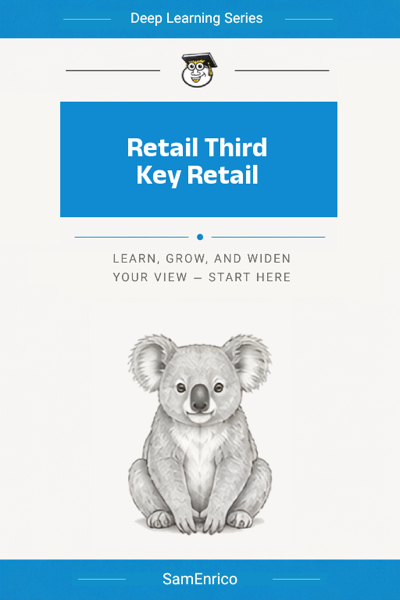
Non-FictionInformativeEducational
Retail Third Key Retail eBook
A Coursebook on Retail Third Key Retail
A Coursebook on Retail Third Key Retail
Formats
Free sample
Chapter 1: The Ecosystem Mandate--–- The announcement scrolled across the conference room screen at 9:47 AM on a Tuesday. "Showrooming is not a threat. Showrooming is a symptom." The retail executive who had commissioned the $2 million study expected to hear that Amazon was killing them. Instead, the data revealed something far more unsettling: customers weren't abandoning the brand. The brand had abandoned the customer by forcing her to choose between the convenience of digital and the sensory richness of physical.
That false choice, the study concluded, was self-inflicted.For the past twenty years, retail has been fighting the wrong war. The battle lines were drawn as "bricks versus clicks," physical stores against e-commerce, old economy against new. Consultants built practices around "omnichannel" as if connecting channels were a revolutionary act. Technology vendors sold "digital transformation" as if becoming a website were the ultimate destination. Meanwhile, the customer stopped noticing the difference.
She checks inventory on her phone while walking into a store. She buys online and picks up curbside. She returns a package to the shelf and buys a replacement from her laptop an hour later. She does not think about channels. She thinks about solving a problem or finding something delightful.The retail industry has been solving the wrong problem.
The question is not how to compete with Amazon or how to drive foot traffic or how to reduce cart abandonment. The question is how to become the kind of ecosystem that customers never need to leave. This chapter introduces the framework that will transform how you see every aspect of retail: the shift from Location (Key 1) to Inventory (Key 2) to Ecosystem Orchestration (Key 3). And it begins with a simple premise that most retailers still get wrong: the customer does not care about your channels. She cares about the seamlessness of her experience, the relevance of your offerings, and the value of her time.
Everything else is internal noise.The Death of the Binary The false binary between physical and digital retail has caused more strategic errors than any other misconception in modern commerce. Retailers built separate teams for stores and e-commerce, each with its own P&L, its own incentives, and its own culture. Store managers were measured on foot traffic and conversion. Digital managers were measured on click-through rates and basket size. Neither was measured on customer lifetime value across both.
The result was a company fighting itself while the customer watched in frustration.Consider the common scenario that plays out millions of times each day. A customer browses a retailer's website at lunch, adds three items to her cart, but does not check out because she wants to see the fabric in person. She drives to the store after work. The item is on the shelf, but the store's system does not know she had it in her online cart. The sales associate has no visibility into her browsing history.
When she asks if the item comes in a different color, the associate checks the back room—the only inventory he can see—and says no. The customer leaves, buys the item from a competitor that offers free shipping and returns, and never comes back. The retailer lost a customer not because its product was bad or its price was high, but because its internal silos prevented a seamless experience.The death of the binary is not a prediction. It is an observation of what has already happened. The most successful retailers of the past decade—not just the obvious digital natives but also traditional players who transformed—have abandoned the distinction.
They have unified their data, their incentives, and their customer experience. They have stopped asking whether a sale happened online or in-store and started asking whether the customer would return.The Three Golden Ages of Retail To understand where retail is going, we must first understand where it has been. The history of modern retail can be understood as three distinct Golden Ages, each defined by a different winning key. These ages did not end so much as accumulate. Each new key added complexity and capability without entirely erasing the importance of the previous keys.
Location still matters. Inventory still matters. But alone, neither is sufficient.The First Golden Age: The Department Store Revolution (Key 1: Location)The late nineteenth century witnessed the birth of the department store. In Paris, Le Bon Marché reimagined retail as a destination rather than a necessity. In London, Harrods offered everything from furniture to food under a single roof.
In New York, Macy's introduced fixed prices, eliminating the exhausting haggling that had characterized general stores. The winning key in this era was unequivocally Location. Being on the main thoroughfare, near public transportation, or in the growing commercial districts determined success. The retailer who secured the best corner won the most traffic.Department stores also introduced concepts we now take for granted: money-back guarantees, window displays as entertainment, seasonal sales, and the idea that shopping could be a leisure activity rather than a chore. The First Golden Age was about aggregation and accessibility.
Bring everything to one place, make it easy to find and pleasant to browse, and customers will come.The Second Golden Age: The Mall and Category Killer Era (Key 2: Inventory)The mid-twentieth century shifted retail from city centers to suburbs. The automobile enabled the shopping mall, and the shopping mall enabled the specialty store. Gap, The Limited, and countless others offered targeted assortments for specific demographics—teenagers, suburban mothers, business professionals. At the same time, category killers like Toys "R" Us, Circuit City, and Home Depot emerged, offering unprecedented depth and breadth within a single category.The winning key in this era was Inventory. The retailer with the most SKUs, the deepest selection, and the ability to satisfy almost any customer need in that category won.
Consumers drove past the downtown department store to the mall with free parking and climate-controlled walkways. They abandoned the generalist for the specialist who could offer twenty styles of khakis or fifty types of power tools.But the Second Golden Age contained the seeds of its own disruption. Massive inventory required massive real estate, which required massive capital. The fixed costs were enormous, and the flexibility was minimal. When digital commerce began offering even greater selection with lower overhead, the category killer model became vulnerable.The Third Golden Age: The Ecosystem Era (Key 3: Orchestration)We are living through the early years of the Third Golden Age, though most retailers have not yet fully understood it.
The winning key is no longer location or inventory alone. It is Ecosystem Orchestration—the ability to seamlessly integrate unified customer data, physical spaces designed for connection, and AI-driven personalization into a cohesive whole that feels effortless to the customer.The Third Golden Age is powered by three converging forces. First, ubiquitous mobile connectivity means the customer carries a supercomputer in her pocket, one that knows her location, her preferences, and her purchase history. Second, AI-driven analytics can process vast amounts of data to predict demand, personalize recommendations, and optimize pricing in real time. Third, a post-pandemic hunger for authentic human connection has elevated the role of physical space as a site for community, discovery, and belonging.The retailers winning…
This is the end of the free sample. Get the eBook to keep going. Buy now
About this book
Details
- Author
- Kozlowski Dania
- Publisher
- SamEnrico
- Language
- English
- Genre
- Non-Fiction, Informative, Educational
- Released
- 2026-06-02
- Pages (approx.)
- 153
- Available as
- eBook, Audiobook

Read better in the ZLOADR app
Your eBooks on your phone or tablet. Sign in with your SamEnrico account and start reading.
More by Kozlowski Dania
 Remote Company Retreats Wellness FocusKozlowski Dania$11.99
 Ex Wedding Attendance GuideKozlowski Dania$11.99
 Patsy Cline Crazy LifeKozlowski Dania$11.99
 First Responder Burnout PreventionKozlowski Dania$11.99
 The Reinhold Messner Solo GuideKozlowski Dania$11.99
 Handel's Royal Fireworks: Music That Defined a MonarchyKozlowski Dania$11.99
 How to Become a Library DirectorKozlowski Dania$11.99
 Master's AI in Germany GuideKozlowski Dania$12.99
 EU Organic Certification CoffeeKozlowski Dania$12.99
 Understanding Sensory Neuropathy Type 1Kozlowski Dania$17.99
You may also like
 Hong Kong Handover 1997Dunn Johnnie$11.99
 Zumba For Postnatal Recovery CourseNeal Christian$11.99
 Zumba for BeginnersLadner Nikia$11.99
 YouTube Comment Mining GuideHumes Pandora$12.99
 Worry Box MeditationCarlin Rudy$11.99
 Workplace Stress MeditationNguyen Lynn$11.99
 Workplace Stress and Sleep RepairHawley Ivory$11.99
 Workplace Perfectionism CureDelaney Jeffry$11.99
 Workplace Injustice Anger GuideWallen Isabelle$11.99
 Work Addiction and Burnout LinkGreenwood Ester$11.99
 Women in Yoga and WellnessBeattie Galina$11.99
 Women in Stand Up ComedyChun Evangeline$11.99