
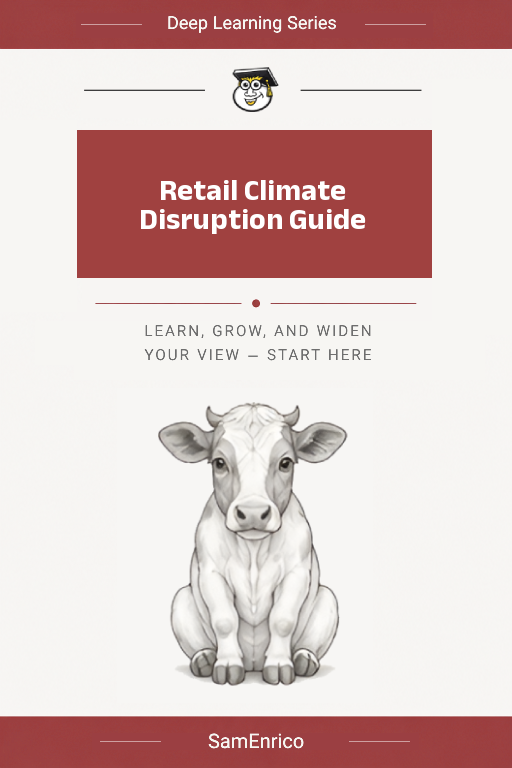
Retail Climate Disruption Guide
Insures retail businesses against climate disrupti
Insures retail businesses against climate disruptions including inventory damage, store closures, and reduced foot traffic from weather events.
Formats
About this book
Free sample
Chapter 1: The Trillion-Dollar Blind Spot--–- On a humid Tuesday morning in July 2025, the manager of a Moscow electronics retailer watched her store's foot traffic dashboard flatline. Outside, thermometers registered 38°C—100.4°F—breaking a 122-year record. Inside, her inventory of portable fans and air conditioners had sold out by 9:15 AM. Her regional distribution center had exactly zero units left. Her standard business interruption insurance policy, which she had renewed three months earlier, covered fires, theft, and structural damage.
It did not cover the 1,200 customers who had searched for "air conditioner near me" on their phones but found nothing. It did not cover the 400,000 rubles in lost margin from the heatwave's third straight day. And it certainly did not cover the spoilage of her refrigerated cosmetics section when the municipal power grid failed the following afternoon.This chapter reveals why the retail industry is sleepwalking into a climate crisis armed with insurance products designed for a world that no longer exists. The gap between what standard policies cover and what climate disruption actually damages now totals an estimated $1 trillion in annual revenue volatility. That gap has a name: the protection gap.
And closing it requires retail leaders to stop treating weather as an act of God and start treating it as a line item on the profit-and-loss statement.The 3.4% Rule: How Weather Became a $1 Trillion Line Item For decades, retailers treated weather as noise. A rainy weekend depressed garden center sales. An unseasonably warm February ate into winter coat margins. These fluctuations were absorbed as the cost of doing business, smoothed over by annualized revenue targets and shrugged off as "volatility." But climate change has transformed volatility into systemic risk, and the numbers are now too large to ignore.According to a synthesis of meteorological and retail analytics research, weather events directly influence an average of 3.4 percent of global retail sales. That percentage varies by sector—4.2 percent for apparel, 5.1 percent for outdoor recreation, 6.8 percent for home improvement—but the aggregate figure translates to approximately 1trillioninannualrevenuethatisvolatile,unpredictable,andlargelyuninsured.Toputthatnumberinperspective,1 trillion in annual revenue that is volatile, unpredictable, and largely uninsured.
To put that number in perspective, 1trillioninannualrevenuethatisvolatile,unpredictable,andlargelyuninsured.Toputthatnumberinperspective,1 trillion exceeds the combined annual revenue of Amazon, Walmart, and Costco. It represents…
This is the end of the free sample. Get the eBook to keep going. Buy now
Contents
- Chapter 1
- Chapter 2
- Chapter 3
- Chapter 4
- Chapter 5
- Chapter 6
- Chapter 7
- Chapter 8
- Chapter 9
- Chapter 10
- Chapter 11
- Chapter 12
Details
- Author
- Dawkins Jarod
- Publisher
- SamEnrico
- Language
- English
- Genre
- Non-Fiction, Business Brief, Retail
- Released
- 2026-06-01
- Pages (approx.)
- 150
- Available as
- eBook, Audiobook

Read better in the ZLOADR app
Your eBooks on your phone or tablet. Sign in with your SamEnrico account and start reading.
More by Dawkins Jarod
 Live From New York StoriesDawkins Jarod$11.99
 Agent Desktop Optimization GuideDawkins Jarod$11.99
 Fast Food Calorie Survival GuideDawkins Jarod$11.99
 The Ice Cube Acting CareerDawkins Jarod$11.99
 Validation for Depressed PartnersDawkins Jarod$11.99
 The Cosmic Philosophers of Ancient Egypt: Stargazers of the NileDawkins Jarod$11.99
 Skye Terrier BreedingDawkins Jarod$11.99
 Startup Unit EconomicsDawkins Jarod$12.99
 Learn to Play the BarrilesDawkins Jarod$11.99
 How to Start a Development for Building Projects for Own Operation Business (Beginners Guide)Dawkins Jarod$11.99
You may also like
 London Pop Up Lease GuideSpencer Shelly$11.99
 Retail Sales PsychologyMclain Alysa$11.99
 Retail Dividend Investing GuideCreech Stormy$11.99
 The Funnel for RetailersCline Mozell$11.99
 Dumb Money IndicatorsGates Kerri$11.99
 Retail REIT ApocalypseJewett Ashlyn$11.99
 Retail Team ExhaustionGant Lu$11.99
 Retail Store InsuranceMolina Ammie$11.99
 Retail Store Credit AccountsBusch Providencia$12.99
 Cash Flow for Retail StoresHuber Deidra$12.99
 AI Retail Accounting GuideDuffy Andrew$12.99