
Non-FictionBusiness BriefUK Jobs
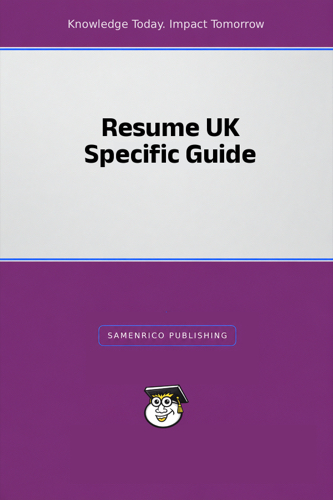
Resume UK Specific Guide eBook
Follow British CV norms and highlight right to wor
Follow British CV norms and highlight right to work status.
Formats
Free sample
Chapter 1: The Two-Minute Execution--The average British recruiter spends exactly 127 seconds looking at your CV before deciding whether you proceed to interview or join the rejection pile. That is not a guess. That is data from the Recruitment and Employment Confederation’s 2024 analysis of 12,000 hiring decisions across the United Kingdom. In less time than it takes to brew a cup of tea, someone you have never met will assess your literacy, your professional worth, your cultural fit, and your legal right to work in this country. If your CV fails to communicate those four elements within that window, nothing else matters.
Not your degree from a top university. Not your fourteen years of experience. Not the glowing reference from your previous employer. You are gone.This chapter is not about formatting or templates or the difference between a CV and a résumé. Those things matter, and they will come in later chapters.
But first, you need to understand who is reading your document, what they are looking for, and why the British approach to hiring is fundamentally different from what you will find in the United States, Canada, Australia, or continental Europe. If you are an international applicant, this chapter may save you from making the single most common mistake that gets qualified people rejected before anyone reads their employment history. If you are British but have only ever used American-style résumés, this chapter will explain why your applications have been failing silently.The British recruiter operates under constraints that most job seekers never consider. First, they are legally obligated to screen every applicant for Right to Work status before the first interview. Second, they are personally liable if they hire someone without valid documentation, with fines reaching £20,000 per illegal worker.
Third, they are drowning in applications. A single administrative role in London can attract over two hundred CVs within forty-eight hours. A graduate scheme at a major bank regularly receives more than three thousand applications. The recruiter cannot read every word of every document. They scan.
They filter. They eliminate. And they do so ruthlessly, using rules that you need to know before you write a single line of your CV.This chapter introduces the foundational concepts that will be expanded throughout this book: the psychology of the British hiring manager, the two-minute rule, the importance of the Personal Profile over the Objective statement, and the surprising role of hobbies in UK hiring decisions. By the end of this chapter, you will understand why your American-style résumé is actively harming your chances in the UK market and what you must do differently starting with your very next application.The British Recruiter’s Mindset: Conservatism, Literacy, and Evidence Let us begin with a direct comparison. In the United States, recruiters are taught to look for confidence, ambition, and self-promotion.
Phrases like "I revolutionized the sales process" or "I am a results-driven innovator" are considered strengths. In the United Kingdom, those same phrases trigger suspicion. British recruiters value conservatism not as a political position but as a professional orientation. They want evidence, not adjectives. They want to see what you actually did, not what you claim you can do.
They want the quiet confidence of someone who does not need to shout about their achievements because those achievements are obvious from the data.Consider two hypothetical applicants for a marketing manager role in Manchester. Applicant A, trained on American résumé conventions, writes: "Revolutionized the company’s digital marketing strategy, driving exceptional growth and delivering game-changing results across all channels." Applicant B, following British norms, writes: "Redesigned the digital marketing strategy. Year-on-year revenue increased by 23 percent across twelve months. Maintained existing budget without additional spend." Which applicant gets the interview? In the United States, Applicant A might proceed.
In the United Kingdom, Applicant B is the clear winner. Why? Because Applicant B provides verifiable, specific, modestly presented evidence. Applicant A provides adjectives that any liar could write.British recruiters are trained to spot what industry insiders call "the American tell" – the use of hyperbolic language that sounds impressive but carries no informational weight. Words like "exceptional," "outstanding," "revolutionary," "game-changing," "visionary," and "guru" are not merely ignored.
They are actively penalized. A 2023 study by the Chartered Institute of Personnel and Development found that CVs containing more than three such adjectives were seventy-two percent less likely to receive an interview callback than identical CVs with the adjectives removed and replaced by plain factual statements. The study controlled for experience, education, and industry. The only variable was language. Adjectives killed applications.Literacy is the second pillar of the British recruiter’s evaluation.
This does not mean simply being able to read and write. It means perfect spelling, perfect punctuation, perfect grammar, and consistent formatting. A missing full stop at the end of a bullet point will be noticed. A comma splice in your Personal Profile will be noted. Using "their" instead of "there" or "your" instead of "you are" is not a minor typo; it is evidence of carelessness.
British recruiters come from a culture where written communication is treated as a reflection of professional competence. If you cannot proofread your own CV, the reasoning goes, how can you be trusted to proofread a client report or a regulatory filing?This is not pedantry. This is efficiency. The recruiter has two hundred CVs to process. They need reasons to eliminate candidates quickly.
A single spelling error gives them that reason. A formatting inconsistency gives them that reason. A missing space after a full stop gives them that reason. Do not give them reasons to reject you. Give them reasons to keep reading.The third pillar is evidence over assertion.
British recruiters want to see what you achieved, not what you were responsible for. There is a profound difference between listing duties and demonstrating outcomes. "Responsible for managing a team of five" is a duty. "Managed a team of five. Under my supervision, the team reduced customer complaint resolution time from forty-eight hours to twenty-four hours over six months" is evidence.
The first statement could be written by anyone who held the job title. The second statement could only be written by someone who actually improved something.The Two-Minute Rule: Why Your CV Must Work in 127 Seconds The two-minute rule is not a suggestion. It is a constraint that shapes every decision you make about your CV’s structure, content, and presentation. Because the recruiter will spend roughly two minutes on your document, you must organize your information so that the most important material appears first, the less important material appears later, and the irrelevant material does not appear at all.Think of your CV as an inverted pyramid. At the top, the widest part, you place your most critical information: your name, your Right to Work status, your location, your contact details, and your Personal Profile.
This is what the recruiter sees in the first ten seconds. If any of this information is missing or incorrect, your CV will be rejected immediately. In the middle of the pyramid, your employment history and key achievements. This is what the recruiter scans in the next sixty seconds. If nothing catches their attention here…
This is the end of the free sample. Get the eBook to keep going. Buy now
About this book
Details
- Author
- Almeida Lorrie
- Publisher
- SamEnrico
- Language
- English
- Genre
- Non-Fiction, Business Brief, UK Jobs
- Released
- 2026-06-07
- Pages (approx.)
- 156
- Available as
- eBook, Audiobook

Read better in the ZLOADR app
Your eBooks on your phone or tablet. Sign in with your SamEnrico account and start reading.
More by Almeida Lorrie
 Managing Slack DistractionsAlmeida Lorrie$11.99
 Complicated Grief Self AssessmentAlmeida Lorrie$11.99
 1031 Exchange Cross Border Real EstateAlmeida Lorrie$11.99
 Rocking Chair PorchAlmeida Lorrie$11.99
 Woman SubmarinerAlmeida Lorrie$11.99
 Pattern Recognition for ReadingAlmeida Lorrie$11.99
 Evan Spiegel SnapchatAlmeida Lorrie$11.99
 The Bitcoin Heist: How One Man Lost a Fortune in 24 HoursAlmeida Lorrie$11.99
 The Maestro of Monte Cassino: Music Amid the RuinsAlmeida Lorrie$11.99
 The Djinn of the Empty Quarter: Wisdom from the WhirlwindAlmeida Lorrie$11.99
 The Complete Guide to Hungry GirlAlmeida Lorrie$11.99
 How to Become a Ampoule-washing-machine OperatorAlmeida Lorrie$11.99
You may also like
 Hong Kong Handover 1997Dunn Johnnie$11.99
 Zumba For Postnatal Recovery CourseNeal Christian$11.99
 Zumba for BeginnersLadner Nikia$11.99
 YouTube Comment Mining GuideHumes Pandora$12.99
 Worry Box MeditationCarlin Rudy$11.99
 Workplace Stress MeditationNguyen Lynn$11.99
 Workplace Stress and Sleep RepairHawley Ivory$11.99
 Workplace Perfectionism CureDelaney Jeffry$11.99
 Workplace Injustice Anger GuideWallen Isabelle$11.99
 Work Addiction and Burnout LinkGreenwood Ester$11.99
 Women in Yoga and WellnessBeattie Galina$11.99
 Women in Stand Up ComedyChun Evangeline$11.99