
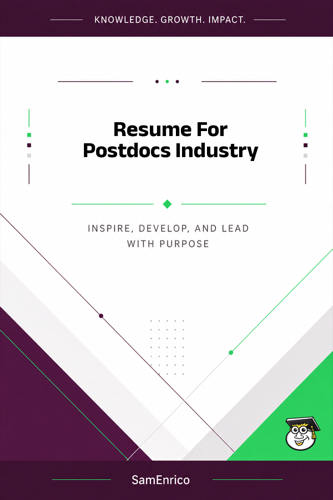
Non-FictionBusiness BriefPostdoc Careers
Resume For Postdocs Industry eBook
Leave academia for corporate research and developm
by Poe Brook
Leave academia for corporate research and development roles.
Formats
Free sample
Chapter 1: The Tombstone Paradox--–- You are holding a document that is killing your career. You probably spent years perfecting it. Your advisor praised its completeness. Your postdoc mentor said it was “impressive.” And yet, every time you send it to a corporate recruiter, you hear nothing. Not rejection.
Silence. The kind of silence that makes you wonder if you accidentally included a confession or a recipe for disaster.That document is your academic CV. And in the world of corporate research and development, it is not merely ineffective. It is actively harmful.This chapter will dismantle everything you believe about your CV and rebuild it from the ground up. By the time you finish reading, you will understand why academic excellence translates so poorly to corporate recruiting, and you will take the first irreversible step toward becoming something new: a Translational Scientist.The Graveyard of Perfect CVs Let me tell you about Elena.
Elena had a Ph D in neuroscience from a top-tier university. She completed a three-year postdoc at an even more prestigious institution. Her publication record included two first-author papers in high-impact journals and four co-authored contributions. She had presented at international conferences, won a young investigator award, and taught graduate-level courses. Her CV was, by every academic metric, flawless.She applied to forty-seven industry positions over six months.
She received three automated rejection emails and forty-four instances of complete silence. Not one phone screen. Not one request for an interview. She came to me with her CV printed on high-quality paper, held it out like a religious artifact, and said, “I don’t understand. What am I doing wrong?”I looked at her CV for fifteen seconds.
Then I told her the truth that no one in academia had ever dared to say: “Elena, your CV is a eulogy. It chronicles everything you have ever done, but it says nothing about what you can do for a company. You are speaking a language that recruiters do not understand, and you are burying your value under mountains of irrelevant detail.”She looked at me as if I had insulted her dead grandmother. But she listened. We rewrote her CV from scratch.
Eight weeks later, she accepted an offer as a Senior Scientist at a mid-sized biotech with a forty percent salary increase over her postdoc stipend.Elena’s story is not exceptional. It is the rule. Every week, thousands of postdocs around the world submit academic CVs to industry job postings, and every week, those CVs are ignored. Not because the candidates are unqualified. Not because industry has no use for Ph D-level scientists.
But because the document itself is fundamentally mismatched to the audience.The Fundamental Error: The Inventory vs. The Blueprint Here is the core problem, stated as simply as possible.An academic CV is an inventory. It lists everything you have done: every paper, every presentation, every teaching assistantship, every committee assignment, every technique you have ever touched. The implicit logic is that more is better. Completeness is a virtue.
The CV says, “Look at the volume and breadth of my work. Therefore, I am qualified.”An industry resume is a blueprint. It does not ask, “What have you done?” It asks, “What can you build for us?” The implicit logic is that relevance is better than completeness. Selectivity is a virtue. The resume says, “Look at these three specific achievements that match your exact needs.
Therefore, I will deliver value.”The difference is not cosmetic. It is ontological. You cannot transform a CV into a resume by changing the font or shortening the margins. You must change the fundamental relationship between the document and the reader.Let me put this in terms that will resonate with any scientist. Imagine you are applying for a grant.
Your proposal must address the specific aims of the funding agency. You would not submit a fifty-page lab report that describes every experiment you have ever performed. You would select the most relevant preliminary data, frame it to match the agency’s priorities, and omit everything else. The resume is no different. The company is the funding agency.
The job description is the request for proposals. Your resume is your grant application. And your academic CV is a lab notebook.The Fifteen-Second Rule Now let us examine the recruiting process through the lens of basic cognitive psychology. Corporate recruiters, particularly those in talent acquisition rather than scientific hiring, operate under extreme time constraints. A single job posting for an R&D position might receive two hundred to five hundred applications.
The recruiter has perhaps two hours to screen that entire pool. That means each document receives between fifteen and thirty seconds of attention.Fifteen seconds.In fifteen seconds, a recruiter is not reading. They are scanning. They are looking for pattern matches: specific keywords that align with the job description, specific role titles that indicate relevant experience, specific numbers that suggest impact. If those patterns do not appear instantly, the document is rejected.
Not because the recruiter is lazy or incompetent, but because the system is designed for speed, not depth.Contrast this with an academic search committee. A faculty search might receive fifty to one hundred applications. Each candidate’s CV is read in detail, often by multiple committee members over several weeks. The committee knows the field. They understand the journals.
They can interpret the significance of a first-author paper versus a middle-author paper. They have time.The industry recruiter does not have that time. They may not even have a scientific background. They are looking for matches to a list of keywords provided by the hiring manager. If your CV says “elucidated the role of micro RNA-122 in hepatocyte metabolism” but the job description says “cell culture and q PCR,” the recruiter may not connect the two.
Your sophisticated science becomes invisible.This is not a bug. It is a feature of the system. And you must design your resume to work within that system, not against it.The Translational Scientist: Your New Identity To write an effective industry resume, you must first adopt a new professional identity. I call this the Translational Scientist.A Translational Scientist is someone who understands that scientific knowledge has value only when it is applied to solve concrete problems under real-world constraints. The Translational Scientist does not ask, “Is this discovery interesting?” They ask, “Can this discovery be turned into a drug, a device, a diagnostic, or a process that generates revenue, saves money, or reduces risk?”This shift from pure discovery to applied value is the single most important psychological transformation you will undergo in your transition from academia to industry.
It will affect every bullet point you write, every conversation you have, and every decision you make about where to apply.Let me give you an example. In academia, you might say: “Characterized the binding kinetics of novel protein kinase B inhibitors using surface plasmon resonance.”That sentence is perfectly fine for a CV. It tells another academic exactly what you did. But it says nothing about why it matters to a company. A Translational Scientist rewrites that sentence as: “Executed high-throughput SPR screens to validate lead inhibitors for…
This is the end of the free sample. Get the eBook to keep going. Buy now
About this book
Details
- Author
- Poe Brook
- Publisher
- SamEnrico
- Language
- English
- Genre
- Non-Fiction, Business Brief, Postdoc Careers
- Released
- 2026-06-07
- Pages (approx.)
- 150
- Available as
- eBook, Audiobook

Read better in the ZLOADR app
Your eBooks on your phone or tablet. Sign in with your SamEnrico account and start reading.
More by Poe Brook
 Ending Relationship Compassionately GuidePoe Brook$11.99
 Pattern Recognition for GamesPoe Brook$11.99
 CRE Property Condition ReportPoe Brook$11.99
 Forgiveness for Educational FailurePoe Brook$11.99
 Nonviolent Anger ExpressionPoe Brook$11.99
 Benzo Taper Support For Families ManualPoe Brook$11.99
 Self Esteem After DivorcePoe Brook$11.99
 Gaslit Childhood Truth Seeker PrimerPoe Brook$11.99
 Vanishing Act: The Mysterious Disappearance of George SmithPoe Brook$11.99
 The Fire Below: Ancient Seafarers and the Mystery of Atlantic RadiationPoe Brook$11.99
 The Iron Genius of the Kongo: The Forgotten Metallurgists of Central AfricaPoe Brook$11.99
 Gamification and Engagement DesignPoe Brook$11.99
You may also like
 Hong Kong Handover 1997Dunn Johnnie$11.99
 Zumba For Postnatal Recovery CourseNeal Christian$11.99
 Zumba for BeginnersLadner Nikia$11.99
 YouTube Comment Mining GuideHumes Pandora$12.99
 Worry Box MeditationCarlin Rudy$11.99
 Workplace Stress MeditationNguyen Lynn$11.99
 Workplace Stress and Sleep RepairHawley Ivory$11.99
 Workplace Perfectionism CureDelaney Jeffry$11.99
 Workplace Injustice Anger GuideWallen Isabelle$11.99
 Work Addiction and Burnout LinkGreenwood Ester$11.99
 Women in Yoga and WellnessBeattie Galina$11.99
 Women in Stand Up ComedyChun Evangeline$11.99