
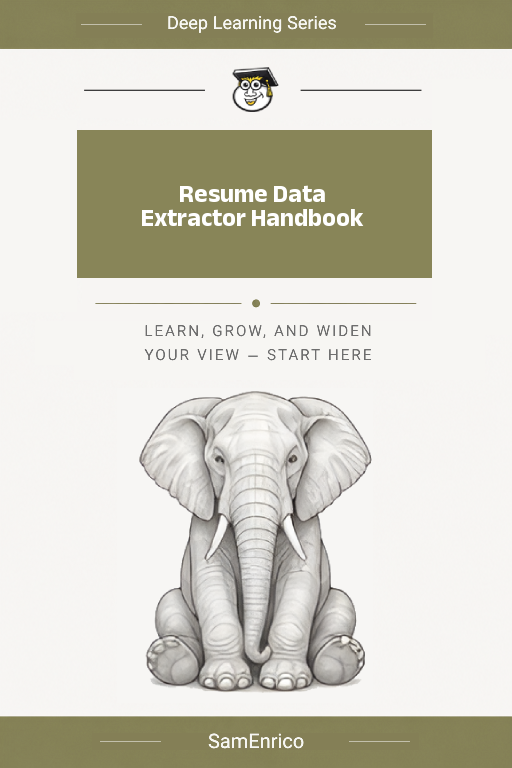
Non-FictionAI OperatorTalent Acquisition TechSkills Guide
Resume Data Extractor Handbook eBook
Parse thousands of resumes to extract skills, expe
by Diaz Freddie
Parse thousands of resumes to extract skills, experience, education, and contact info using AI. Includes format handling (PDF, DOCX, TXT), field mapping, and duplicate detection.
Formats
Free sample
Chapter 1: The Broken Filter--The recruiter stared at her screen, frozen mid-click. Eleven thousand, four hundred and twenty-seven resumes. For three software engineering roles. The job posting had been live for just seventy-two hours.She had a team of four recruiters, a budget of zero dollars for new tools, and a directive from the VP of Engineering: "Find me the top ten candidates by Friday." It was Tuesday.This is not a hypothetical. This is the reality of high-volume hiring in 2026.
And it is breaking the global talent acquisition system.The Mathematics of Impossibility Let us be precise about the scale of the problem. A competent recruiter, reading carefully, can review a resume in approximately two minutes. That includes scanning for relevant experience, verifying skills, checking education, and making a preliminary "yes/no" judgment. Two minutes is optimistic—many resumes require five—but let us take the lower bound.At two minutes per resume, our recruiter would need 22,854 minutes to process 11,427 applications. That is 381 hours.
Assuming a forty-hour work week with no meetings, no lunch breaks, and no bathroom stops, that is nine and a half weeks of continuous resume reading.She had three days.What happens in practice is not reading. It is filtering. Brutal, arbitrary, statistically indefensible filtering.The recruiter searches for keywords. "Python." "AWS." "Senior." If the resume contains these strings, it moves forward. If the candidate phrased their experience as "developed cloud-native solutions using Amazon Web Services" rather than "AWS," they are discarded.
If they listed "Py Torch" but the search was for "deep learning," they are invisible. If they formatted their dates as "2020-2023" instead of "2020 to 2023," the parser—if one exists at all—might miss the span entirely.This is not hiring. This is a lottery with terrible odds, and everyone loses.The Anatomy of a False Negative Let me introduce a concept that will appear throughout this book: the false negative. In the context of resume parsing, a false negative is a qualified candidate who is rejected or overlooked because the extraction system failed to capture their relevant attributes.False negatives are invisible. You never know they happened.
The candidate receives a generic rejection email—or more likely, silence. The recruiter moves on to the next resume. The hiring manager interviews someone else. The company makes a hire. The false negative candidate takes a job elsewhere, perhaps at a competitor.The cost, however, is very real.Consider a simple model.
A software engineer generates approximately $200,000 in annual value to a technology company. This is a conservative estimate—at top-tier firms, the number is significantly higher. Now assume that a qualified candidate has a 5% chance of being rejected due to inconsistent or incomplete resume parsing. Perhaps their skills section is formatted as a table that the parser cannot read. Perhaps their job title is unconventional.
Perhaps they used a synonym that the keyword filter does not recognize.For every 1,000 resumes processed, that 5% false negative rate means 50 qualified candidates are lost. At 200,000invaluepercandidate,theexpectedlossis200,000 in value per candidate, the expected loss is 200,000invaluepercandidate,theexpectedlossis10,000 per 1,000 resumes. For a company that receives 100,000 resumes annually (typical for a mid-sized tech employer), the annualized loss exceeds one million dollars.And that is just the direct cost. The indirect costs are larger still. The time recruiters spend manually correcting extraction errors.
The opportunity cost of unfilled roles. The compounding effect of hiring mediocre candidates because the good ones were filtered out. The damage to employer brand when candidates experience a broken application process.The Three-Tier Landscape of Resume Parsing Before we build our own solution, we must understand what already exists. The current market divides neatly into three tiers, each with distinct trade-offs.Tier One: Legacy Applicant Tracking Systems The oldest and most widely deployed solutions come from legacy ATS vendors: Taleo (now Oracle), Lever, Greenhouse, i CIMS, and Workday. These systems were designed in an era when resume parsing meant keyword matching and boolean search.Their approach is simple: convert the resume to plain text, then scan for specific strings.
If the word "Python" appears anywhere, the candidate is flagged as having Python experience. If "MBA" appears, they are flagged for education. There is no understanding of context, no entity extraction, no relationship detection.The limitations are severe. A candidate who writes "I have used Python for data analysis" is indistinguishable from one who writes "I do not have Python experience" (the keyword still matches). A candidate whose resume is formatted as an image is completely invisible.
A candidate who lists skills in a table—a common design pattern—will have those skills ignored because the parser cannot navigate table structures.Legacy ATS systems are also expensive. Licensing costs range from 10,000to10,000 to 10,000to100,000 annually for mid-market organizations, with enterprise contracts reaching significantly higher. Despite this cost, most do not include modern NLP capabilities. The value proposition is workflow management and compliance tracking, not intelligent parsing.Tier Two: AI-Native Vendors A new generation of vendors has emerged in the past decade: Ideal, Eightfold, Hire Vue, Pymetrics, and others. These companies were founded on the premise that machine learning could fundamentally improve candidate matching.Their solutions use genuine NLP.
They extract entities—skills, experience durations, job titles, education levels—rather than just keywords. They attempt to understand semantics, mapping "led a team of five engineers" to "management experience" even without the word "manager." They provide matching scores that consider both explicit qualifications and inferred potential.The accuracy is genuinely higher. In benchmark studies, the best AI-native vendors achieve 94-96% precision on skill extraction, compared to 70-75% for legacy systems.However, these solutions have their own problems. They are black boxes. You submit a resume and receive a JSON response, but you have no insight into how the extraction was performed, what model was used, or why a particular decision was made.
When the system makes an error—and it will—you cannot fix it. You cannot retrain the model on your specific resume formats. You cannot add domain-specific skills to the taxonomy.The pricing reflects this opacity. Most AI-native vendors charge per-resume fees ranging from 0.10to0.10 to 0.10to0.50. For a company processing 100,000 resumes annually, this adds 10,000to10,000 to 10,000to50,000 in variable costs on top of fixed licensing fees.
Over time, the total cost of ownership often exceeds legacy systems.Tier Three: Open Source, Roll-Your-Own This is the approach this book teaches. You will build your own resume parsing system using open-source libraries: spa Cy for NER, Py Mu PDF for PDF extraction, sentence-transformers for skill embeddings, and Hugging Face transformers for the final NER model.The advantages are compelling. Zero licensing costs. Complete transparency—you can inspect every line of code, every model weight, every extraction decision. Full customization—you can add any skill to the taxonomy, modify any extraction rule, fine-tune any model on your specific resume corpus.
No vendor lock-in—your system runs on your infrastructure, and you can modify it freely.The disadvantages are equally real. You need engineering expertise. This is not a plug-and-play solution; it requires Python proficiency, understanding of NLP concepts, and comfort with command-line tools. You need annotation effort—at least 2,000 labeled resumes to fine-tune a transformer model to 96% accuracy. You need maintenance—libraries update…
This is the end of the free sample. Get the eBook to keep going. Buy now
About this book
Details
- Author
- Diaz Freddie
- Publisher
- SamEnrico
- Language
- English
- Genre
- Non-Fiction, AI Operator, Talent Acquisition Tech, Skills Guide
- Released
- 2026-05-29
- Pages (approx.)
- 105
- Available as
- eBook, Audiobook

Read better in the ZLOADR app
Your eBooks on your phone or tablet. Sign in with your SamEnrico account and start reading.
More by Diaz Freddie
 Saint Ignatius LoyolaDiaz Freddie$11.99
 Air Traffic Controller Stress HandbookDiaz Freddie$11.99
 Voice Tone Nonverbal GuideDiaz Freddie$11.99
 Pet Loss Guilt ReleaseDiaz Freddie$11.99
 The Self Esteem for Caregivers GuideDiaz Freddie$11.99
 The Dragon’s Apprentice: How Saint George Learned to SlayDiaz Freddie$11.99
 Understanding Kuster–majewski–hammerstein SyndromeDiaz Freddie$17.99
 Automation Test EngineerDiaz Freddie$11.99
 Green Building Materials GuideDiaz Freddie$12.99
 How to Start a Baked Goods Store BusinessDiaz Freddie$11.99
You may also like
 Hong Kong Handover 1997Dunn Johnnie$11.99
 Zumba For Postnatal Recovery CourseNeal Christian$11.99
 Zumba for BeginnersLadner Nikia$11.99
 YouTube Comment Mining GuideHumes Pandora$12.99
 Worry Box MeditationCarlin Rudy$11.99
 Workplace Stress MeditationNguyen Lynn$11.99
 Workplace Stress and Sleep RepairHawley Ivory$11.99
 Workplace Perfectionism CureDelaney Jeffry$11.99
 Workplace Injustice Anger GuideWallen Isabelle$11.99
 Work Addiction and Burnout LinkGreenwood Ester$11.99
 Women in Yoga and WellnessBeattie Galina$11.99
 Women in Stand Up ComedyChun Evangeline$11.99