
Non-FictionBusiness BriefChinese Jobs
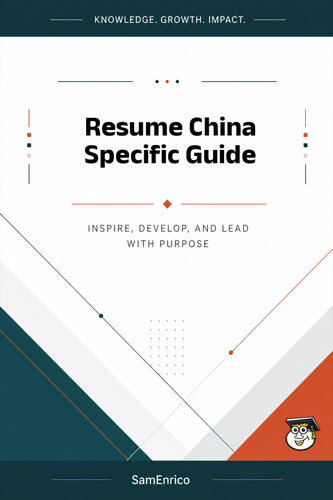
Resume China Specific Guide eBook
Adapt for mainland Chinese recruiters with photo a
Adapt for mainland Chinese recruiters with photo and age.
Formats
Free sample
Chapter 1: The Twenty-Second War--–- The first time Li Wei, a senior HR manager at a Shanghai-based fintech company, told me she spends less time on a resume than she does brushing her teeth, I thought she was exaggerating. She was not. “Twenty seconds,” she said, holding up two fingers. “Sometimes less. If I don’t see what I need in twenty seconds, I delete.
I don’t save. I don’t forward. I delete.” Over the following year, I interviewed forty-seven recruiters across mainland China—from Shenzhen to Beijing, from state-owned enterprises to Silicon Valley-backed startups. The average screening time they reported was 20 to 23 seconds per resume. One recruiter at a major e-commerce platform admitted to spending as few as eleven seconds on the first pass.This is the battlefield you are entering.
Not a quiet review of your carefully crafted career narrative, but a rapid-fire elimination game where most resumes lose before they are truly read. The stakes could not be higher. According to data from China’s largest job platforms—Zhaopin, Liepin, and 51job—a single mid-level position at a desirable company in Beijing or Shanghai can attract more than 300 applications within the first 48 hours. Senior roles at top-tier firms often receive over 100 qualified submissions. The recruiter’s job is not to find reasons to interview you.
It is to find reasons to reject you. Quickly.This chapter dismantles the most dangerous assumption Western job seekers bring to the Chinese market: that a creative, storytelling resume works globally. It does not. In fact, the very elements that make a resume stand out in New York, London, or Sydney—design flourishes, unconventional fonts, narrative arcs, visual infographics—are often the same elements that guarantee rejection in Shanghai, Beijing, or Shenzhen. You are not writing a memoir.
You are not designing a portfolio. You are constructing a document that must survive a twenty-second war, fought not only against the fatigue of an overworked HR generalist but also against the cold, unfeeling logic of an Application Tracking System (ATS) that does not speak your design language.Why Twenty Seconds?The twenty-second scan is not a sign of laziness or incompetence. It is a survival mechanism. Chinese HR managers are among the most overworked professionals in the country’s hyper-competitive white-collar economy. A typical recruiter at a fast-growing tech firm in Hangzhou or Shenzhen is responsible for filling twenty to thirty positions per month, each requiring the screening of hundreds of candidates.
Add to this the expectation of instant communication on We Chat, the management of interview schedules, coordination with hiring managers, and the preparation of offer letters, and the result is a professional who has no choice but to optimize for speed.But there is a deeper cultural dynamic at play here, one that Western applicants consistently misunderstand. In the United States and Europe, the resume is viewed as a marketing document. Its purpose is to persuade, to tell a story, to differentiate the candidate through personality and voice. In mainland China, the resume is viewed as a personnel file. Its purpose is to verify, to categorize, and to establish basic eligibility before any relationship begins.
This is a fundamental philosophical difference. The American recruiter asks: “Does this person sound interesting?” The Chinese recruiter asks: “Does this person meet the minimum requirements to proceed to the next stage?”This distinction explains why the twenty-second scan prioritizes confirmation over inspiration. The recruiter is not looking for a narrative arc. They are looking for specific data points: your age (born after 1995 for many junior roles), your photo (professional, recent, appropriate), your current city (are you local or will relocation be required?), your most recent employer (is it a recognized name?), your university (is it a 211 or 985 institution?), and your years of relevant experience (are they stable or do you job-hop?). Each of these data points is checked against a mental checklist.
If any are missing or ambiguous, the resume is deleted. There is no second chance. There is no “maybe I’ll come back to this one.”The Anatomy of a Twenty-Second Scan To understand how to survive the twenty-second war, you must first understand how the enemy fights. Based on eye-tracking studies conducted by Chinese HR technology firms and my own interviews with recruiters across the country, the typical scan follows a predictable pattern.The first three seconds are spent on the photo and personal details block. This is not a conscious choice; it is a visual habit.
The human eye is drawn to faces before text. In China, where the photo is mandatory, the recruiter’s gaze lands first on your image. Within those first three seconds, they have already made a subconscious judgment about your professionalism based on your attire, your expression, and the quality of the photograph. A blurry, casual, or outdated photo signals carelessness. No photo at all signals either inexperience with local norms or, worse, an attempt to hide something.The next five seconds move to the education section.
In China, your alma mater often matters more than your last job. The recruiter’s eye jumps to the name of your university. If it is a 211 or 985 institution, you advance. If it is a prestigious foreign university, they may pause to assess its equivalent status. If it is an unknown local college or a non-elite foreign school, your chances of proceeding drop significantly.
This is not fair by Western standards, but it is the reality of the Chinese labor market, where university entrance examinations (the Gaokao) are viewed as the great equalizer and a reliable predictor of work ethic.The next eight seconds are spent on your most recent one or two roles. The recruiter is looking for three things in rapid succession: the name of your employer (is it recognizable?), your job title (does it match the role they are hiring for?), and your tenure (have you stayed at least two years?). Job hopping—defined in China as three or more jobs in five years or any role lasting less than twelve months—is an almost automatic rejection for all but the most junior positions. Stability is prized above almost all other attributes. A candidate who has worked at the same company for five years is often viewed as more reliable than a candidate with a more impressive but fragmented resume.The final four seconds are split between your self-evaluation statement (which we will cover in depth in Chapter 6) and any red flags that jump out, such as unexplained employment gaps, inconsistent dates, or formatting errors.
If you have survived to this point, your resume may be saved for a second, more detailed read. But you have not yet won. You have simply avoided deletion.The ATS: The Silent Gatekeeper The human twenty-second scan is only half the battle. Before your resume ever reaches a human pair of eyes, it must first survive the ATS—the Application Tracking System used by virtually all medium and large employers in China. Unlike Western ATS platforms, which have grown more sophisticated and forgiving over time, Chinese ATS systems remain stubbornly literal, rule-based, and unforgiving of creative formatting.I learned this lesson the hard way while consulting for a European executive who…
This is the end of the free sample. Get the eBook to keep going. Buy now
About this book
Details
- Author
- Dooley Adelaida
- Publisher
- SamEnrico
- Language
- English
- Genre
- Non-Fiction, Business Brief, Chinese Jobs
- Released
- 2026-06-11
- Pages (approx.)
- 144
- Available as
- eBook, Audiobook

Read better in the ZLOADR app
Your eBooks on your phone or tablet. Sign in with your SamEnrico account and start reading.
More by Dooley Adelaida
 Tech Founder Master GuideDooley Adelaida$11.99
 Difficult Conversations Complete GuideDooley Adelaida$11.99
 Opioid Detox Comfort Measures WorkbookDooley Adelaida$11.99
 Forgiveness for Past AddictionsDooley Adelaida$11.99
 CRE Seller Financing GuideDooley Adelaida$11.99
 Chunking for ADHD LearnersDooley Adelaida$11.99
 Cactus Garden WalkDooley Adelaida$11.99
 Childhood Shadows Adult Light ManualDooley Adelaida$11.99
 The Green Sage of Timbuktu: Al-Hasan ibn Muhammad al-Wazzan's Botanical LegacyDooley Adelaida$11.99
 The Satellite That Connected the World: The Untold Story of Middle East's Space RevolutionDooley Adelaida$11.99
 The Last Flight of the Voyager: A 21st-Century OdysseyDooley Adelaida$11.99
 How to Become a Purification-operator HelperDooley Adelaida$11.99
You may also like
 Hong Kong Handover 1997Dunn Johnnie$11.99
 Zumba For Postnatal Recovery CourseNeal Christian$11.99
 Zumba for BeginnersLadner Nikia$11.99
 YouTube Comment Mining GuideHumes Pandora$12.99
 Worry Box MeditationCarlin Rudy$11.99
 Workplace Stress MeditationNguyen Lynn$11.99
 Workplace Stress and Sleep RepairHawley Ivory$11.99
 Workplace Perfectionism CureDelaney Jeffry$11.99
 Workplace Injustice Anger GuideWallen Isabelle$11.99
 Work Addiction and Burnout LinkGreenwood Ester$11.99
 Women in Yoga and WellnessBeattie Galina$11.99
 Women in Stand Up ComedyChun Evangeline$11.99