
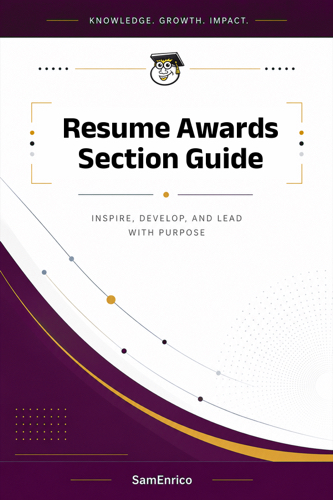
Non-FictionBusiness BriefRecognition
Resume Awards Section Guide eBook
Highlight honors that differentiate you from other
Highlight honors that differentiate you from other candidates.
Formats
Free sample
Chapter 1: The Spikes Concept--Every day, thousands of resumes land on recruiters' desks containing the exact same five words: "Dean's List – multiple semesters." And every day, thousands of those resumes are deleted without a second glance. Not because Dean's List isn't an achievement. It is. You worked hard. You earned recognition.
But here is the uncomfortable truth that no career center will tell you: on a resume, generic honors don't help you. They actually hurt you. They signal that you are normal, predictable, and indistinguishable from the hundreds of other candidates who also made the Dean's List. In a job market where recruiters spend an average of seven seconds on their initial resume scan, "normal" is a death sentence.This chapter introduces the foundational framework that will govern every decision you make about awards for the rest of this book: The Spikes Concept. It is the single most important idea in differentiating yourself from other candidates.
It will force you to delete awards you are proud of, reframe achievements you thought were settled, and make ruthless choices that feel wrong but work. By the end of this chapter, you will have a completely new understanding of what an "award" actually is on a resume—and you will have deleted at least half of your current honors section.The Seven-Second Reality Check Before we build anything, we must destroy your existing assumptions. Let us begin with an experiment.Open your current resume. Find your awards section—or wherever you have listed honors, recognitions, or achievements. Count every single line item.
Now answer this question honestly: if you removed the three least impressive awards from that list, would any recruiter notice? Would any hiring manager call you and ask, "Hey, I noticed you removed your 'Perfect Attendance' award from 2019—what happened?"Of course not.But here is the follow-up question, the one that stings: if you removed the three most impressive awards from that list, would a recruiter notice? Would the narrative of your resume change? Would you still look like a top-tier candidate?If the answer to that second question is also "no," you have a serious problem. Your awards section is not differentiating you.
It is merely occupying space.Recruiters do not scan resumes looking for reasons to hire you. They scan looking for reasons to eliminate you. Seven seconds. That is the average time a recruiter spends on the first pass of a resume, according to multiple eye-tracking studies published in the Journal of Business and Psychology. In those seven seconds, their brain is performing a single function: pattern matching.
They are looking for anomalies, outliers, spikes—anything that deviates from the expected profile of a candidate with your years of experience, education level, and industry.A "spike" is any achievement that falls outside the normal distribution. If the average salesperson in your industry closes $500,000 per year, and you closed $1.2 million, that is a spike. If the average project manager delivers 90% of projects on time, and you delivered 99.5% across twelve projects, that is a spike. If the average graduate in your major leaves university with no published research, and you have a peer-reviewed paper, that is a spike.Everything else—anything that falls within the normal range—is noise. And noise does not get you hired.
Noise gets you ignored.The Three-Tier Hierarchy of Honors Not all awards are created equal. In fact, most awards are not awards at all—at least not in the way recruiters evaluate them. This book introduces a three-tier hierarchy that separates genuine differentiators from resume filler. You will use this hierarchy to evaluate every potential award entry throughout the remainder of the book.Tier Three: Participation (Showing Up)Participation awards are exactly what they sound like: recognitions given to everyone who completes a basic requirement, shows up to a minimum number of events, or avoids being fired. These include certificates of completion, "perfect attendance" awards, "thank you for your service" plaques for routine work, and any honor that does not involve a competitive selection process.
In the hierarchy of differentiation, participation awards are worthless. Not low-value. Not situationally useful. Worthless. They signal that you met a minimum standard.
They do not signal excellence. They do not signal competitiveness. They signal that you are baseline functional.Here is the test: if every member of your team received the same award, it is a participation award. Delete it immediately.Exception: The only time a participation award belongs on a resume is when you have literally no other awards, you are a first-year college student, and you are applying for an internship where the baseline expectation is simply "showed up and tried." For everyone else, participation awards are resume poison.Tier Two: Achievement (Meeting a Standard)Achievement awards require you to meet a defined, often quantitative standard—but they do not require you to defeat anyone else. The Dean's List is the classic example.
You met a GPA threshold. You achieved something real. But so did hundreds of other students at your university. Achievement awards signal competence, not exceptionalism. They tell a recruiter that you can meet expectations.
That is necessary but not sufficient for getting hired.Other examples include: "Exceeds Expectations" on a performance review, "Top Performer" in a program where the top 25% qualify, "Honor Roll," "Sales Quota Achiever" (without ranking), and "Certified" status without percentile data. These achievements are not worthless, but they are also not differentiating. They belong on your resume only when you have few Tier One awards and when the achievement is directly relevant to the job description.The Key Distinction: Achievement awards say "I did what was asked." Tier One awards say "I did what was asked better than almost everyone else who was asked."Tier One: Competition (Defeating Others)Competition awards require you to defeat other candidates in a structured, verifiable contest. These are the only awards that genuinely differentiate you. They signal not just competence but dominance.
They tell a recruiter that when the stakes were high and the competition was real, you won.Examples include: "Ranked #2 out of 120 regionally," "President's Club (top 5% of sales force)," "Selected as 1 of 10 finalists from 500 applicants," "First Place, National Case Competition (defeated 40 university teams)," "Rhodes Scholar (selected from thousands of applicants)." Notice the common thread: each of these awards involves a known denominator. You know how many people you defeated, or you know the selection percentage. That specificity is what creates differentiation.Throughout this book, the primary goal is to help you identify, engineer, and present Tier One awards. Tier Two awards are supporting players. Tier Three awards do not appear at all.The Spikes Concept: Why Your Average Awards Are Hurting You Now we arrive at the core framework that gives this chapter its name.
The Spikes Concept comes from a simple statistical observation: human brains remember outliers. In a data set of one hundred numbers, you will remember the three highest and the three lowest. Everything in the middle blurs together. Your resume is the same.If you list ten awards, from "National Salesperson of the Year" down to "Perfect Attendance 2019," you have not created a section that showcases excellence. You have created a distribution.
And a recruiter's brain will naturally average that distribution. They will think, "This candidate has some impressive awards and some…
This is the end of the free sample. Get the eBook to keep going. Buy now
About this book
Details
- Author
- Havens Lyndsay
- Publisher
- SamEnrico
- Language
- English
- Genre
- Non-Fiction, Business Brief, Recognition
- Released
- 2026-06-08
- Pages (approx.)
- 140
- Available as
- eBook, Audiobook

Read better in the ZLOADR app
Your eBooks on your phone or tablet. Sign in with your SamEnrico account and start reading.
More by Havens Lyndsay
 Grief and Mourning Distinction GuideHavens Lyndsay$11.99
 Cocaine Cravings To Clarity ManualHavens Lyndsay$11.99
 Benzo Legal Issues GuideHavens Lyndsay$11.99
 Tea Ceremony CalmHavens Lyndsay$11.99
 Morning Routine For InvestorsHavens Lyndsay$11.99
 Michael Dell PCHavens Lyndsay$11.99
 Medical Office Building StrategyHavens Lyndsay$11.99
 Apache Attack PilotHavens Lyndsay$11.99
 The Silent Queen: Caroline of Ansbach’s Hidden ReignHavens Lyndsay$11.99
 The Iron Duke of France: Henri de Navarre and the Wars of ReligionHavens Lyndsay$11.99
 The Frozen Tombs of the Pamir: A Race Against Time in the Heart of AsiaHavens Lyndsay$11.99
 Understanding Alopecia TotalisHavens Lyndsay$17.99
You may also like
 Hong Kong Handover 1997Dunn Johnnie$11.99
 Zumba For Postnatal Recovery CourseNeal Christian$11.99
 Zumba for BeginnersLadner Nikia$11.99
 YouTube Comment Mining GuideHumes Pandora$12.99
 Worry Box MeditationCarlin Rudy$11.99
 Workplace Stress MeditationNguyen Lynn$11.99
 Workplace Stress and Sleep RepairHawley Ivory$11.99
 Workplace Perfectionism CureDelaney Jeffry$11.99
 Workplace Injustice Anger GuideWallen Isabelle$11.99
 Work Addiction and Burnout LinkGreenwood Ester$11.99
 Women in Yoga and WellnessBeattie Galina$11.99
 Women in Stand Up ComedyChun Evangeline$11.99