
Non-FictionHealth & WellnessDining Out
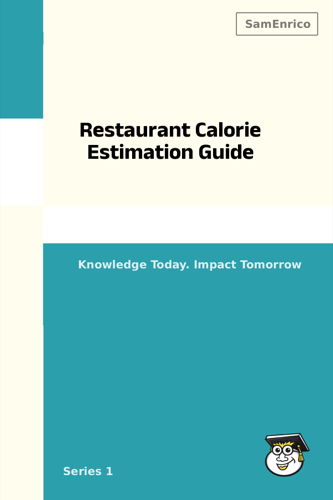
Restaurant Calorie Estimation Guide eBook
Teaches how to estimate calories when nutrition in
Teaches how to estimate calories when nutrition info isn't available.
Formats
Free sample
Chapter 1: The 600‑Calorie Lie--–- The menu said “healthy choice.” Your app logged 550 calories. The scale told a different story.You have done this hundreds of times. You walk into a restaurant that feels safe—maybe a national chain with calorie counts printed neatly beside each dish, or a local café that uses words like “fresh,” “light,” and “wholesome” like a prayer. You order what any reasonable person would call a sensible meal. A salad with grilled chicken.
A vegetable soup with a side of multigrain bread. A quinoa bowl with roasted vegetables. You open your favorite calorie‑tracking app—My Fitness Pal, Lose It, Cronometer—and tap in your choices. The number looks reassuring. 550 calories.
Perfect for a weekday lunch.Then a month passes. Two months. You have been eating out three or four times every week, always making what you believe are smart, health‑conscious decisions. But your weight has not moved down. It has crept up.
Five pounds. Eight pounds. You check your logging history. Everything looks right. You were under your daily calorie target almost every single day.
How is this possible?The answer is not that you are bad at math or that you lack willpower. The answer is not even that you have been secretly snacking or forgetting to log your coffee creamer. The answer is far more insidious: you have been lied to. Not by malice, not by a conspiracy, but by a system—a system of menu language, portion distortion, and hidden ingredients designed to make restaurant food appear healthier, lighter, and smaller than it actually is.The 550‑calorie salad you logged was closer to 1,100. The “light” soup was thickened with heavy cream.
The “drizzle” of balsamic glaze was three tablespoons of sugar and oil. The “grilled” chicken was brushed with clarified butter to keep it from sticking to the grill. And your app, for all its sophistication, had no idea what was actually on your plate. It gave you the average of fifty other users’ entries, many of whom were guessing just like you.This chapter is called The 600‑Calorie Lie because research consistently shows that the average person underestimates restaurant meals by approximately 600 calories per sitting. Six hundred calories.
Every single meal. Over a year of eating out twice per week, that adds up to more than sixty thousand extra unaccounted calories—roughly seventeen pounds of weight gain, all from meals you thought were helping you lose weight.But here is the liberating truth: the solution is not to stop eating out. The solution is to stop trusting the database.The purpose of this chapter is to dismantle your reliance on calorie‑counting apps and printed tables forever. Not because apps are useless—they have their place for packaged foods and home cooking—but because they fail catastrophically in the chaotic, variable, unstandardized world of restaurant food. You do not need a better app.
You do not need to carry a food scale in your purse. You do not need to interrogate your server about every ingredient. You need a system that works anywhere, for any dish, at any restaurant, from a food truck to a white‑tablecloth steakhouse. That system begins with understanding why the database approach is fundamentally, irreparably broken.The Database Illusion Let us start with a simple experiment that you can perform right now. Open your preferred calorie‑tracking app.
Search for “spaghetti with meat sauce.” I will wait.You will see dozens—perhaps hundreds—of entries. “Spaghetti with meat sauce, homemade.” “Spaghetti with meat sauce, frozen meal.” “Spaghetti with meat sauce, Olive Garden.” “Spaghetti with meat sauce, Lean Cuisine.” “Spaghetti with meat sauce, generic.” The calorie counts will range from 280 calories per cup to 890 calories per serving. Which one is correct? All of them. And none of them.The problem is that “spaghetti with meat sauce” is not a standardized food.
It is a category that includes infinite real‑world variations. A homemade version might use lean ground turkey (93/7), a single tablespoon of olive oil to sweat the onions, a tomato‑based sauce with no added sugar, and a modest sprinkle of Parmesan on top. That version might be 400 calories for a generous two‑cup serving. The same dish at a casual Italian chain restaurant might use 80/20 ground beef (high fat), three tablespoons of olive oil to sauté the aromatics, a quarter cup of Parmesan cheese folded directly into the sauce (where it melts invisibly), and a hidden tablespoon of sugar to balance the acidity of cheap canned tomatoes. That version could be 900 calories for a smaller one‑and‑a‑half‑cup serving.The noodles themselves tell only a small part of the story.
The real calories are in the invisible fats and sugars that you cannot taste individually but that collectively double or triple the calorie count. And no database can predict which version is on your plate.This is what we call the Database Illusion. It is the false but deeply comforting belief that because a number exists in an app, that number applies to your specific plate of food at this specific restaurant on this specific night. But restaurant cooking is not laboratory science. It is improvisation, executed by tired, underpaid line cooks working with whatever ingredients are cheapest and most available that week.
The same chain restaurant, same menu item, can vary by 300 to 500 calories depending on who is working the grill and how heavy‑handed they are with the oil that day.A landmark study published in the Journal of the American Medical Association analyzed the actual calorie content of restaurant meals from 42 different chain restaurants. The researchers took meals to a laboratory and measured their caloric value directly. The results were staggering. The average meal contained 18 percent more calories than the published values. Some dishes exceeded their listed calories by more than 50 percent.
A “low‑calorie” salad that the menu claimed had 420 calories was measured at 710. A “grilled chicken sandwich” listed at 540 calories came in at 890. The errors were not random. They were systematic. Every single dish that involved a sauce, a dressing, or any preparation beyond plain grilling was significantly underreported.When nutrition information is not provided at all—which is the case for the vast majority of independent restaurants worldwide—the margin for error grows even larger.
One study of non‑chain restaurants found that the average entrée contained 1,200 calories, but diners estimated it at 700. A separate study of “healthy” fast‑casual restaurants found that people consistently underestimated their meals by 600 to 800 calories, even when they were trying to be careful.The Database Illusion has a second, more pernicious form. Even when the calorie count is technically accurate—say, a chain restaurant that rigorously standardizes its recipes—the database may not reflect your meal. Because the cook might add an extra splash of oil. The portion scoop might be heaping rather than level.
The “light” dressing might be applied with a heavy hand. Restaurants are not frauds. They are human operations. And humans are inconsistent.The Anxiety of the Unknown This uncertainty creates a specific kind of psychological distress that nutrition researchers call menu anxiety. You have felt it.
It is that low‑grade dread that creeps in when you sit down at a restaurant, open the menu, and realize…
This is the end of the free sample. Get the eBook to keep going. Buy now
About this book
Details
- Author
- Olmstead Shantay
- Publisher
- SamEnrico
- Language
- English
- Genre
- Non-Fiction, Health & Wellness, Dining Out
- Released
- 2026-06-05
- Pages (approx.)
- 143
- Available as
- eBook, Audiobook

Read better in the ZLOADR app
Your eBooks on your phone or tablet. Sign in with your SamEnrico account and start reading.
More by Olmstead Shantay
 Nightmare Rescripting For Sleep Terror Disorder GuideOlmstead Shantay$11.99
 Bipolar And Giftedness OverlapOlmstead Shantay$11.99
 Kigali Government Grant GuideOlmstead Shantay$11.99
 Customer Service Anger TriggersOlmstead Shantay$11.99
 The Alchemist of Timbuktu: The Secret Science of the SoninkeOlmstead Shantay$11.99
 Understanding Prosencephaly Cerebellar DysgenesisOlmstead Shantay$17.99
 Storytelling with Data GuideOlmstead Shantay$12.99
 QuickBooks RetentionOlmstead Shantay$12.99
 How to Become a Drier AttendantOlmstead Shantay$11.99
 Data Operations LeadOlmstead Shantay$11.99
You may also like
 Hong Kong Handover 1997Dunn Johnnie$11.99
 Zumba For Postnatal Recovery CourseNeal Christian$11.99
 Zumba for BeginnersLadner Nikia$11.99
 YouTube Comment Mining GuideHumes Pandora$12.99
 Worry Box MeditationCarlin Rudy$11.99
 Workplace Stress MeditationNguyen Lynn$11.99
 Workplace Stress and Sleep RepairHawley Ivory$11.99
 Workplace Perfectionism CureDelaney Jeffry$11.99
 Workplace Injustice Anger GuideWallen Isabelle$11.99
 Work Addiction and Burnout LinkGreenwood Ester$11.99
 Women in Yoga and WellnessBeattie Galina$11.99
 Women in Stand Up ComedyChun Evangeline$11.99