
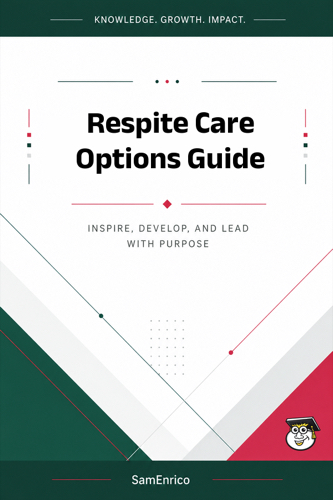
Respite Care Options Guide eBook
Take breaks using adult day services or short term
Take breaks using adult day services or short term facilities.
Formats
Free sample
Chapter 1: The 53 Million...--–- The call came at 2:17 on a Tuesday afternoon. Margaret, sixty-one, had been a critical care nurse for thirty-four years before retiring to care for her mother, Eleanor, who had Alzheimer's. Margaret had managed codes, trauma bays, and the chaotic dance of an emergency room. But on that Tuesday, she found herself crying in a grocery store parking lot because she could not remember the last time she had eaten a meal while it was still hot. Her mother had wandered outside twice that morning.
Margaret had not showered in three days. Her hands trembled from exhaustion, and when her own daughter called to ask how she was doing, Margaret lied and said, "Fine, just tired."Margaret is not an exception. She is the rule.The Invisible Epidemic There are 53 million family caregivers in the United States. That is roughly one in every five adults. They provide an estimated $600 billion in unpaid care annually—more than the total cost of Medicaid.
And the vast majority of them, like Margaret, rarely ask for help. They view their role as an unending duty, a sacred obligation that no one else can fulfill. They tell themselves stories: "I'm the only one who can do it right." "She would have done it for me." "I promised I would never put him in a home."These stories are not wrong. They are rooted in love, loyalty, and a profound sense of responsibility. But they are incomplete.
And that incompleteness is killing caregivers.The research is unambiguous. Family caregivers have higher rates of depression, anxiety, and cardiovascular disease than non-caregivers. Their immune function is suppressed, making them more susceptible to infections. They have higher levels of inflammatory markers, which are linked to everything from arthritis to cancer. A study from the Journal of the American Medical Association found that elderly spouses who reported feeling strained as caregivers had a 63 percent higher mortality rate than those who were not caregivers.
Sixty-three percent.Let that sink in.Caregiving is not just emotionally hard. It is physiologically dangerous. And the mechanism that makes it dangerous is the same mechanism that makes it so hard to take a break.The Action-Motivated Trap To understand why caregivers don't take breaks—and why those breaks are not luxuries but medical necessities—we have to understand a concept that neuroscientists call the action-motivated trap.Here is how it works. The human stress response evolved to handle acute, time-limited threats. A tiger appears.
Your body releases cortisol and adrenaline. Your heart rate spikes. Blood flows to your large muscle groups. Your pupils dilate. You either fight the tiger or run from it.
Then, whether you win or escape, the threat is gone. Your body returns to baseline. The stress response completes its cycle.Caregiving is not a tiger. It is a tiger that never leaves.The care recipient needs something every few hours—sometimes every few minutes. A drink.
The bathroom. Medication. Redirection. Reassurance. A clean diaper.
An answer to the same question asked for the twelfth time. Each of these needs triggers a micro-stress response. A small spike of cortisol. A tiny jolt of adrenaline. And because caregiving has no clear endpoint, because the needs keep coming day after day, week after week, year after year, the stress response never completes.
It accumulates. It becomes chronic.This is the trap. Caregiving feels urgent, so caregivers act. They solve problems, manage crises, put out fires. Each action provides a small dopamine hit—the satisfaction of having done something useful.
But the stress does not resolve. The cortisol stays elevated. The body remains in a state of low-grade emergency, permanently.And here is the cruelest part of the trap: the more effectively a caregiver manages the daily chaos, the more invisible the stress becomes. They stop noticing the trembling hands. They forget what it feels like to be truly relaxed.
They adapt to a new baseline of exhaustion and call it normal.Margaret, the former critical care nurse, had spent decades recognizing stress in her patients. She could spot a subtle change in vital signs from across a room. But she could not recognize it in herself. She had become so accustomed to the cortisol that she thought her constant fatigue, her irritability, her inability to concentrate, her frequent colds, and her aching joints were just what caring for someone with dementia felt like.She was wrong. Those were the symptoms of a stress response that had not completed in over two years.The Biology of Burnout Let us be precise about what chronic caregiving stress does to the human body.
This is not metaphor. This is not "feeling tired." This is measurable, biological pathology.Cortisol dysregulation. In a healthy stress response, cortisol spikes and then falls. In chronic caregiving, cortisol remains elevated, which damages the hippocampus—the part of the brain responsible for memory and emotional regulation. Caregivers actually show measurable hippocampal atrophy on brain scans.
They are not just forgetting things because they are tired. Their brains are physically changing.Inflammatory activation. Chronic stress increases pro-inflammatory cytokines, which are associated with depression, autoimmune disorders, and cardiovascular disease. Caregivers have higher levels of C-reactive protein, a marker of systemic inflammation. This is why caregivers have higher rates of heart disease, not because they are older or sicker, but because the act of caring for someone without respite is inflammatory.Immune suppression.
Natural killer cells, which fight viruses and cancer, are less active in chronically stressed caregivers. This is why caregivers get more colds, why their wounds heal more slowly, and why they have higher rates of certain cancers.Telomere shortening. Telomeres are the protective caps at the ends of chromosomes. They shorten with age and stress. Caregivers have shorter telomeres than non-caregivers of the same age, meaning their biological age is older than their chronological age.
The stress of caregiving without respite literally ages them faster.This is what Margaret was experiencing. The trembling hands were not anxiety. They were neurological dysregulation. The frequent colds were not bad luck. They were immune suppression.
The exhaustion was not normal. It was toxic.The Guilt That Keeps You Sick If the biology of caregiving stress is so clear, why do caregivers still refuse respite? Why do they resist adult day services, short-term facilities, and even a few hours of paid help?The answer is guilt. And guilt is not just an emotion. It is a behavioral lock.Guilt is the psychological mechanism that keeps caregivers in the action-motivated trap.
It whispers that taking a break is selfish. It shouts that no one can care for your loved one as well as you can. It convinces you that asking for help is admitting failure. And it weaponizes love against you.Consider the most common guilt statements that caregivers say to themselves:"I should be able to handle this.""She would never have put me in a home.""What if something happens while I'm gone?""I made a promise.""Other people do more than I do.""I'm not that tired."Each of these statements contains a hidden premise that is false. Let us dismantle them one by one."I should be able to handle this." Should, according to whom?…
This is the end of the free sample. Get the eBook to keep going. Buy now
About this book
Details
- Author
- Devore Tracie
- Publisher
- SamEnrico
- Language
- English
- Genre
- Non-Fiction, Biography, Respite
- Released
- 2026-06-10
- Pages (approx.)
- 135
- Available as
- eBook, Audiobook

Read better in the ZLOADR app
Your eBooks on your phone or tablet. Sign in with your SamEnrico account and start reading.
More by Devore Tracie
 Couples Meal PlanningDevore Tracie$11.99
 Scottish Highlands GuideDevore Tracie$11.99
 The Immigrant Turnaround ArtistDevore Tracie$11.99
 Postpartum OCD GuideDevore Tracie$11.99
 Value Based Activation GuideDevore Tracie$11.99
 Pomodoro For Adhd FocusDevore Tracie$11.99
 Fear of Failure for Customer ServiceDevore Tracie$11.99
 The Scholastic Crown of the West: Oxford's Medieval EnlightenmentDevore Tracie$11.99
 The Burning of the SS Mararoa: Fire, Fraud, and Forensic Firsts in Prohibition-Era New ZealandDevore Tracie$11.99
 Service Providers Guide to Correspondence ClubsDevore Tracie$11.99
 Bond Pricing Excel GuideDevore Tracie$12.99
 Government Contract Debriefing GuideDevore Tracie$12.99
You may also like
 Hong Kong Handover 1997Dunn Johnnie$11.99
 Zumba For Postnatal Recovery CourseNeal Christian$11.99
 Zumba for BeginnersLadner Nikia$11.99
 YouTube Comment Mining GuideHumes Pandora$12.99
 Worry Box MeditationCarlin Rudy$11.99
 Workplace Stress MeditationNguyen Lynn$11.99
 Workplace Stress and Sleep RepairHawley Ivory$11.99
 Workplace Perfectionism CureDelaney Jeffry$11.99
 Workplace Injustice Anger GuideWallen Isabelle$11.99
 Work Addiction and Burnout LinkGreenwood Ester$11.99
 Women in Yoga and WellnessBeattie Galina$11.99
 Women in Stand Up ComedyChun Evangeline$11.99