
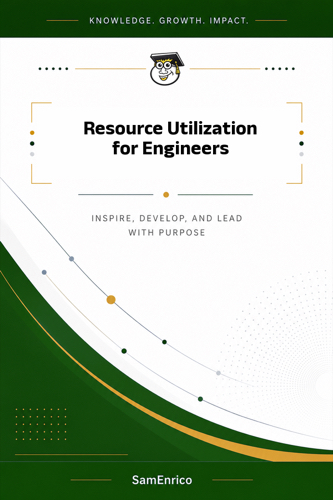
Free sample
Chapter 1: The Optimization Trap--–- The meeting was supposed to be a celebration. Six months of work, three engineering teams, a budget of nearly half a million dollars—all culminating in a presentation that would prove the plant had become a model of industrial efficiency.Sarah Velez, the senior process engineer at a Midwest automotive parts manufacturer, clicked to the final slide of her deck. The numbers glowed green on the conference room screen: energy consumption down 18 percent, raw material waste reduced by 23 percent, overall equipment effectiveness up from 62 percent to 74 percent. Her team had done everything right. They had applied lean principles, optimized changeover times, installed variable frequency drives on every major motor, and retrained the entire shift on standard work procedures.
The vice president of operations had flown in from corporate headquarters to see the results in person.“Outstanding work, Sarah,” the VP said, standing to shake her hand. “This is exactly the kind of thinking we need across the network.”She smiled, accepted the praise, and tried to ignore the knot in her stomach.The knot had appeared three weeks earlier, during a routine shift handover. A veteran operator named Dan—forty years on the factory floor, the kind of guy who could hear a bearing failing before any vibration sensor—had pulled her aside. “You know all this efficiency stuff is gonna kill us someday, right?” he’d said. “We’re running so lean there’s no slack left.
One thing goes wrong and the whole place falls apart.”Sarah had nodded, made a note, and promptly ignored it. Dan was a great operator, but he wasn’t an engineer. He didn’t understand the math.Three months after the celebration, the math failed.A single conveyor belt motor, model 407-C, the same motor that had run without issue for eleven years, burned out during the second shift. The motor cost $1,400 to replace. It was in stock at the local supplier.
The repair should have taken two hours.But the plant had eliminated its spare parts inventory eighteen months earlier as part of a lean initiative. Every dollar tied up in inventory was waste, the consultants had said. Run just in time. Trust the supply chain. And so the plant had no spare motor.
The local supplier had three, but their delivery truck was already on its route and couldn’t return until morning. The plant could send someone to pick it up, but the only vehicle available was a manager’s sedan, which couldn’t carry a 200-pound motor.The motor arrived at 9:00 AM the next day. The repair took two hours. By then, the line had been down for sixteen hours.The downstream effects were catastrophic. The just-in-time delivery of components assumed continuous production; when the line stopped, the receiving bay filled within three hours, then blocked incoming trucks, then cascaded delays to suppliers who had scheduled their own production around the plant’s demand.
By the time the line restarted, the plant had lost $1.2 million in production, $80,000 in spoiled work-in-process, and the confidence of two major customers who had received partial shipments three days late.Sarah’s efficiency gains had not prevented the failure. They had amplified it. Every optimization—the lean inventory, the just-in-time deliveries, the elimination of slack—had made the system more productive when everything worked and more fragile when anything broke.She had optimized the plant for the expected world. The unexpected world had destroyed it.The Most Dangerous Word in Engineering Let us name the enemy. It is not laziness, incompetence, or ignorance.
It is a word that appears in every job description, every performance review, every annual report. It is a word that engineers are trained to worship from their first thermodynamics lecture to their last day before retirement.The word is efficiency.Efficiency is the ratio of useful output to total input. An engine that converts 40 percent of fuel energy into motion is more efficient than one that converts 30 percent. A factory that produces 100 units with the same labor-hours that used to produce 80 units is more efficient. A data center that delivers the same compute with 20 percent less electricity is more efficient.
Efficiency is mathematics. Efficiency is physics. Efficiency is truth.And efficiency, when pursued as the sole objective, is a trap.This chapter will explain why. It will introduce the foundational concepts that every engineer must understand before optimizing anything: the difference between efficiency and effectiveness, the paradox that makes efficiency backfire, the hidden costs of linear thinking, and the alternative that turns waste into wealth. These concepts are not academic.
They are the difference between a career of celebrated successes and a career of explaining why the plant failed.Efficiency Versus Effectiveness: The Distinction That Changes Everything Sarah Velez’s plant was highly efficient. It was also profoundly ineffective.Efficiency asks: Are we using our inputs well? It is a ratio, a fraction, a percentage. It cares about the relationship between what goes in and what comes out. It does not care whether what comes out is needed, valuable, or sustainable.Effectiveness asks: Are we doing the right thing?
It is not a ratio. It is a judgment. It cares about purpose, about outcomes, about the gap between what the system produces and what the world actually needs.An efficient factory that produces unwanted products is not effective. An efficient hospital that discharges patients who need continued care is not effective. An efficient data pipeline that delivers the wrong data to the wrong decision-maker is not effective.
Efficiency is necessary. Effectiveness is sufficient. You cannot succeed without both.The relationship between them is not linear. A system can be efficient and effective—this is the goal. A system can be efficient but ineffective—this is tragedy.
A system can be effective but inefficient—this is survivable, and often the starting point for improvement. A system can be neither—this is failure.Most engineering training focuses on efficiency because efficiency is measurable. You can calculate energy per unit, labor per unit, material per unit. You can put numbers on a dashboard and trend them over time. You can reward people for improving them.Effectiveness is harder to measure.
It requires answering questions like: What is the purpose of this system? What does success look like? Who are the stakeholders, and what do they actually need? These questions are not mathematical. They are philosophical, political, and strategic.
They require judgment, not calculation.But difficulty is not impossibility. Throughout this book, we will develop practical tools for assessing effectiveness. Chapter 3 introduces the Effectiveness Audit, a five-question framework that forces every optimization project to justify its purpose before its methods. Chapter 11 provides financial tools for evaluating whether an efficient project is also effective in creating shareholder value. Chapter 13 introduces ESG metrics that measure effectiveness against social and environmental goals.For now, remember this: An engineer who optimizes efficiency without questioning effectiveness is not an engineer.
They are a calculator.The Paradox That Destroys Good Intentions If efficiency were simply insufficient, that would be manageable. You could learn to balance it with effectiveness, to add slack where needed, to question purpose before pursuing optimization. The problem is worse. Under specific…
This is the end of the free sample. Get the eBook to keep going. Buy now
About this book
Details
- Author
- Knott Davida
- Publisher
- SamEnrico
- Language
- English
- Genre
- Non-Fiction, Self-Help
- Released
- 2026-06-07
- Pages (approx.)
- 151
- Available as
- eBook, Audiobook

Read better in the ZLOADR app
Your eBooks on your phone or tablet. Sign in with your SamEnrico account and start reading.
More by Knott Davida
 CrossFit Weightlifting PrimerKnott Davida$11.99
 Anki For LSAT LogicKnott Davida$11.99
 The Sobriety Relapse PreventionKnott Davida$11.99
 Professional Attire ConfidenceKnott Davida$11.99
 Green Supply Chain TechKnott Davida$11.99
 The Mathematicians of Meroë: The Golden Calculations of the Kushite ScholarsKnott Davida$11.99
 Mindfulness for LonelinessKnott Davida$11.99
 Interruption Management for NursesKnott Davida$11.99
 The Magic Lantern’s First Spark: How the Lumières Brought Animation to Life (1790s)Knott Davida$11.99
 The Essential Guide to Praise & WorshipKnott Davida$11.99
 Corporate Event Risk ManagementKnott Davida$12.99
 UK Business Credit for Sole Traders BlueprintKnott Davida$12.99
You may also like
 Hong Kong Handover 1997Dunn Johnnie$11.99
 Zumba For Postnatal Recovery CourseNeal Christian$11.99
 Zumba for BeginnersLadner Nikia$11.99
 YouTube Comment Mining GuideHumes Pandora$12.99
 Worry Box MeditationCarlin Rudy$11.99
 Workplace Stress MeditationNguyen Lynn$11.99
 Workplace Stress and Sleep RepairHawley Ivory$11.99
 Workplace Perfectionism CureDelaney Jeffry$11.99
 Workplace Injustice Anger GuideWallen Isabelle$11.99
 Work Addiction and Burnout LinkGreenwood Ester$11.99
 Women in Yoga and WellnessBeattie Galina$11.99
 Women in Stand Up ComedyChun Evangeline$11.99